Thursday, October 18, 2012

The Science of Good Cooking


I’ve written a little about my job here on this blog. A bit here. A bit there. But not too much. I’ve never really given you the details. And this month, the details came together into something big, something concrete, something about which I’m quite proud.

I began working at America’s Test Kitchen a few months before my own book came out. I was hired to edit a cookbook. An exciting cookbook. One that was published on October 1: Cook’s Illustrated’s The Science of Good Cooking.

If I learned anything in the last couple years it’s that there really isn’t any thrill quite like the thrill of holding a book that you toiled over—wordsmithed over, wrote and edited and rewrote and reedited for so many, many months—in your hands. You may not see my name on the cover of this particular book, as is the Cook's Illustrated way, but I’m in there. I was in charge of every word on every page of this scientific tome. And, damn, I’m proud. The thrill of holding this book was a different kind of thrill than the one I had holding my own book for that first time, breathing in its new-ink aroma, feeling the concrete reality of its spine. But a thrill nonetheless.

The Science of Good Cooking is organized into 50 basic concepts of food science—simple concepts, ones that every cook should know. Gentle Heat Retains Moisture. High Heat Develops Flavor. Salty Marinades Work Best. Sugar Changes Sweetness and Texture. There are recipes, 400 of them, all culled from the last 20 years of Cook’s Illustrated magazine. There are scientific experiments to bring these concepts to light, performed by a talented test cook in the kitchen that sprawls across the first floor of our office building. (I've been writing a bit about them a bit, here.)

The best part about editing this book? It taught me to cook with more confidence. Many years of my life were spent tied to recipes, tied to instructions, unsure of how dishes would change if I were to cook by instinct rather than rule. But learning about the hows and whys, the way food actually work on a molecular level has drastically changed the way I cook, the way I think about cooking, the way I move at the stove. Check it out

Wednesday, September 19, 2012

Grilled Pork and Peaches


A few weeks ago in Maine I cooked the hell out of some pork butt.

That’s right. Pork butt. And peaches. On the grill. In less than an hour. If summer has to end, we might as well send it off in style.

In Cambridge, I live in a studio apartment. There’s no fire escape or roof access. There certainly isn’t a grill. But at my family’s place Maine? There are multiple rooms in the house. There’s even a yard. And a deck. And a grill. A big fat gas grill. The possibilities are endless.


For this dish, a perfect late-summer dish (though I know I’m now pushing this dangerously close to fall), I used a recipe from the New York Times. It accompanied an article called “How To Burn Dinner,” written by Sam Sifton, who really has this uncanny ability to turn a hunk of tough, fatty meat into something quiet poetic.

As the title implies, it’s an article about burning your dinner. Or, not quite burning your dinner. “What you are looking for on the edges of the meat and fruit is color: a deep, dark brown that is almost black — a black without bitter, a burn that is not burned,” Sifton writes.


It’s all about a technique championed by Francis Mallmann in his cookbook (written with Peter Kaminsky) “Seven Fires: Grilling the Argentinean Way”– cooking a piece of meat outdoors over high heat, on a chapa, or a leggy cast-iron construction, to create a thick, crunchy crust. “If Mallmann’s cooking were music, it would be very loud,” writes Sifton.

It was easy. I took a 2-pound piece of pork butt. Butterflied it. Trimmed it. Pounded it down. I liberally seasoned the meat with salt and pepper. I slathered it with a mixture of olive oil, rosemary, and garlic. I heated up the grill with two cast iron pans on the grates.


When they got hot, super hot, smoking hot, I plunked the pork right on down and didn’t move it for 15 minutes. Oh, man: that crust! I then flipped the pork and let it cook for a good 15 minutes more. The high heat of the grill causes something called the Maillard reaction, a chemical reaction between denatured proteins and sugars, which begins to take place at just about 300 degrees. This is what causes the familiar deep brown color on searing meats (and, for that matter, toasted bread and caramel) and a build up of flavor molecules—in this case, that pungent porcine deliciousness of a thick, bronzed crust.

After the pork came off the grill to rest, I stuck halved peaches, cut-side down, into the hot cast iron pans. They cooked quickly in the pork fat (and a little bit of butter, too). They were a sweet, silky counterpoint to the crunchy, lusciously fatty meat.

I served the pork and peaches alongside a simple green salad. Bread. Red wine. Oysters, too. (Why not? Welcome to Maine.) (Goodbye to summer.)


Grilled Pork and Peaches on a Gas Grill
Adapted from the New York Times, Sam Sifton, and Francis Mallmann

2 pounds boneless pork butt, butterflied and trimmed
10 garlic cloves, peeled and minced
2 tablespoons fresh rosemary, chopped
8 tablespoons olive oil
salt and pepper
6 peaches, halved and pitted (skin on)
4 tablespoons unsalted butter

Turn on your grill. Set it to high. Place a very large cast iron pan (or two smaller ones) over the burners. Let it get hot. Very hot.

While the grill heats, work on the pork. Place the butterflied pork on a cutting board and pound it with a meat mallet until it’s evenly thick—about ¾ inch across.

Mix together the garlic, rosemary, and 6 tablespoons of the oil in a small bowl. Season the pork (liberally, “aggressively,” says Sifton) with salt and pepper on both sides. Spread the garlic mixture on both sides as well. Because I used two smaller cast iron pans on the grill, I cut my pork in half, so that I could cook each piece simultaneously.

Back to the grill. Turn the heat to medium. Brush the pan (or pans) with the remaining oil. Let the oil heat up for a minute, and then place the meat in the pan(s) and leave it alone. Don’t touch it. This is what will get it that crust, that char, that flavor. I let my pork sit for 15 minutes. Sifton says 10. It depends on how hot your grill is, how thick your pans and pork are. It’s important to do what feels right here. Wait until that crust forms.

Use tongs to turn over the meat (or pieces of meat). Cook for another good 10 – 15 minutes. When the meat is nice and crusty, remove it, place it on a cutting board, tent it with foil, and let it rest.

Now, take the halved peaches and place them, cut side down, in the cast iron pan(s). Dot them with butter. Cook for about five minutes, until soft and slightly charred.

Slice the meat and serve with the peaches. And salad. And bread. And wine. (And oysters.)


Thursday, August 30, 2012

Seven Years


Seven years ago today I was hit by a car while jogging. I broke my pelvis, tore the tendons in my left knee, fractured the back of my skull—and, as a result, lost my sense of smell. For a long time, I wasn’t okay. Not physically, not emotionally. In an instant, everything had changed. I was 22 years old.

I write about the anniversary of the accident almost every year. I write about it in the same way, even. Short, staccato statements. (Hit by a car. Fractured the back of my skull. Lost my sense of smell.) I’ve thought about the events of that drizzly late-August morning often. I’ve talked about them. I’ve written about them. So much, in fact, it’s difficult for me to remember what happened before all happenings began to exist in the concrete netherworld of typeset and paper.

But every year I like to take a moment to remember where I came from, and how far I’ve come. I recovered, of course, as you all know—slowly, cautiously, but completely. I’m lucky. I’m so lucky sometimes it hurts. For me, August 30th is an emotional anniversary. It’s also a physical one. If I close my eyes and take a few deep breaths, I can feel it in my bones—in the ridge of my pelvis, in the contours of my skull.

Last year, yesterday, I wrote about a dinner that I cooked for my father, stepmother, and Matt. A heaping bowl of spaghetti sauced with little more than the luscious raw tomatoes of August, the bite of a bit of arugula and red onion, a few glugs of olive oil and some grated Parmesan cheese.

I made the same dish again last night for some friends. I hadn’t realized the symmetry of the dates. But it’s not the first time this has happened. In 2009 and 2010 I baked the same plum cake, a simple butter cake that made my kitchen smell sweet and warm, like fruit and caramel and autumn.

And today, as I sit at my kitchen table on this sunny August morning, that feels right. Who am I if I’m not circling back to my past—to events in my past, to the people of my past, to the smells and tastes and flavors of my past? These are the things that have made me who I am. What I am. Where I am. Whether monumental accidents or simple late-summer meals: this is where I’ll return, even as I move forward.

Sunday, August 19, 2012

Summer


I walk to work each morning, an hour-long trek along the Charles River, over the BU Bridge, winding through the manicured lawns and vine-wrapped homes lining certain streets in Brookline. It has been a hot and humid summer. Prime time for smell. And as I walk, scents hit me—light but sharp, one at a time, pok pok pok, like ping pong balls. The cool river-scent of the Charles. The dark and earthy dank of bark mulch. Hot pavement. Car exhaust. Cigarette smoke twirling up into the air. I pass fellow pedestrians and, bam, deodorant. Perfume. Sweet, salty, sour sweat. There’s also grass, fresh cut. Coffee, fresh brewed. The promise of sun and sand.

The other night I had dinner with friends. I sat at their dining room table, close to 9pm, ready to eat: thick slices of heirloom tomatoes, roasted eggplant, anchovies, cheese, bread and wine. A veritable farmer’s market feast. Before we began to eat, the hostess walked over to her windowsill and plucked a few leaves off a small basil plant. The window was open, and right at the moment of plucking, there was a waft of warm wind. Some stray olfactory molecules hit my nose with the breeze—that fresh herbed scent. Such a familiar smell, but surprising nonetheless. It filled my mind with the color green, the lightness of summer.

On Thursday I read from Season to Taste at Porter Square Books. It was a wonderful evening, filled with friends and family and readers and writers and just a few people who wandered in to buy a magazine but stayed to listen and then chat. Afterward, I went out for drinks with a few folks, including one of my oldest friends, who lives across the country but just so happened to be in town for the week. I’ve been thinking a lot about what it means to be here, in the present, in the moment, right now. I’m trying to pay more attention to the small things right in front of me. The tastes, the smells, the way it feels to laugh. But when my friend and I hugged for the first time in a long time, I inhaled, my nose right there by his head. And then there I was, immediately transported back. I no longer existed in that moment, but one far in my past. 


Thursday, August 16, 2012

Tonight at Porter Square Books!


A little last-minute heads up for you local Boston folk: I’m doing a reading tonight (Thursday, August 16) at Porter Square Books in Cambridge. 7pm. Would love to see you there!

Sunday, August 12, 2012

An Outlaw Wedding

I made another wedding cake. This time, for my mother. She and Charley were married last Saturday at their house up in Maine. 


(Well, they weren't “married,” not really, if we’re going to be legally exact. It was more of a commitment ceremony. They called it their “outlaw” wedding.)


The ceremony was simple and quiet. A handful of my mom and Charley’s closest friends and family members stood up, one at a time, to tell stories about the couple—some funny, others serious, all beautiful and touching in their own ways. Ben, my little brother, officiated. My mom and Charley each wrote their own vows. It was a clear, warm day, but thunder rumbled in the distance as they read them out loud.


They are a quirky couple, an unexpected match in many ways. But it works. They've made it work. They've been together for ten years. And listening to them read their vows, it struck me again just how perfect they are together. My mom and Charley know each other, every part of each other. The good parts and the bad parts and all the parts in between. And they love each other both because of and despite them all.


After the ceremony, we celebrated.

Now, I will admit that this wedding stressed me out for a number of weeks beforehand. After all, I was the wedding planner, a task I assigned to myself without thinking too hard about the details. And let me tell you: There were details. Rentals and hirings and food and drink and lights and taxis and hotels and schedules and music and flowers, oh my. But after a bit of hectic running around, a thick stack of “to do” lists illegibly scrawled on legal pads, and a few last-minute orders (kindly) barked at unsuspecting family members, it all came together. Miraculously, we made a wedding. A real un-real wedding. It was perfect in its imperfections.


The evening began with champagne toasts, moved on to dancing, and was filled with good food throughout. Bryan and Dan, two of my buds from Cook’s Illustrated, catered the whole thing. (If you’re in the Boston area and are looking for a great team of caterers, let me know!) There was tomato bruschetta with boquerones, and Spanish tortilla with preserved lemon aioli. Gravlax blini with red onion crème fraiche, and octopus and potato brochettes. Bacon-wrapped dates stuffed with almonds. Pork tostadas with queso fresco and radishes. When the plates of sliders came out of the kitchen, guests hovered around them like vultures, waiting to go in for the kill. 


And then the cake. I made the same cake that I made for my friends Ashley and Colin back in 2009. (If it isn't broken...) An almond cake sandwiching layers of lemon curd and blueberry jam. Frosted with a swiss buttercream. It was a rustic looking cake. A little splotchy. A tiny bit lopsided. We ate it in the dim, blue light of dusk. It tasted damn good.


Sunday, July 29, 2012

Ottolenghi's Soba with Mango and Eggplant


I spent a good part of this week trying to write a post about dating. Because, hey! I’ve been dating! Slowly. Cautiously. But dating all the same.

The first date I went on in five years took place about two months ago. It was a Thursday afternoon. A perfect summer afternoon. We met at a bar in Cambridge after work.

I was nervous. I had forgotten what it was like to position myself in the world of single people. What it was like to judge and to be judged. That dating could be fun. 

And this guy was nice. He was smart. We sat at the bar and ordered drinks and talked about work, family, and our favorite restaurants in Boston. But he looked only a little like he did in his dating profile. (Yup, folks, I’m online dating! Why the hell not.) And though everything he wrote in his profile was true, a writing voice is far from a talking voice. The stories we tell to sell ourselves and the stories that exist deep within us are two very different things. Anyway: There wasn’t a spark.

But I’ve continued to date. I like dating. I like meeting new people. Different people. People who intrigue me. People who make me laugh. People who challenge me to look at myself differently. People who look at the world through a different lens. Of course not all of my dates have been stellar. There have been some real doozies. But I love the possibility, the magic of a spark, that split-second knowing: this could be something.

However, this week when I sat down to write about my experiences in dating—about the stories we tell ourselves, about the stories we tell others—my mind kept looping back to a moment in 2009.

That was the year I wrote my book. The year Matt was deployed to Afghanistan. One of many years I lived in the hectic jumble of buildings and concrete called New York City. That fall I spent a month in a cabin in Woodstock, New York. I was there as part of a writers’ residency, a community of creative folk trying to be simultaneously alone and together. I was 26 years old.

I remember how dark it got at night in Woodstock, up there in the middle of the woods. The woods where bears trundled. And owls hooted. And ghosts of all kinds lurked. When I went outside at night, looking up at those impossible shimmers of starlight, it was easy to believe that the sounds of rustling leaves were whispers, that the moon had a voice, that there was a lot of life to be lived under the cover of darkness.

On one of my last nights at the residency there was a party. Local community members attended. Some of us read our work out loud. It was the first time I did a reading, in fact. I remember that as I stood in front of the crowd, grasping a few pages of my words, my hands shook. I had to take a few deep breaths in order to calm down. But then I read. And when I finished, I could barely hear the applause under the thunderous tone of my relief.

Afterward, as we all sat around drinking wine, one guest announced that she was a palm reader. She was an older woman with gray hair, deep wrinkles, and a voice like gravel. She took our palms in her hands, one after another, tracing the delicate lines of our skin with her fingers. I don’t remember what she told anyone else. But I’ll never forget what she said to me.

“Around the age of thirty,” she said, “something big will happen. It’s something that will cause you to struggle. It will change the way you look at life.”

I nodded. That seemed like a lot to get out of a palm.

“Are you sure you don’t mean around age 20?” I asked. I told her about the car accident that cost me my sense of smell and had almost cost me my life. I was 22 years old. “That was something that caused a hell of a lot of struggle. It certainly changed everything.”

“No,” she said, simply. This struggle was still to come.

I didn’t think that this gravel-voiced woman could tell the future from my palm. Not really. But I thought about her words a lot after that night. I worried that she was right.

Sure we all struggle, at least a bit, in our daily lives. But the struggle she spoke of felt large. And it grew larger in my mind with each passing day. I've already had that kind of struggle, I thought, despite the fact that I know struggle isn't the chicken pox; you can get it again. Recovering from my injuries after being hit by that car had felt like one Herculean effort after another, moving slowly from broken back to whole, discarding painful skins of my former self along the way. And when I emerged on the other side, I felt inhumanly lucky. Could I do it again? I wasn't sure.

But then, this winter, I again faced something terrifying and large. A different kind of terrifying. A different kind of large. As I wrote back in April "When Matt and I split, I felt like I was ripping my arm out of the shoulder socket, or cutting my leg off at the knee, or tearing a pattern of tiny holes in my gut, or all of that, or maybe none of that, but nonetheless it was substantial and consuming and physical all at the same time." For a while, I felt like I would never be okay. Maybe you were right, palm lady: I am 29 years old.

But I got through it. I’m sitting here at my kitchen table on a Sunday morning, sipping coffee and eating toast with homemade jam, and I am decidedly okay. It's still hard, but infinitely less hard, and it certainly isn’t hard all the time. In many ways, I feel better than I have in years.

And so when I sat down to write about my new adventures in dating, and I began to think about that woman in Woodstock whose words caused me to dread turning 30 because I knew that before I got there I would have to struggle, I realized that I was thinking about it all wrong.

Yes, this woman told me I would struggle. But she also told me that this struggle would change the way I see the world. She was right.

I’ve been forced to look at myself in a different way these last six months or so. I’m repositioning myself in my own head. Among my family. Among my friends. I’m taking a closer look at the stories I tell myself and the stories I tell those around me. The ones about who I am and who I will be. This is hard work. But it’s good work. Work that needed to be done. Work I’m not sure I would have had the guts to do if I hadn’t already been forced to wage some kind of battle in my own mind.

And this all ties into dating, a bit. Because dating is storytelling, really, when you get down to it. But what I really wanted to write about when I sat down to write about dating, I think, is the biggest blessing of this whole struggle-recovery mess: My family. My friends. The people who listen to my stories. Who help me to tell my stories. The old ones. The new ones. All the ones in between. I couldn't have done any of this alone. 

Two of these lovely people are Jess and Mary, fantastic writers and tellers of stories in their own right. The first time I made this dish was for them. Thanks, ladies.


Ottolenghi’s Soba with Mango and Eggplant
From Yotam Ottolenghi's Plenty

It’s no secret that I love Ottolenghi’s latest cookbook PLENTY. And this noodle dish is the perfect summer meal: cool and light and packed with the bold flavors of sweet mango, salty eggplant, fresh cilantro, and nutty toasted sesame oil. I like to make the noodles and the dressing ahead of time, and then add the mango, eggplant, and herbs right before serving. It’s a colorful dish and the perfect backdrop for stories—the ones we tell ourselves and the ones we tell others, too.

½ cup rice vinegar
3 tablespoons sugar (I’ve used both white and brown sugar; both are good)
½ teaspoon salt
2 garlic cloves, crushed
½ fresh red chile, (seeds and pith discarded if you’re not that into spice; retained if you are), finely chopped
1 tablespoon toasted sesame oil
grated zest and juice of 1 lime
1 cup sunflower oil
2 eggplants, cut into 3/4-inch pieces
8 to 9 ounces soba noodles
1 large ripe mango, cut into ½-inch pieces
1 ½ cup basil leaves, roughly chopped
2 ½ cups cilantro leaves, chopped
½ red onion, very thinly sliced

First, in a small saucepan, mix the vinegar, sugar, and salt and warm it over medium heat for just 1 minute, until the sugar dissolves. Off the heat, add the garlic, chile, and sesame oil. Let cool. Then, add the lime juice and zest. Set aside.

Meanwhile, in a large pan, heat the sunflower oil and then shallow-fry the eggplant. Don’t overcrowd the eggplant—do this in three or four batches. Allow the eggplant chunks to become golden brown, flipping a couple times as they fry to get even color. When cooked, remove the chunks to a colander, sprinkle (generously) with salt, and let them drain.

Now, cook the soba noodles in a big pot of boiling, liberally salted water. They should be tender but still with a bit of a bite. This should take about 5 – 8 minutes. Drain, and rinse under cold water. Shake ‘em off, and then let them drain completely on a clean dish towel.

In a big serving bowl, mix the noodles, dressing, mango, eggplant, half of the fresh herbs and the onion. Let sit for a few hours. This will allow all the flavors to seep and meld. (I’ve also just mixed the noodles and the dressing at this point and let it sit over night, adding the rest of the components the next day. This works out well, too.) Just before serving, add the rest of the herbs, give it a mix, and enjoy.

Tuesday, July 17, 2012

Lately


(hi.)
 

Sunday, June 10, 2012

Gingered Strawberry Rhubarb Pie


As I write, I’m in Maine. I drove up to the little house owned by my mom and Charley on Friday after work. They are out of town and needed someone to water their plants. It’s only an hour away. I wanted somewhere to write.
 
I’m sitting at the picnic table in their back yard. It’s warm out, but not too warm. Ants are crawling along the wooden boards; the occasional wasp buzzes by my head. I can see the Piscataqua River, fast-moving to my left. It’s windy, getting windier by the minute. The leaves are rattling in the trees. Rain, I think, is moving in. The air smells briny and damp.


The last time I was up here in Maine was Memorial Day weekend. My brother, Ben, and his girlfriend, Ashley, had joined us from New York. It was fun. My mom made us go kayaking. My brother made us a little drunk. I cooked. Fully embracing the occasion that Saturday night, I went for the traditional: Burgers. Salad. Strawberry-rhubarb pie.

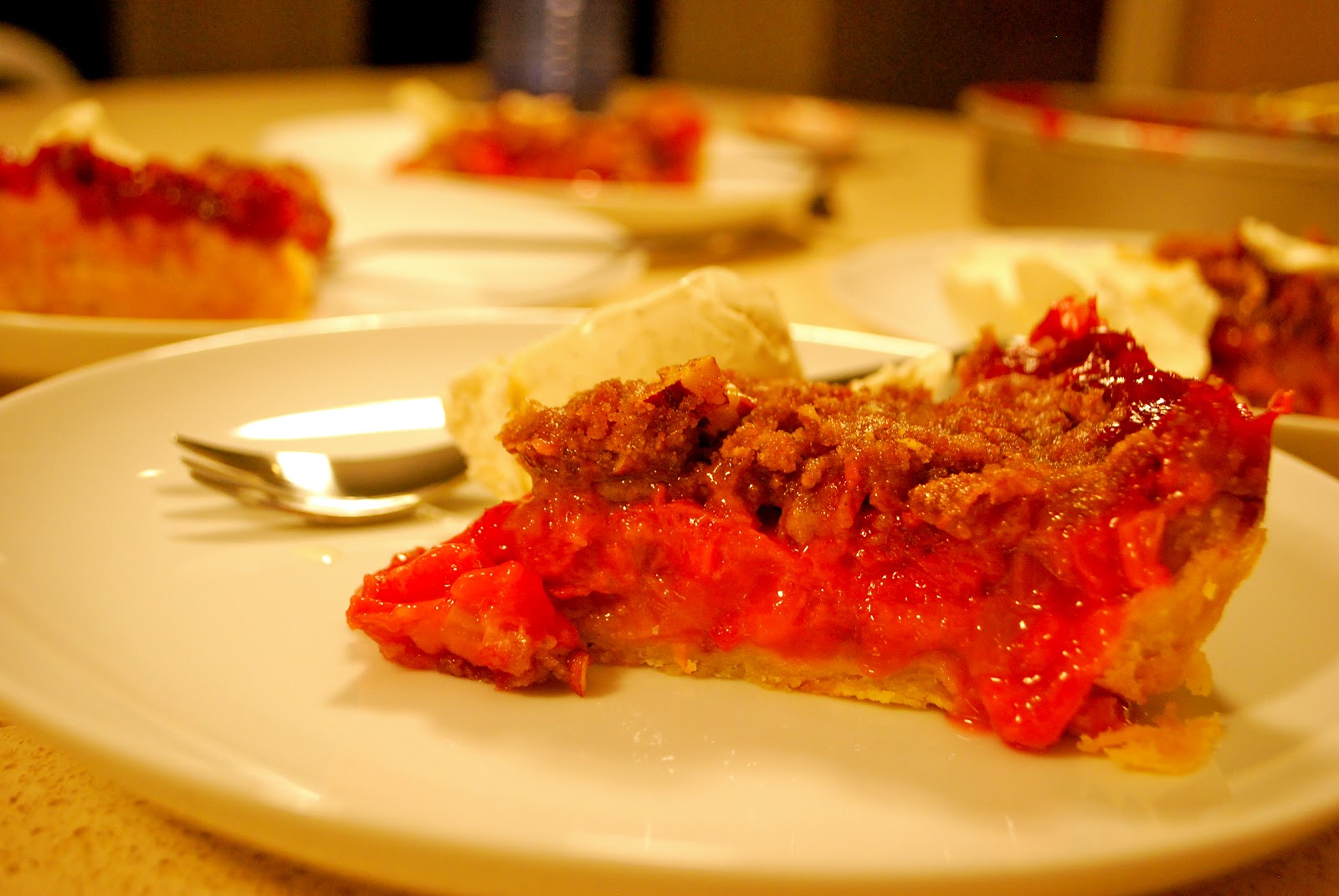
I’ve written about this particular strawberry-rhubarb pie before. It’s the pie that I developed for the New York Times when they ran an article about my book, just about a year ago. When I was developing this recipe, I made a lot of pies. So many pies that by the time I clicked “send” on the email to the editor containing the recipe, I was pretty sure that I would never want to eat pie—or anything else, for that matter—ever again. Surprise, surprise: I was wrong.

I love this pie. It’s all warm and spicy with fresh, crystallized, and powdered ginger; covered in a crunchy streusel topping; and filled with a mixture of fruit that isn’t too sweet. Generally, strawberry-rhubarb pies are a fierce reminder of my grandmother, of my mother, of myself as a child. They taste like the past. But because I revamped this recipe, updated it, prodded and poked and tested it, this pie tastes new. Making it, eating it, I am entirely present. Sometimes, that’s exactly what I want.

(Just don’t forget your pie plate when you bake this pie. Over Memorial Day weekend, I didn’t realize that we were missing this key piece of equipment until I had already made, chilled, and rolled the pie dough. This is why I baked the pie in a cake pan, as you can see in this photograph, below. It kind of worked. It kind of didn’t. The pie looked strange, but it tasted damn good.)


Right now, in Maine, this time alone, the sun is beginning to set. I’ve moved inside, and am watching the ominous sky, which is practically shimmering with the threat of rain. A seagull just flew past the window, screaming, a drape of seaweed hanging from its mouth.

Lately, I’ve been reading a backlog of the advice columns that Cheryl Strayed writes for The Rumpus called "Dear Sugar." They aren’t typical advice columns. They’re strong and sassy, straight-to-the-point and written with an almost vicious beauty. Strayed is the author of WILD, the book chosen by Oprah for her revived book club, a book that is getting a lot of play. I haven’t read this book. But I want to. Because if Strayed’s book is anything like her advice columns, dudes, it’s probably great.


In these columns, Strayed writes a lot about things that I’ve been thinking about, that we’re all probably thinking about in one way or another: love, trust, sex, money, children, identity, writing.

I’ve been thinking a lot my own writing. The future direction of my writing. What I want. What I might someday want. Who I am. Who I will be. (Yowza!) Maybe this is all because I’ve recently finished a big project, a book project, for the publishing house where I currently work. Maybe it’s because the paperback version of my baby, my book, is out in the world. Maybe that’s just what happens when you throw your life up into the air, like confetti, and try and catch the pieces—not all of the pieces, just some of the pieces, the important one—as they fall back down.

Strayed responded to a letter from a young woman writer named Elissa Bassist in August of 2010. Now, I can identify with some of the things that this woman wrote in her letter, though certainly not all of them. And Strayed and I have obviously had different experiences and taken different paths. But I’ve been thinking a lot about what it means to be a writer, to call oneself a capital-W writer, to write, to publish, to continue to write and publish, to feel like you have stories welling up within you, whether those stories come from within or from the world around you. What does it mean to be a woman in the professional world? What does it mean to be a woman writer? What does it mean to have talent, or to have luck, or to simply have the resolve to work your ass off?

I like what Strayed says, here:

“Writing is hard for every last one of us—straight white men included. Coal mining is harder. Do you think miners stand around all day talking about how hard it is to mine for coal? They do not. They simply dig.”

I’m digging.

I also like what Strayed says, here, this line that has become a "Dear Sugar" tagline:

“So write, Elissa Bassist. Not like a girl. Not like a boy. Write like a motherfucker.”

That’s why I came to Maine today, really. Not to water the plants. Or spend some time by the water. But to write. Like a motherfucker.


Gingered Strawberry Rhubarb Pie
From me, and the New York Times
Time: 2 hours and 30 minutes

FOR THE CRUST:
1 1/4 cups all-purpose flour
1/4 teaspoon salt
1 tablespoon sugar
6 tablespoons butter, chilled and cut into 10 pieces
4 tablespoons vegetable shortening, chilled
2 tablespoons fresh ginger, peeled and grated
1 large egg, beaten, for glazing rim

FOR THE FILLING:
4 cups rhubarb (about 5 large stalks), halved lengthwise and chopped into 1/2-inch pieces
1 pint strawberries, sliced
3/4 cup sugar
1/3 cup all-purpose flour
Finely grated zest of 1 orange

FOR THE STREUSEL:
1/2 cup all-purpose flour, plus additional as needed
1/2 cup light brown sugar
1/4 teaspoon salt
1/2 teaspoon cinnamon
1/2 teaspoon ground ginger
8 tablespoons butter, chilled and cut in pieces
3 tablespoons candied ginger, minced
1/2 cup pecans, lightly toasted, chopped fine
Vanilla ice cream, for serving.

1. To make the crust: In a large bowl, whisk together 1 1/4 cups flour with the salt and sugar. Add the butter and shortening and quickly break the large chunks apart with your fingers until the mixture resembles very coarse meal. Stir in the fresh ginger. Sprinkle 3 tablespoons ice water over the dough and mix the dough with your hands, without over-handling, until it comes together. If too dry, add another tablespoon or 2 of water. Cover in plastic wrap and refrigerate for 30 minutes to an hour.

2. To make the filling: Mix the rhubarb, strawberries, sugar, 1/3 cup flour and orange zest.

3. To make the streusel: Mix 1/2 cup flour with the brown sugar, salt, cinnamon and ginger. Add the butter and mix with your fingertips until it is broken into tiny pebbles. Mix in the candied ginger and chopped pecans.

4. Heat the oven to 475 degrees with a rack in the middle. Cover a rimmed sheet pan with foil. On a lightly floured surface, roll out the dough with a floured rolling pin into a disk about 1/4-inch thick and a few inches larger than the pie pan, pressing together if it breaks apart. Fold the disk in half and gently place across the center of a 9-inch pie plate. Unfold. Crimp the edges of the dough so that it ends along the rim. Press down around the edge with the tines of a fork.

5. Mound the filling in the center and spread the streusel evenly on top, pressing down lightly. Brush the exposed crust with beaten egg and place on the prepared pan. Bake for 15 minutes, then reduce heat to 375 degrees and bake until golden brown, about 30 to 40 minutes more, checking the pie as it bakes. If the crust begins to look too brown, wrap a strip of foil around its edge. Cool for at least 20 minutes before serving. Serve warm or at room temperature, with ice cream.

Yield: one 9-inch pie (8 to 10 servings).

Wednesday, June 06, 2012

Paperback Giveaway Winners


Thanks to all who entered the paperback giveaway. I loved reading all of your comments. Though I’ve picked winners (thanks, random.org!), please do continue to tell us about your favorite scents and scent memories in the comments. Scent is so evocative, so moving, so telling, so present far beyond the here and now. I want more!

The numbers pulled for the paperback winners were comments #12 and #31. This means Miss T and Leanne. Please email me (molly.birnbaum@gmail.com) your mailing addresses, and I’ll put those books in the mail, ASAP.

In the meantime, I’ll finish this post with a little sampling of my (many) favorite comments:

“My favourite scent comes from tomato plants. That green, vegetal smell is something I wait for all year.” -- JB.

“I remember my whole preschool class charging down a Baltimore street and screaming, trying to outrun the putrid smell of crushed ginkgo seeds on the sidewalk. It's a horrible, nauseating smell but for some reason I am now very fond of the beautiful trees with their fan-shaped leaves that remind me of the wonder of being a little kid.” -- Jenn.

“My earliest memories of realizing that I had no sense of smell are, reading a scratch and sniff book with my mom and wondering why everything smelled the same and thinking that maybe the books just don't work. I also remember playing a game in my Kindergarten class where I'd be blindfolded and would pick an object from a bag and then asked to figure out what it was simply by smelling it. And that anxiety of hoping I wouldn't pull out perfume or hoping that I would pick something out of the bag, like a rock, that I wouldn't have to smell but could feel it and tell what it was. Unfortunately, I went home smelling of perfume and a memory of the confused look on my teacher's face when I told her that I couldn't smell.” -- Garrett.

“When I smell a clove cigarette I'm back in college, wearing Doc Martens, listening to Seattle-based grunge rock, planning political protests and falling in love.” -- Kerry.

“I love the smell of just-picked cucumbers, fresh from the backyard garden -- the kind that still have white spikes on them and probably taste bitter at the ends.” -- D.

“A long time ago, Crayola made crayons that smelled like their color. The brown one was labeled "dirt" and smelled exactly like the grass and dirt after a rainstorm, which is one of my favorite scents, it reminds me of being outdoors. I still can't figure out how Crayola managed to nail that scent so precisely.” -- Michele. [Ed note: I remember that! It was like magic.]

And, “If I'm not too late, it'd have to tack stores. Or, more specifically, new leather. Not at all animal friendly, but the scent makes me swoon.” -- Jacqueline.