Monday, August 29, 2005

what followed me to italy

Cold, brown water gushed from a black opening in the bottom of the wall-mounted air conditioner near my bed. It roared out of the rumbling metal contraption, splashing on the gleaming mahogany chest of drawers below and forming muddled pools on the bronze tiled floor. The majority of that putrid water was collecting in large plastic buckets, thick and hefty. Each filthy bucket was deposited on my bed. One by one, a never ending stream. I couldn’t see who was putting them there – an invisible hand was slowly, carefully stacking them in concentric circles around where I lay. Through closed eyes I imagined a hazy cave of plastic, felt an encroaching suffocation, a dreamy procession of liquid kitchen-duties literally piling up on top of me. The large canopied bed, fitted with off-white blankets and ruffled pillows was inundated with the containers of mysteriously flowing water. I lay there under my covers, utterly unwilling and unable to move. I could feel their watery weight shifting the mattress, yet I still could not make myself get up. There was no way I could rouse myself to bring the buckets to the sink and empty them like I knew, somehow, I was supposed to. I was so tired; it was so late. They were piling up so quickly. I would soon be crushed.

I dug myself deeply under my blankets, hair wildly flung about my pillow, restlessly tossing about, half in this disturbing dream world. My impending suffocation-by-air-conditioner-water was eerily real, yet still not sharp enough to throw me into full wakefulness. I could practically hear The Chef yelling my name, reprimanding my tardy cleaning. Why are those buckets still full? What the hell are you doing? I mumbled incoherently, tossing and turning, unable to shake the sound of rushing water.

A bucket floating over my head, slowly descending – I woke with a start, alone in an empty bed, on my first night in Umbria. I was surprised to find a dry mattress, a smoothly running air conditioner.

The restaurant followed me to Italy. The Chef in my dreams did not seem to care that I was in an Umbrian villa with my family; he hounded me as there was work to be done. I couldn’t fall asleep again that first jet-lagged night. I couldn’t shake the feeling that I had left (my dream? the restaurant?) too suddenly, that S. would be stuck taking all the water from the bed in Umbria to the sink alone.

***

I was surprised on this trip to Italy to find that my rudimentary restaurant-Spanish eclipsed all the Italian I had studied in college. It took me two days to stop saying hola when I meant buongiorno; a week to substitute molto for mucho. I was also surprised to find myself thinking about S. far more than anyone else I left at the restaurant. And so before I can write about Italy, I need to write about him. S. touched me far more than I affected him, I’m sure. But he was a defining character in my life this summer.

S., the other prep-chef and dishwasher in the small restaurant where I worked this summer, is a short man, standing only a few inches higher than my 5’3. His dark skin is rough, weather-hewn, stretched across his small features in a way that makes him look much older than his 31 years. His eyes, though, are young, sad. He is thin but strong, his belly just beginning to acquire a slight paunch. At the end of each night of work his shirt and pants were always spotless, pristinely clean in comparison to my inevitably stained clothing. He is quiet; it took an entire summer of long hours in the prep room, our heads bent over a mountain of fresh garbanzo beans or dirty mushrooms, unfamiliar words tossed out into the void of mistranslation, before I felt like I knew him at all.

S. emigrated from El Salvador two years go, leaving behind a girlfriend, 4-year-old son, and five of his nine siblings. He speaks hardly a word of English, despite his great desire to learn this foreign tongue and get a better job.

As my Spanish improved, I began translating what was said in the kitchen for him: the jokes, the insults, the quickly spouted instructions. Never before having felt integrated into the restaurant life, he appreciated the newfound lingual entrance. He was inspired enough to sign up for an English class beginning this fall. He, in turn, always managed to procure and save for me the extra desserts that were unfit for service, knowing my undying passion for chocolate. It was a wonderful partnership.

One night during a lull of service, he showed me his boxing moves, blowing out air in mock speed sounds from his mouth, eyes narrowed, a glint in his eyes – ferocious and utterly disconnected form the meekly gentle man that I dishwashed with. He was in the El Salvadorian army for five years. He ran two hours a day with his fellow soldiers, he told me proudly. His back is covered with light purple, spidery thin scars.

S. gave me a high-five and a goofily loud Hola, chica each afternoon when we converged at the sink. He plays soccer ever Sunday morning in the park with his friends, paints houses on his days off, and sends all his extra money back to his family. He worked harder than anyone I have ever witnessed: never a shortcut, hardly ever a break, night after night without fail, his cheerfulness never faltering. Our lives were different in every possible way. I feel incredibly lucky to have known him. I feel guilty to be moving on. I went to work at the restaurant expecting only an experience of food. What has been foremost in my mind recently, however, is my undying respect for S., a man who drowned every morsel of food in Tabasco sauce.

When I said goodbye to him my last night, I gave him my phone number so that he could practice his English when he began taking the language class. He told me that he doesn’t have a phone.

Saturday, August 13, 2005

on leaving the restaurant and going to italy

Last week I told The Chef that I was leaving the restaurant. His eyes hardened and narrowed into a cold, penetrating stare. He blew a puff of offended air, exploding out of his pursed lips.

When The Chef hired me last spring we agreed that I would be traveling the last two weeks in August in Italy with my mom. I have been plagued by a constant rumble of guilt, lodged deep in the pit of my stomach, while deciding the future of my employment. But in the end, I will not be returning to my dishwashing position after this Italian journey.

The Chef was not happy; I braced myself for his wrath.

I told him that I have the opportunity to go to France, to learn the language. (Which I do; a village in the Alps.) And then an earlier starting date at culinary school.

Culinary school. What a waste. Why pay for that crock when you could be working; learning with your hands.

I told him how much I respect him and his work. This job has been an eye opening experience; I have learned more than I could ever have dreamed of.

Stop blowing hot air up my ass, Molly.

I apologized for leaving earlier than The Chef has wanted; I feel irresponsible.

You are irresponsible. This is not Brown; you can’t wake up and roll out of bed and go to class. You are an utter disappointment.

The words hit my like a slap in the face. I am an utter disappointment.

Attempting to fight the tears welling up in my eyes (there’s no crying in kitchens, Molly) I began to ramble, desperately trying to redeem my horrifying crash of respect in the eyes of The Chef. I told him that I wanted to write; that I needed more academic tutoring, a look at food beyond a faraway observation and a mountain of dirty plates. In the last few months he himself has spent a total of ten minutes with me, teaching me only to devein shrimp. I need more; I have the opportunity for more. I can’t pass it up, no matter how much I respect him.

Go interview Ruth Reichl. She worked in a kitchen. Apple worked in a kitchen. You are too romantic, Molly. That is not reality; live in the real world.

In a sad display of dishwasher toughness, I tried to smile as the tears slid unwelcome down my cheeks.

I’m sorry, Chef. I need to move on.

The Chef just stared at my, poignantly, as if he were visually measuring my worth and finding it obviously, painfully lacking. Ok, fine. Thank you for your work.

I told S. later that night in my halting Spanish, bursting into tears again. It was not a good night for dishwashing stoicism. I valiantly finished out the week, hoping somewhere in the back of my mind to impress The Chef with my hard work enthusiasm, romantic notions and all.

***

I leave for Italy this afternoon. There is so much more I have to write about The Chef, J., A., and S. It will have to wait until I return, two weeks from now.

But in conclusion, I have gained many things in my summer as a dishwasher and prep chef:

A continuing and undeniable love of all things culinary,

A hugely consuming respect for anyone who works in a kitchen,

A fascination with preserved meats like confit,

An even greater fascination with France, the French and French food,

Seven pounds in muscle,

And a groundwork of stories and personalities that I will never tire of writing about.

Monday, August 08, 2005

a sweetbreads overkill

I simultaneously adore and loathe Sunday nights at the restaurant. It’s a typical hectic night of chopping, cleaning, washing, and dodging clumsy backwaiters while balancing large stacks of dishes right up until 9pm on the dot. That’s when things change; that’s when The Chef’s Whim begins.

The Whim is a four course tasting menu, created by The Chef on the spur of the moment. It is done in waves: one each at 9, 9:30, and 10. Each eating member of the wave dines on the same things, though every wave is different. The food is brought out one course at a time by a parade of smiling servers, vibrant colors jumping off the feast of plates. It is an ingenious way to clear out the diminished supplies of food in the walk-in refrigerator before the restaurant closes for our two day ‘weekend’.

I loathe Sunday nights because the service takes hours longer. An additional course and a longer wait between the expedition of plates makes for extended periods of time with little to do and a much more intense post-service cleaning. Stumbling into bed at 3am after an intense Whim often makes me wonder what the hell I’m doing cleaning my brains out at the restaurant and not spending more time asleep.

The lull of work during The Whim, however, is prime observation time. And this is what I love. For each course The Chef lines up the empty, thick white plates (sometimes there are so many they are balanced all over the kitchen; extra space sometimes even found on the edge of the sink). He and the sous-chefs L. and J. follow him, each bearing a sauté pan filled with meticulously cooked delicacies. They all hunch over the plates, working quickly, closely. The Chef swirls an artistic line of bright green sauce, frothy and filled with spring. L. carefully balances a plump pink piece of olive-oil poached sea bass at a left-handed angle. J. delicately arranges a pile of buttery vegetables, careful not to repeat colors. The Chef returns, working his way down each plate, sprinkling lemon zest, fleur de sel. L. comes back with a tiny mound of crispy fried ginger on the crown of each piece of fish. J. wipes the edges of the plates, aesthetically perfect. I am entranced. The nimble delicacy of their work, the visual artwork, the utter penchant for perfectionism that they embody as a team: I drink it in with my eyes.

The highlights of last night’s Whim included a creamy corn soup, pale yellow and glisteningly fresh; a flash of butter poached lobster, dark and small cockles; crispy chicken breast and confit with a shockingly orange apricot puree. The second course for the second wave: a mountain of crispy fried lamb sweetbreads on a creamy ginger sauce paired with buttery sautéed vegetables. As the plates were being carefully lifted to the service window, The Chef called out to the house manager: Call the Mount Auburn Hospital – tell them to expect 11 heart attack victims within the next hour. These people don’t know what’s coming! He was smiling, gleeful with his sweetbread generosity and the delicious bomb of pure gourmet fat the dining room was at that moment happily imbibing.

The Chef later created a special Whim just for the five of us kitchen staff: a four course tasting of buffalo “wings” paired with an emulsified blue cheese dipping sauce. We all crowded around the metal serving cart, laughing and clinking our delightfully cold beers, reveling in our strange and tasty late-night-bar-food-with-a-twist. It was a neon red, eyes-wateringly spicy, unhealthy feast. I was in heaven. We ate crisply deep fried buffalo rock shrimp that burst with flavor in my mouth; a smooth pile buffalo scallops; a interestingly textured buffalo squid; and to top off our own culinary overkill, buffalo sweetbreads. You haven’t lived until you’ve had my special buffalo sweetbreads, The Chef told me proudly. He was right. no matter what else, this experience is still about the food.

Sunday, August 07, 2005

pork confit for a beer

I spent two hours last night with my arms submerged to the elbow in a bucket of slick yellow pork fat, slimy and viscous, pulling apart the tender meat of pork confit. I first slid my hands slowly under the thick layer of skin on each piece, using my fingers to separate the attaching fibers – the leathery squishiness was at first alarming but soon its wonderfully disgusting texture was almost comforting in the warm oil. The skin came off in one long piece; “perfect to make a mask with,” as the sous-chef A. told me. (An image of the kitchen staff, all wearing elaborate pig’s skin masks, dancing around the deep fryer immediately sprung to mind…) The skin will be dried and baked, a richly flavored chip. And then, discarding the cartilage, bones and gristle, I shredded the meat – so tender it practically dissolved in my hands. It smelled like a cozy winter’s night; a delicious olfactory journey away from the 100 degree kitchen. It tastes like the best pork you’ve ever had, only richer, more delicate and infinitely tender.

Confit, according to my newest idol Harold McGee, is a word “used loosely to describe just about anything cooked slowly and gently to a rich, succulent consistency: onions in olive oil, for example, or shrimp cooked and stored under clarified butter.” Or, in the case of my little restaurant, an array of heartier meats: hunks of pork, chicken thigh, lamb and duck tongue. The meat is cooked slowly in the oven at a low temperature, submerged in fat (either thickly rich pork or duck fat) for around 8 hours. Once cooled, I take the tender meats, cradling them delicately in the palm of my hand like a baby animal, and place them neatly into plastic tubs. I strain the cooking fat over the top to remove impurities until the meat is completely covered. This concoction is stored in the confit refrigerator; the meat is preserved by burying it under the airtight layer of fat. One month later it is removed and the great skin-removal and meat shredding begins.

It was one of the first times I was asked to handle a finished meat product for service. I felt much more a part of the production aspect of the restaurant, if only for a brief few hours. In the last two weeks The Chef has (somewhat grudgingly) given me more responsibility after a sous-chef quit. Along with the confit, I have been tutored in the preparation of ice creams (thyme, lemon verbena, crème fraise) and the dough for mini-donut beignets. The increased responsibility, no matter how brief it will be, makes me feel more of a person in the restaurant rather than a dishwashing work-horse.

It is becoming increasingly difficult to watch, however, the treatment of my co-worker S., a 31-year-old El Salvadorian who speaks no English. He is nowhere near abused, certainly; everyone is very nice. But as I have gained a bit of responsibility and a modicum of respect, his status of dishwashing work-horse is painfully obvious. I have been thinking about this a lot and will soon write more about him. But last night after the last plate went out, beers were passed around in the kitchen, a clink of good work on a busy Saturday night. The Chef handed me one (sweet reviving coldness pouring down my throat) and a pat on the back. He saw S. watching, yearning to be included, but only shook his head. No beer for you while working, S. Maybe later, man. S. did not understand The Chef’s words exactly, only the fact that he is the only one not allowed to have a drink at the conclusion of service. S. looked sad, eyes softened. But he also nodded in acceptance; he is resolved to his lower status. I don’t understand why, really; I had a guilty lump in the back of my throat as I drank.

I would gladly have given up all the pork confit in the world for S. to just have a beer with the rest of us.

Thursday, August 04, 2005

secrets

I stealthily slid, tiptoeing in my dilapidated New Balance sneakers, towards the restaurant’s dining room. I passed the gleaming prep table, the plastic rumbling ice box. I maneuvered around the fresh faced backwaiter carefully polishing wine glasses. I bypassed the stack of dirty dishes calling out to me in the small room sharing space with the walk in refrigerator. I could hear the clink of glasses, the burst of muddled laughter, the soft hum of chatter and the lilting tones of background jazz rifts. I was invading an alien territory; I certainly didn't belong in the dining room. I don’t fit in; my overly stained chef’s shirt screams out ‘kitchen’. Only The Chef goes into that land of the diner. The rest of us are left only with our imagination and the server’s reports. I paused at the silverware station, a mere two feet away from the happily eating customers. I watched, unnoticed for a moment, as the servers bustled in and out, carting bottles of red wine, aromatic plates of bluefish and hanger steak. They looked clean, cool and collected; a slight difference from the sweaty kitchen interior. I inched my way closer to the divide and slowly, carefully, craned my neck around the door frame. It was there, at a crisply linened table closest to me, that I found what I was looking for.

Christopher Kimball.

A skinny middle-aged man with rounded glasses perched on his nose, arms folded over his chest, grinning at the words of his companions. He was perched delicately on a wooden chair, holding a partially emptied wine glass. His light blue shirt was perfectly pressed; his signature bow tie was bright yellow. His receding hairline shimmered in the elegant candlelit room.

Christopher Kimball is founder, editor, and publisher of Cook’s Illustrated, an elegantly scientific culinary magazine. He writes cookbooks and has a TV show, America’s Test Kitchen. He is a well known gastronomical figure whose work I deeply respect. In fact, purely and simply, I love him.


In one magical moment, I watched Mr. Kimball take a bite of The Chef’s specialty pork belly, smile, and look around contentedly. Strange as it sounds, the scene sent a tingle down my spine.

The world quickly came back into focus, however, with a disgruntled shout from The Chef. I quickly withdrew from my secret viewing point and made my way back to the steaming, hectic kitchen.


It was a difficult night. We were behind on prep work, overwhelmed and ‘in the weeds’ for the larger portion of service. J. was kicked off the line again due to extremely shoddy salad presentation; when I left at 2am he and The Chef were still in the midst of a dangerously serious talk. I dropped two bread plates in close succession, and received a harsh rebuke from The Chef. The dough for the sweet fried beignets wouldn’t come together and the sorbets were frozen into an inedible solid.


In the midst of the mishaps and crazy tension of the kitchen, Christopher Kimball provided a moment of beautiful calm. A glimpse into the dining room gave me the much needed proof that we serve people (many people, real people, famous people) and don’t exist solely in the drama and grime of the kitchen. And I even almost enjoyed washing the dishes that came from his table. Almost.


It was a deliciously secret observation. And, I will now admit, not my only secret.


The Chef is not yet aware that I am going to culinary school.
My days with him and his little bistro are numbered. After winning a small scholarship last spring to the Culinary Institute of America, culinary school has been constantly hovering in the back of my mind. This summer of work has solidified my love of food and my desire to cook. While an incredibly interesting (and intense) experience, I am not content with the painfully slow learning curve dishwashing provides (not very surprising, I suppose). I itch to wield my own chef’s knife, throw a sauté pan on the stove, create a sauce and a plate with artistry and flavor. I am garnering the courage to tell The Chef that I will soon be leaving. But until then, my unrevealed, soon-to-be culinary student status as well as hidden dining room observations are warmly motivating me through mountains of dishes to wash and buckets of mushrooms to clean.

Monday, August 01, 2005

chicken heads, temper tantrums, and the deveining of shrimp

Trying to fall asleep last night, I was barraged by images of chicken heads bobbing in a steaming vat of stock whenever I closed my eyes. Dribbles of oil and hunks of aromatic vegetables floating like life rafts behind my eyelids were begging the drowning poultry to grab hold.

I have been spending an increasing amount of time with stocks at work. I strain them, the huge metal vats piping hot off the stove, and cool them down. When the stocks – most often chicken and veal – cool, the fat coagulates and rises to the top. It’s my job to get them into a portable container and in the fridge before that happens. Not only has this given me massive arm muscles (on my day off last week I had dinner with Alex, who I hadn’t seen in a few months; he took one look at my shoulders and biceps and quickly dubbed me Rambo) but also it has given me a strangely disturbing array of pre-sleep images. No matter how many decapitated animalia I encounter, I am always a little shocked and surprised by their vacant eyes and limp neck sockets.

Since the blackout, this week went by in a blur, probably due to increased working hours. Eleven hours of dishwashing can do a number on your mental faculties, let me tell you. I feel like my brain is encased in a fog.

There were moments that stand out, however. Some were unfortunately of absolute horror -

Last night in the heat of service, the sous chef L. dropped two perfectly plated masterpieces of lamb’s tongue confit in a smash of broken china on the floor. The Chef looked stunned for a moment; the dishes were for a table of ‘very VIP’ and it was the last of the lamb’s tongue. He visibly clenched his jaw, perhaps trying to hold in the unavoidable blow out. But then yelled FUCK and slammed his fist down on the metal counter. He whirled around, looking at the mess, and slammed his fist down again. Plates rattled on the shelves; a collective cringe went through the kitchen staff. The Chef refused to make eye contact with L.; the kitchen was silent for the rest of service. The tension was so tangible I felt as if I could scoop it out of the air and store it in the fridge just like chicken stock.

The garde manger ( or salad and dessert chef) J. also began making mistakes again on Friday night. It began when he attempted to send out a plate of sour milk panna cotta which wasn’t perfect. The Chef saw and coldly moved right up in J’s face. What the fuck do you think you’re doing man? Do you think I don’t see everything here? EVERYTHING? Do it over. Walking away he muttered: I’ve got a garde manger cook who doesn’t know right from wrong.

J. has the unfortunate tendency to shut down under pressure and criticism. As soon as The Chef began his loud rant, J. only made more mistakes. The more yelling, the more imperfect plates. It’s a vicious cycle – one that spells doom for J’s chances to work sauté line, a position that he visibly yearns for. With each additional sloppy plate, the heat of The Chef’s mounting anger spread. It certainly reached as far as the sink and I wouldn’t have been surprised to later find my eyebrows singed off. J. was a disaster and The Chef was unrelenting. There was something wrong with every single plate, no matter what. The peach crisp he plated was one inch too big. The foie gras was a centimeter too thin. The green salad was not stacked tall enough; there were three too many crispy onions on top. The colorful vegetables in the farm stand salad were not arranged with proper visual gradation. It was painful to watch, my own ears were burning with embarrassment for J. He crumbled under the pressure.

After service, J. walked around the kitchen with blank eyes, foul temper, deflated ego, and a visible, undulating hatred for The Chef.

This week there were also, however, moments of wonderful gastronomy -

The Chef was wearing denim shorts and a ratty blue t-shirt. Without his baggy chef’s whites he was an alien being, unfamiliar and strange. But, not surprisingly, much more approachable. Together, hunched over the back prep table, he gave me a lesson on cleaning fresh Georgian shrimp. We peeled the shells off of their slick gray bodies, slit open their backs and delicately removed their digestive tracts. We kept them in a metal bowl resting in a box of ice. Seafood, The Chef told me, is ideally kept just a bit over freezing. The refrigerator, kept at 40 degrees, is still a bit too warm. Even a few degrees affects its taste. He is a thorough, inspiring teacher. I hung onto his every word, trying to drink in his knowledge. He asked me if I read about food. I said yes, of course, and rambled off a list of my most recent culinary literature (Calvin Trillin, MFK Fisher, Ruth Reichl…). The Chef just looked at me and raised his eyebrows. Get your head out of the clouds, Molly. Read about real food. Leave the romance for later.

I bought myself a copy of Harold McGee’s On Food and Cooking this morning.

And in one of the first working relationships where the whisper of friendship lurks somewhere in the background, the sous-chef A. seems to have taken me under her wing. Every night she helps me to make a list of things to be done, explaining the science behind technique and answering the multitude of questions with which I barrage her. She went to the Culinary Institute of America; when I told her that I was in the process of applying there she hugged me.

Thursday, July 28, 2005

A Battle Against the Elements

I arrived early at the restaurant on Wednesday afternoon. One of the sous-chefs had abruptly quit the week before and I have been officially ‘promoted’ to taking care of some of her prep work. I walked in the door, donned my chef’s whites, and began to peel some juicy, blood red beets. I was having fun, making a mess with the colorful vegetables and turning my hands a neon purple.

Suddenly, a loud crack echoed through the kitchen. And then everything stopped, completely. The lights went off; the rumbling appliances were silent. We all looked around at each other, surprised. The power was gone. We waited for a hesitant flicker of light and the consequent laughing sigh of relief. 10 seconds, 2 minutes, 10, 20. It didn’t come.

Without power, the entire kitchen came to a standstill. We didn’t want to open the refrigerators and lose whatever coolness was contained within. We could hardly see our hands in front of our faces without the usual florescent glow lighting the dark back rooms. And worst of all, it was hot. The temperature was soaring in the hottest day of the summer thus far. The thermometer on the kitchen wall read 112 degrees. It felt as if our skin was melting off of our bodies. The meats in the quickly warming fridges were not going to last long.

The Chef was remarkably calm. He immediately knew what needed to be done. We began rounding up everything perishable – boxes of chicken, veal, pork liver and clams; buckets of bright orange carrots and delicate greens, raspberries and peaches; containers filled with the easily ruined confit; large mason jars of preserved lemons. By the light of candles, we ferried the precious restaurant goods into the large walk in refrigerator, filling it to capacity. Dry ice was placed on the top shelf, wafts of smoky coldness cascaded down around our feet. It was eerie, seeing the faces of the chefs shakily illuminated by a flickering candle, their bodies encased in undulating smoke.

Two hours of hectic preservation ended with a full fridge and, of course, the power turning back on as soon as we were finished. Just in time to begin service.

The rest of the night was a flurry of activity, trying to catch up from our two hours of lost prep time. We had to bump the 5:30 reservations to 6 because of the outage, making a record number of 22 menus down in the first five minutes. When 22 orders come in at the same time, the kitchen and its three chefs are swamped. Roasting in the unbelievable heat, valiantly cooking for a huge number of starving diners, it felt as if we were at war. We were fighting for our lives, battling the elements. A cavalry charge against the weather, the power, the throngs of hungry fork-bearing Bostonites.

Half way through service I looked down and amusedly noticed the mass amounts of bright red beet juice I had messily spilled down my shirt before the power outage. I imagined that I cut quite the romantic figure: a warrior wounded in battle, blood dripping down my front. I was in the last throws of a lingering life, my guts oozing out, yet bravely soldiering on intent on triumph. Of course in reality I was simply washing mountains of dirty dishes, but I do what I can to get me through the night.

I wondered, later, how often chefs have to cook in the face of natural disasters such as our magnificent loss of power. The Chef told me that he has done it all: hurricanes, power outages, floods and snowstorms. J. told me that once while working in a resort kitchen they lost all power. Instead of closing down the line, they brought in a few small gas grills and served their entire menu without a single diner knowing the different. A., another sous-chef, said that once while working in another restaurant they lost power for an entire day. They, too, attempted to work through the outage, only to be closed down by the Health Board. Apparently it’s illegal to cook without a working refrigerator.

And last night when the order tickets began to pile up en masse, The Chef was smiling a crazy, manic smile. He was getting more and more excited with every seemingly impossible additional order to cook. He looked ecstatic. Bring it on! he said, jubilantly. You can’t take me down! I’m not sure who he was talking to – perhaps the number of tickets, the lost power, or the soaring heat. But whoever it was The Chef was addressing, it certainly didn’t come close to touching him that evening.

Tuesday, July 26, 2005

a complex man, great pork

Luckily I have redeemed myself in the eyes of The Chef. I spent the rest of this week nimbly rushing around the kitchen, prepping and washing my heart out. I shelled fava beans in record time. I wrestled valiantly with large vats of chicken and veal stock. I checked every refrigerator door at least twice.

I walked into the small cozy dining room on Saturday afternoon, prepared for another hectic, angry night. Expecting the flurry of pre-opening cleaning and cooking, I was surprised when I saw The Chef, surrounded by a little crowd of staff in an otherwise still room. Instead of the electric tension in the air of the last few days, this afternoon there was laughter. Everyone was gathered around The Chef, watching him tell an animated story. He was wearing a pair of oversized dark aviator glasses, straight out of the 1980’s. His hair, usually tamed into a ponytail, was wildly flying down around his shoulders. He was grinning, pleased with himself and his goofy act. Everyone was happy.

Later, we were all in the kitchen; our pristine white shirts glistened in their last few minutes of cleanliness before service began. The Chef walked in, whistling. He looked around the kitchen, thinking, taking it all in. He was rubbing his chin, slowly, thoughtfully. He sauntered around the stations, inspecting all the equipment: the four burners and one large griddle on the stove, the gleaming metal of the counters for hot and cold prep, the deep fryer, the sink and sanitizer. He didn’t appear to be looking for anything in particular; he was simply surveying his empire. He chuckled to himself a little, inexplicably, and grabbed his big chef’s knife. He began the clanging, driving motion of sharpening it on a long metal rod.

It’s Saturday
, he yelled gleefully, not missing a beat with the knife. YEAH! He whooped. His smile extended from one ear to the other. Are we ready for some cookin’?

Everyone looked up, laughing. YEAH! We all chorused back, cheerful and excited. The Chef’s good mood was contagious. I felt like doing a little dance right there next to the sink.

Alright – countdown 10 minutes until our first four-top.
Let’s get excited!! Espresso all around!! The Chef was practically bursting with his enthusiasm. He waved at the head waitress, who immediately started making the coffee. The five of us (The Chef, three sous-chefs, and I) had a brief moment of calm, standing at our stations, sipping nutty espresso from tiny china cups before the storm of orders began flying in.

And it was a great night. The Chef was buoyant, vibrating with a thrum of excited movement. He smiled; he encouraged; he yelled only a little. Instead of accusing and slamming pans, he joked and shouted words of confidence. It was infectious; every single person in the restaurant could feel his energy. We luxuriated in it, reveling in the happy drive that it gave us all. I’m not sure where this good mood came from. But with its unequivocal difference from the recent hellish moods, I am asking no questions.

Half way through service I heard The Chef yell my name, MOLLY!

Yes, Chef. I came running. Had the mood turned? I immediately thought of all of the fridge doors I could have left open.

But instead, a smiling Chef bearing a delicately concave white plate: Here, this is for you. Tell me what you think. Shocked and surprised, The Chef handed it to me: a crispy oval of pork confit topped with a matched circle of fried egg, trimmed to rounded perfection, nestled on a bright swath of green sorrel sauce and drizzled with a luminous red chorizo broth. The Chef does not usually encourage eating during the height of service (a rule that I generally don’t adhere to, but still). It was wonderful.

1:30am, I was finishing mopping the floor. L, a sous chef, was finishing a foie gras terrine while J., another sous chef, was pureeing the last of the raspberries. The Chef called us all out into the dining room. It was one of the waiter’s last night of work before moving out west. The Chef doled out delicate flutes of champagne, smiling. Despite the blurry eyed exhaustion, we all happily accepted and toasted to the waiter’s new life in Portland. In a soft voice, The Chef said: We are very sad to see you go. This restaurant is a family, my family. You are all my family and I will miss you. We will all miss you. I wish you luck; but just know that you will always have a place here with us. There were tears in the waiter’s eyes. I felt bathed in the warmth of deep camaraderie. A family; his family. We all looked around and smiled, drawn to the light of The Chef’s words and emotion.

Looking back on this week from the safety of my days off, I see small brushstrokes in the portrait of a complex man. The Chef is a force almost impossible to describe. His light is vivid and infectious. His darkness is cloying and disturbing. His talent is undeniable and his passion intense. I am at once drawn to and repulsed by him. I want to know what makes him tick.

Thursday, July 21, 2005

more than one neck under the cleaver

A., a scrappy female sous-chef, was chopping the heads off of plucked ducks in the back room, their bodies stiff with rigor mortis, skin a pale beige. The day prep man, R., picked up one of the body-less heads off the steel table. It looked naked and confused, a little tuft of black hair on the very tip of its skull. R. tried to pierce the top skin above its forehead with a knife and run string through the hole – to make what I can only imagine was a grotesque kind of necklace. La cabeza di pato esta mucho duro; the duck head is too hard, he said. Thank god. He tossed it in the garbage and went on his way. Later, I found the lonely duck head lying on the floor near my work station. It was as if he had courageously jumped out of the trash and miraculously waddled a leg-less walk back to where the rest of his body was being stored in a plastic tub on the concrete stairs. I picked up the head (slimy, cold) and met the gaze of that poor little duck. If I ignored the fact that I was holding him near the dangling chopped remains of his spine, he looked as if he could be alive. His beak, orangey-red with a small yellow tongue flap sticking out, was curved in a way that made him look like he was smiling. A surprised, small smile. He looked surprised to find himself here, just a head, the rest of him covered in saran wrap away in a box. His eyes stared into the distance, lost. I imagined he was very sorry he no longer had his body.

Later that night, I committed my first large gaff at the restaurant and was feeling very sorry myself. In a mad dash getting things done during service, I put a box of confit (chicken thighs in the month-long process of being preserved in duck fat) into the confit refrigerator, located in a back room. Two hours later a sous-chef realized that the door to the refrigerator was still open. I had forgotten to close it. Luckily it was caught early; the entire contents of the fridge could have been lost. If the confit becomes too warm, bacteria will start to grow and the entirety of the restaurant’s difficult to make and very expensive collection would have gone bad.

When I realized what I had done, I felt like the wind had been knocked out of me. I am painstakingly careful in my tasks and already feeling like I walk on thin ice being so new to the business – I couldn’t believe I had made such a potentially grave mistake. I apologized to The Chef, his eyes ripe with anger, and took full blame. I expected yelling and a good number of swears. But he only looked at me levelly and said: “This is a restaurant, Molly.” And while that statement in itself doesn’t really mean a whole lot, he said it with such disappointment, such weight and gravity, that I truly felt like I had committed a crime far graver than murder. Paroxysms of guilt over an open refrigerator door.

I tortured myself the rest of the night - wondering what would happen if I had truly destroyed a fridge full of expensive food items, wondering if The Chef would hate me forever, wondering if I could garner sympathy if I somehow gouged out my own eyes with that dead duck’s sharp beak. And then I began, in the exhausted haze of early morning scrubbing, to wonder if I would be fired. Taking on an inexperienced intern was a leap in itself for The Chef – but one who nearly destroyed your confit? He could replace me with a hefty, Spanish speaking man in a second. I broke out into a cold sweat.

“Molly, come here for a second.” We had just about finished cleaning; The Chef’s voice was grave. I slowly walked toward his office: impending doom.

“Yes, Chef?” I was ready to take the hit, to be yelled and cursed at, fired and thrown out jobless into the night.

But what came was far from that.

“One of the trash bags split in the trash compound outside. We seem to have a maggot problem now. There are three 5 gallon buckets that are… not pleasant. You need to bring them in and clean them. Now.” The words were delivered in an upbeat, genial fashion. But the underlying meaning was clear: You fucked up, now go clean some maggots.

And so I did. 1am, my co-worker already home; I cleaned out putrid buckets filled with stinking trash juice and writhing maggots. And I imagine in that moment I looked very similar to my friend the duck-head: surprised to find myself where I was, bewildered and slightly sad. My own neck was stretched out, ready for The Chef’s cleaver. Luckily I got maggots instead.

And as I wrote in the very beginning, I always knew there would be times where I would mutter to myself, desperately wondering what the hell was I thinking? This was certainly one of those times. The kitchen is not a place for mistakes. It is not a place for the squeamish.

Tuesday, July 19, 2005

BEHIND YOU

The kitchen of the restaurant is hardly bigger than my own modestly sized bedroom. It is long and narrow, filled to capacity with stainless steel counters, shelves, pots, pans, and the all too familiar sink and sanitizer. During service, it is alight with frenzied activity: sizzling sauté pans, bubbling deep fryer, tense chefs and bilious sanitizer-steam. The six of us working there are intertwined in a delicate choreography. We are coordinating our movements, dancing the complicated culinary dance of a tiny kitchen. In order to prepare the food and keep the chef’s supplied with dishes and ingredients, we are all nimbly darting around each other in the tight quarters with a lightning speed that necessitates all our powers of concentration. Concentration and communication. In order to avoid huge collisions involving extremely hot pans and huge stacks of breakable dishes, there is a verbal code rigidly enforced. It is the key to the safety of all working in the kitchen. Whenever you are nearby or behind someone, you yell BEHIND YOU. Holding something hot: HOT HOT HOT. A knife in hand: SHARP KNIFE SHARP KNIFE. While at first I felt self-conscious and slightly silly always yelling out my location and what I was holding, I quickly understood the necessity. The red and blistery burn mark on J.’s neck, received in a surprise collision with an unannounced sauté pan, scared me into hearty narration of my every movement. And now it hardly requires a second thought – a light touch on the back and a piercing BEHIND YOU is my verbal code of choice.

And yesterday I was in the local Whole Foods wearing a grubby sweat shirt, my hair flying out in every direction, in desperate need of a coffee and in search of dinner ingredients. I was darting in and out of the throngs of Brooklinites who seem to do their shopping en mass at precisely 5pm every day, always standing with a full cart and a horde of tiny children directly in front of the exact item I need. I was having a hard time finding evaporated milk (for an experimental ice cream, but that’s another story in itself) and was careening up and down the isles. Slightly distracted by my frustrating search, I offhandedly noticed that I was getting some strange looks from those I passed. I know if look a bit disheveled, but I don’t think I look bad enough for these odd looks, I thought to myself disgruntledly. But then with a start, I realized that in my mad dash through the supermarket I had not been silent. Unconsciously, but with a consistency that would have made The Chef proud, I had been lightly touching the backs of all I passed and confidently belting out BEHIND YOU, hardly registering what I was doing. At least I know I’ll never be burned by a surprise sauté pan while grocery shopping.

decapitated sardines and flying saute pans

My two week hiatus from work during the restaurant’s summer vacation is over and I am back prepping and washing dishes at the bistro. I am still reeling as I type right now, even on my night off. The intensity of the kitchen never ceases to amaze and overwhelm me, no matter how much time I have clocked in thus far.

This week I spent countless hours plucking the blossoms and leaves off of fresh stalks of marjoram, wild sorrel, burnet, and a pungent black basil. I chopped cornichons, or tiny pickles, into a microscopic mince for garnishes. I cleaned arugula and black trumpet mushrooms. I peeled garlic and onions, tears streaming down my cheeks. I learned about the various stages of veal stock, an aromatic pot always bubbling away on the back burner, strained and intensified over and over before its flavor is fully deepened. I watched the preparation of guanciale, an intensely flavored dried hog jowl. I puzzled over the service of cock’s comb, which I was surprised to find out is truly the floppy red thing on top of a rooster’s head. This cartilage-rich chicken-plumage is cooked slowly to break down the naturally gummy gelatin and create a richly textured dish. I washed dishes with rhythmic efficiency.

What intrigued me most this week, however, was not the food. The human drama of the kitchen has me entranced.

I was standing over a mountain of fresh sardines: tiny silver heads and floppy decapitated bodies shimmerd while the red guts oozed out of their body cavities. Their glassy eyes, all two hundred of them, stared at me with an eerie vacant gaze. S., my co-prepper who speaks no English, and I were chatting (I’ve learned a remarkable amount of Spanish this summer) as we pulled the skeletons out of the fish-bodies and washed them out in a tub of cold water that soon turned the color of a deep red wine. I was trying to decipher S.’s long story about his brother in El Salvador when I heard a huge crash. I looked up to see The Chef, hair tied back in a ponytail and sweat streaming down his forehead, wielding a sauté pan in his right hand. He raised his arm over his head and with all his strength brought the pan crashing down against the counter again. There was utter silence in the kitchen. Even the rumbling sanitizer seemed to quiet down. The tension was so thick it could be cut with the dullest of butter knives.

“What the hell do you think you’re doing,” The Chef growled. His upper lip was curled like a snarling dog. He was looking straight at J., the hefty young sous-chef with a black bandana tied around his head and a look of utter terror in his eyes. J. looked dumbly at The Chef, fear written all over his face.

“I don’t know, Chef,” he said meekly. “I was trying to plate the pork.”

“Did you even look at what you were doing? Did you taste it? Look at this shit. This is the worst cooking I have ever seen.” The Chef didn’t raise his voice. “How dare you try and serve something like this here. In my kitchen. How dare you.” He made no move to slam any more sauté pans. But the raw edge of his voice, the crazy gleam in his eye, the ominous hum of the pork on the stove signaled trouble. J. obviously didn’t know how to respond, torn between defending himself or admitting his mistake. He hadn’t tasted the pork; he hadn’t plated it with perfection. J. simply shrugged his shoulders. This noncommittal answer was unacceptable for The Chef. There was a long pause in which the entire kitchen froze, time in slow motion, waiting for the explosion.

And then it came. “GET OUT OF MY KITCHEN. GET OFF THE LINE," The Chef bellowed, phlegm flickering at his lips. More quietly: "You are the worst chef I’ve ever seen. Come back when you are ready to cook.” J. looked like he was going to argue, then thought better of it. He walked out of the kitchen and into the back hallway, shoulders sagging and his head down.

It is difficult to explain the significance of being thrown off the line. It is a matter of lost honor, broken pride, the disruption of a chef’s basic identity. The kitchen is a battle ground on which line cooks valiantly fight the clock and the physical elements to deliver an aesthetic and gustatory experience for the diner. To be thrown off, publicly yelled at like a small child being sent to his room after a temper tantrum is the ultimate humiliation. It is a soldier being told he is not good enough to fight for what he believes in. It is a grown man being reduced to toddler.

There is no arguing with The Chef, though. He is all powerful in that tiny, sweltering kitchen. He is explosive and unrelenting. He meters out well-aimed blows to both sauté pans and egos. His anger sneaks up on you like a pouncing feline. The tough yet benevolent father of the bistro, his words can make or break you. One withering look sends you into paroxysms of guilt while his crooked smile and a playful punch on the shoulder inspires joyous waves of happiness. His charisma is undeniable. He is infectiously passionate and his driving desire for transcendent food is contagious. This intrigues me above all else: a personality of such overwhelming intensity and the reverberations in his small culinary empire of a kitchen.

When I later walked into the back hallway, J. was motionlessly staring into space. His eyes were empty, as if his consciousness had stepped out of the building and left his body behind. He was standing awkwardly, unsure of his footing. There was a smear of flour on his cheek and a large brown stain on his white chef-shirt. He looked rakish and wild; his atipically unkempt appearance suggesting that he lost not only his honor and coveted place on the line, but quite possibly his sanity as well. J. looked small. Lost. He slowly turned his head towards the sound of my footsteps, pivoting his head but not his body, and shook himself awake.

“I’m at my saturation point, Molly,” he said, gruffly. “I can’t take it anymore.” He opened his mouth and then closed it again, sighing deeply. He shook his head and then cleared his throat. Hearing those words come out of his mouth surprised him. As if saying it out loud finalized a sentiment he had long been feeling. He frowned, shook out his shoulders, and steeled his expression. “I’m going back,” he said. And he did. There were no more flying sauté pans; only bruised egos and a hearty dose of kitchen reality.

Tuesday, July 12, 2005

adventurous eating: quinoa and squirrels

My mom is squeamish when it comes to eating. And while she has made great strides in the last few years (goat cheese, wine) well-known and well-done are the most important descriptors of her food. Her meat always roasts on the grill for crucial minutes longer than anyone else’s, a lone steak ridding itself of all vestiges of pink center. Sushi scares her. The look on her face when I described the three-inch-long insect I (only somewhat hesitantly) consumed while traveling in China last summer was priceless. She thinks tofu is a slimy, disgusting mess and recoils in horror at the thought of many of my “bohemian” eating habits.

She loved, however, my quinoa salad. And as a key component in my crunchy hippy diet, this says a lot.


Quinoa is a relatively new addition to the North American market. It has been cultivated in the Andes for more than 5,000 years, the sustaining force of the Incan diet. Nutritionally, quinoa is a super-grain containing amazing reserves of protein and iron. Technically, however, quinoa is the seed of a leafy plant (distantly related to spinach) and no grain at all. Whatever it is, though, it is delicious. Quinoa cooks to a light, fluffy texture; a soft grain with a crunchy external tail and a deeply nutty taste. Delicate and golden brown, the fragile appearance belies a strong structure that holds up to a myriad of tastes.


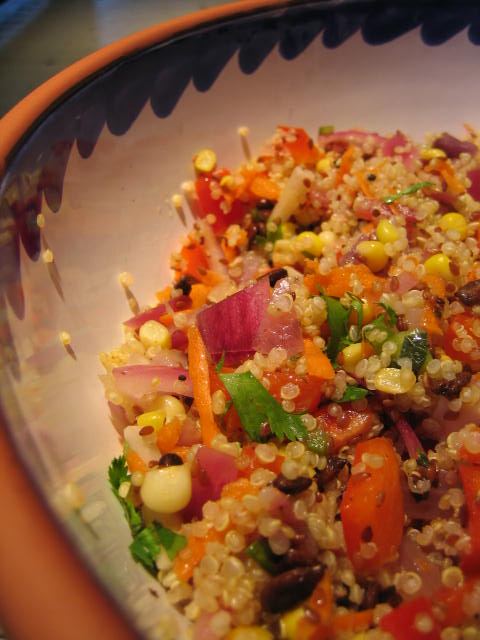
This is the most beautiful salad I have ever made, hands down. The colors are phenomenal. It looks like box of crayons, a sky-view of the Macy’s Day Parade, my ridiculous shoe collection. The combination of crunchy vegetables and soft grain combine in a satisfying texture. The zesty marinade does not overpower the fresh taste of the farmer’s market. Three different kinds of toasted seeds give an unexpected richness.


My mom even ate the leftovers. This is a true culinary triumph.

On another, slightly related note: In the past few years I have amassed an odd stock of t-shirts. One reads Alabama: So Many Recipes, So Few Squirrels in block letters across the front. It tickles me (and was on sale). I was decked out in all its squirrel-glory when a pair of young, fresh faced Mormon men came to my door the other day. They were nervous, stumbling over their words. My street was one of the first stops on their two year mission of conversion and they seemed disappointed that I wasn’t all that excited to talk about Jesus. (I don’t know why they were surprised; I live down the street from an orthodox synagogue and next door to a lesbian couple. A Mormon’s mission in Brookline seems doomed to failure.) But when they saw my t-shirt they warmed right up. As it turns out, they have a good friend serving his mission in Alabama. And, they informed me, squirrels are indeed often on the menu there. We chatted about different rodent recipes for a while. They were very nice; I even agreed to read one of their pamphlets on Mormonism.

And now I can’t help but wonder: what do squirrels taste like, and would my mom ever eat one?


Quinoa Salad
adapted from Peter Berley's The Modern Vegetarian Kitchen

For the salad:
1/3 c. sesame seeds

1/3 c. sunflower seeds

1/3 c. pumpkin seeds

½ tsp. sea salt

1 c. quinoa

Kernels from 2 ears of sweet corn

1 red onion, diced

1 red bell pepper, diced

1 bunch red radishes (8-10), trimmed and cut into matchsticks

1 large carrot, grated


For the marinade:

½ c. cider vinegar

1/3 c. olive oil

1 small bunch cilantro

2 scallions, chopped

1 jalapeno pepper, minced

1 garlic clove, minced

Sea salt

Fresh ground pepper


- preheat oven to 375


-spread seeds on a baking sheet and toast in oven for 10 minutes. Pour them into a bowl and set aside to cool.

-in a small saucepan over high heat, bring 1 ½ c. water to a boil with a pinch of salt. Add the quinoa. When the water returns to a boil, reduce the heat to low, cover, and simmer for 20 minutes or until all of the water has been absorbed. Spread the quinoa on a baking sheet to cool.

-in a pot fitted with a steamer, combine the corn kernels with the red onion. Steam for 3 to 5 minutes, until crisp-tender. Remove to a colander and chill under cold running water. Drain thoroughly.

-to make the marinade, combine the vinegar, oil, cilantro, scallions, jalapeno pepper, garlic, 2 tsp salt, and black pepper to taste in a large mixing bowl. Whisk well.

-add the toasted seeds, quinoa, steamed vegetables, red pepper, radishes, and carrot to the marinade.
Mix well and refrigerate for at least 20 minutes to marry the flavors.

Monday, July 04, 2005

on taste and tobias: back to earth with gazpacho

I sat on a hard gray bench; the wind violently whipping my hair, bright sun soaking into my shoulders. People were laughing and chatting all around me, moving wobbly on the rocking ferry boat. A plump brunette woman napped against her tattooed boyfriend, his leather jacketed shoulder a soft pillow. A hip looking younger man wearing a bright blue bandana painted bright smears on a canvas near my feet. Muscled, bronze men sipped Bloody Marys, leaning comfortably against the railing, looking out at the calm sea. The early ferry to Provincetown from Boston to kick off the Fourth of July weekend contains an interesting crowd. But I could hardly do justice to my usually passionate people-watching. I sa t there for two hours, hardly comprehending what was going on around me, lost in a book.

Tobias Wolff’s Old School is a short novel, one that I randomly grabbed from the bookshelf on my way out the door. But once I started reading I was lost. I was completely entranced by the narrative, the words. I left my body for the world of the novel. I haven’t had that sensation of involvement and total immersion within a book in a long time. By the end, college had given all reading, for class or fun, a repugnant aura of intensely academic over-analysis. I lost the ability to lose myself in the moment of reading, of wholly traveling to the realm of the story. But in the most unlikely of places this Saturday, that bench on the deck of a crowded sea-vessel, I entered completely into the world of Tobias Wolff’s boarding school narrative. I practically forgot to breath I was so intent on devouring the words and turning the pages.

The story itself (an intriguingly woven boy-to-man tale, piercing and believable) is not so important for these food-blogging purposes. As strange as it sounds, it was the feeling of complete bodily abandonment juxtaposed with a summer’s evening gazpacho that was the most interesting revelation.

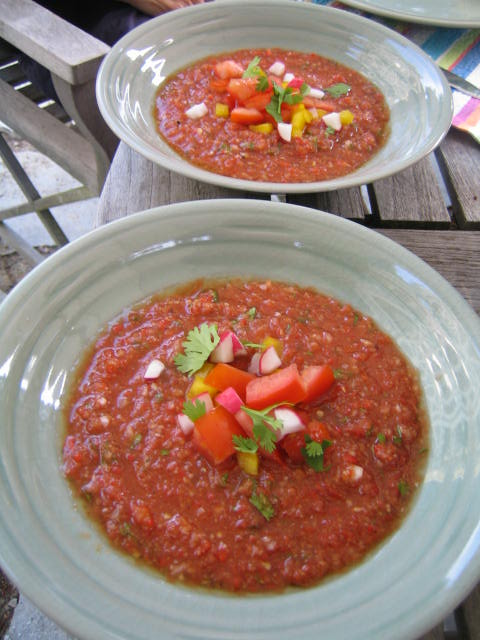
Reading so intently I felt as if I had abandoned my body, lost in that book I was without all normal bodily sensation. I was left with only words, story, internal literary imaginings. And eating the freshly chilled soup later that night my tongue and I were very much grounded in the wonderful physical reality of taste. With the first spoonful of gazpacho – the tangy jolt of sherry vinegar, garlic and cilantro; the visual feast of reds, yellows and green – I felt the full extent to which I had previously lost my senses to the literary world. It was a surprising taste awakening. One that brought me back to earth and made me feel very much alive.

I would like to have Tobias Wolff over for dinner. I wonder if he likes gazpacho.

Gazpacho
Adapted from Tyler Florence and the Food Network (loves of my life)

3 slices wheat bread, crusts removed

2 pounds vine-ripe medium tomatoes, seeded and coarsely chopped
1 cucumber, seeded and coarsely chopped
1 red bell pepper, cored, seeded, and coarsely chopped
1 medium onion, coarsely chopped
2 garlic cloves, chopped

1 jalepeno pepper, minced

2 cups tomato juice (the organic kind from whole foods, yum)

1 tablespoon sugar

1 tablespoon Spanish paprika

salt and pepper

1/4 cup sherry wine vinegar

1/2 cup extra-virgin olive oil

1 handful cilantro, coarsely chopped

1/2 lemon, juiced


-Soak the bread in 1 cup of water for 5 minutes, and then squeeze out the excess water.

-Place the bread in a blender or food processor; add the tomatoes, cucumbers, bell pepper, onion, garlic and jalapeno.

-Puree the ingredients until slightly smooth, keeping a modest amount of texture.

-Pour the vegetable mixture into a large bowl; stir in the tomato juice, sugar, paprika, salt, pepper, vinegar, oil, cilantro, and lemon juice until well combined.

-Refrigerate a few hours until very well chilled; the flavors will develop as it sits.

-Garnish with chopped yellow pepper, radish, tomato, avocado, and a few more leaves of
cilantro. (Adding color and crunch). Do another round of salt and pepper before serving.

Friday, July 01, 2005

little cake, big hands, massive passion

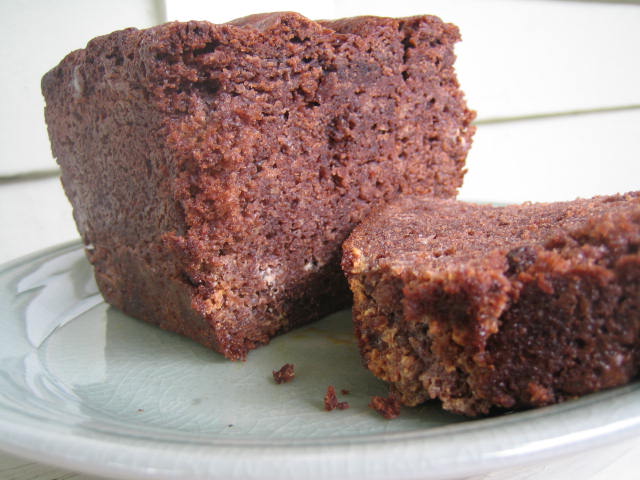
I was standing in the center of a car-less parking lot, surrounded by bustling people lugging plastic bags of fruit and vegetables, a misty layer of sweat on my forehead and deeply inhaling the smell of fresh basil. I watched from behind a stack of rhubarb as a tall man with a pink, weather-hewn face and crinkly long red hair smiled as he greeted a customer, radiating a sense of affability. He was wearing worn denim overalls, a rumply white shirt. His tan, freckled nose and the obvious but hidden muscles, lurking under his bilious clothing, were the mark of what I would consider a stereotypical farmer. He towered over the makeshift wooden table, his own stall at the farmers market in Coolidge Corner yesterday. His giant frame, dwarfing all others, was made even more acute when seen in context of his goods for sale. The tables surrounding him were covered in displays of tiny pies, little cakes, and stacks of cookies. Flakey pie crusts oozing blueberry and raspberry juices; golden pumpkin streusel cakes in mini aluminum loaf pans; chocolate chip cookies larger than my head (yet I imagine still smaller than his massive hands). I was drawn to the man’s quiet happiness, the wild looks of pleasure flashing on the faces of his customers, and who am I, really, to pass up a baked good. I extricated myself from the rhubarb and approached the table gingerly, mesmerized by the cakes, the seller, and only somewhat worried about my lack of self control in the face of butter and sugar. My eyes were immediately drawn to the towering mountain of a large chocolate loaf, its formidable sides in crusty peaks, reminding me of drip sandcastles on the beach.

The pink-faced farmer saw me eyeing the voluptuous cakes, practically drooling. He picked one up and held it out to me. Even through the cellophane wrap I could smell its buttery richness. This week we ran out of dark chocolate chips, the man said softly, almost nervously, in a deep voice. The gruff tambour of his speech perfectly suited his wide mouth and rough face, but was jarring in relation to his sweetly concerned words. I’m really so very sorry, but this morning we just ran out. I don’t want any of our regulars to be surprised or upset, so I need to warn you that we used white chips today.

When I seemed confused, he asked if I had ever had their Chocolate Banana Sour Cream Cake before. No. He smiled at the cake, lovingly; and he smiled at me, like he knew a secret I couldn’t possibly yet understand. Of course I bought some – he handed it over delicately, cradled as carefully as a newborn baby. I didn’t say anything; I was in awe of the love this man possessed for his work and his product. I was struck dumb and mute by the sheer passion that he exuded simply holding a chocolate loaf or peach pie, each dwarfed in his large hands. I paid and slipped silently away, clutching my cake, wondering if my obsession could ever possibly match his in pure force and happiness.

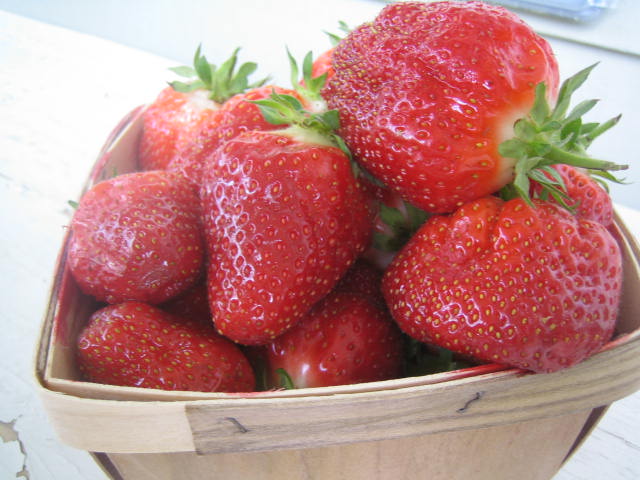
I walked home happily, a buoyant spring in my step despite the fact that I was practically swimming in Boston’s summer humidity. I unloaded my bag, and besides my cake took out a bundle of bright, crisp radishes, a cluster of juicy tomatoes, a pot of ginger-fig jam, and two quarts of burstingly ripe strawberries.

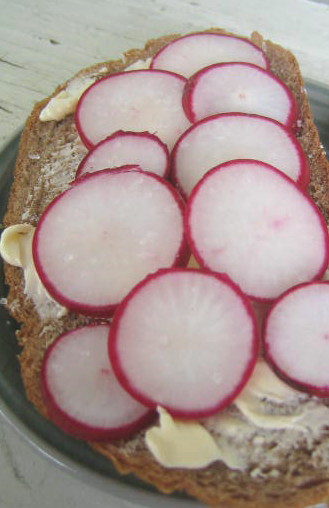
I created a masterpiece of lunch with my farmer’s market bounty: fresh wheat bread slathered with butter, topped with thinly sliced radishes and a smattering of sea salt. Crunchy red-rimmed radish against the cool creamy butter, the perfect bite of salt. A peach, explodingly ripe. And a huge hunk of chocolate banana cake – moist and rich, gooey with a crusty rim - alarmingly addictive. That stuff should be monitored by the FDA it’s so good.

I later sat surveying my mountain of ripe strawberries; a pile larger than any one house of humans could possibly eat.

I was pondering what to do with them, unsure why I bought so many, when an image of the dark corner of my basement immediately infiltrated my mind’s eye. A dusty shelf stacked with a plethora of random plates and utensils brought home from my college apartment, a fish poacher, panini maker, and an ice cream machine. When Becca and I moved into our apartment last year, we possessed none of the necessary kitchenware, not even a table. We also, collectively, had a dearth of money. We went to the mall, hoping to buy some of the basics – so at least that we didn’t have to eat off the floor that night. The only thing we came home with, however, was an ice cream maker (and decidedly smaller bank accounts). Of course we never regretted that purchase, despite the fact that it was used a pitifully few number of times in the last year.

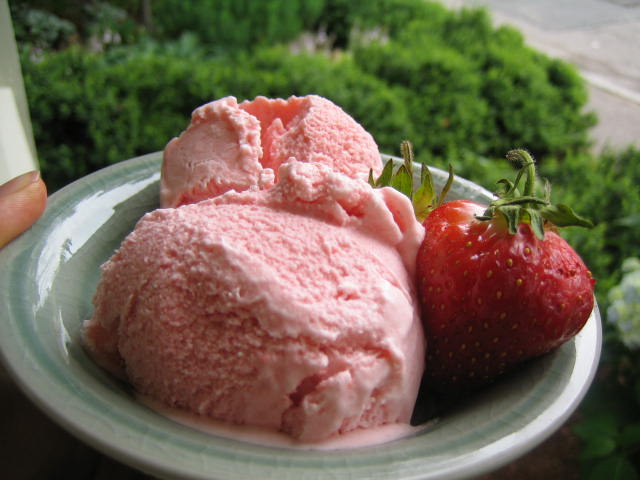
Yesterday, though, the ice cream machine was resurrected in all its former glory to create the perfect food for a day that made me sweat just walking to the fridge. I rubbed the ripe berries against a sieve, catching the juice and puree, leaving the seeds. I added citrus and sugar; whipping cream beaten to soft peaks. And what I ended up with was a soft and richly flavored strawberry ice cream – filled with pure summer and so far in taste from the preservative-pumped supermarket brands that it should be considered an evolutionarily miracle and taxonomically re-labeled.

My first bite of the cold pink ice cream was sweet, smooth, frothy, and infused with the sun, earth, and vines of the farm-fresh berries. I didn’t speak for a moment, mute with pleasure. And that’s when I realized that though I may not have hands the size of 10-inch peach pies, I certainly do have the ability to happily strike myself dumb with culinary passion.

Strawberry Ice Cream
Adapted from Shona Crawford Poole’s Ice Cream

1 quart of ripe strawberries, hulled

juice of one orange

juice of half a lemon

juice of half a lime

a scant ½ cup of sugar

¾ pint whipping cream, chilled


- rub the berries through a sieve, keeping the juice and discarding the seeds and solids.
- combine the strawberry with citrus juices and sugar, letting it sit for a few hours in the fridge to marry the flavors.
- whip the cream into stiff peaks and then fold it into the fruit puree.

- freeze in an ice cream machine.

Tuesday, June 28, 2005

a post-cleaning blueberry cake

I woke up Monday morning to hear the twittering of those tiny birds who are roosting on the roof, the dulcet sound of a humming air conditioner. I could smell coffee and a hint of cinammon, brewed hours before yet still pungent. I stretched out in bed, the sun shining through my window, pondering the patterns of light illuminating the piles of dirty clothes strewn all about the room. I was slightly groggy, somewhat sore (who knew mopping could work so many muscles?), and giddy with the prospect of an entirely free day.

I had planned on instituting an immediate plan of vacation-action: To Explore Boston, a city that I know sadly little of. Days after graduation I had left for Israel, returning to Boston only to begin work the next day. There has been no time yet to feel comfortable in the city, like I belong here. But true to my Brunonian background, whenever there are other ‘larger’ things to be done it seems like my productivity facilities shutdown and I immediately revert to some kind of procrastination. And after that last night’s 11-hour stint of hard core cleaning, my mind and body united to tell me one thing and one thing only: bake a cake.

Looking in the refrigerator for inspiration, I found a magnificent pint of blueberries. Poppingly ripe and almost blackly-blue, they are the soul of my blueberry coffee cake with a crunchy toasted pecan crust.

When I later pulled the cake out of the oven I could hardly wait for it to sufficiently cool before cutting a generous slice. Its smell immediately brought me back to when I was ten - the small cluster of blueberry bushes near my aunt’s lakeside house in Pennsylvania, my mouth stained blue, juice dripping down my chin, the berries roasting in the hot summer sun. The cake itself was soft and light, gooey and steaming blue with burst berries. The crust was a perfect combination of sweet and crunchy – the toasted pecans add an extra oomph of rich nutty texture.

I took my piece of blueberry cake, a steaming mug of coffee, and the new David Sedaris book out onto the shady porch. I sat there for a long while, perfectly content. Emily and Sarah, my oldest, comfiest friends, soon arrived and had no problem helping me in the cake eating fest. Later, though, we did go out to explore Boston, laugh over food and wine while perched at a breezy outdoor table, and talk about where this so-called "Real World" is taking us.

I maintain, though, that any talk of the Real World must be preceded by cake. It is much more palatable that way.


Blueberry Coffee Cake with a Crunchy Pecan Crust
adapted from The Gourmet Cookbook

2 c. flour
2 tsp. baking powder
3/4 tsp. salt
1 stick softened butter
1 1/4 plus 3 tbs. sugar
2 eggs
1/2 tsp. almond extract
1/2 c. milk
3+ c. blueberries (I like to err on the side of more)
1 egg white
1 1/2 c. toasted pecans, roughly chopped

-preheat oven to 350 and grease a 2-3 inch cake pan
-sift together flour, baking powder, and salt into a bowl.
-combine butter and 1 1/4 c. sugar in another large bowl, beating it until pale and fluffy. Then beat in the eggs, one at a time, then the almond extract. Slowly add the flour, alternating with the milk, until it is just incorporated.
-fold in the berries and spoon the concoction in to the baking dish.
-in another bowl, stir the egg white, pecans, and remaining sugar until coated. spoon the mixture evenly on top of the cake.
-bake for around 45-50 minutes, or until golden brown and a cake tester poked into the center comes out clean.