“What does it smell like?” I asked my mom. We were sitting in her car, windows open, parked in a tiny lot in Cambridge, Massachusetts. Just coming off the recent heat wave, the breeze hitting the back of my neck was warm but not clammy, the sunlight tinted with that bronzed edge of a summer evening.
“It smells…good,” she said, inhaling deeply, “like… cooking.”
I peered out of the car window and looked at the a familiar red sign, next to a large brick building, a doorway and small set of stairs. The name of The Restaurant, emblazoned on the sign in white letters, was bigger than I remembered. We had a 7:30 reservation to eat dinner and I was not yet ready to open the car door. It had been a year since I was last in that parking lot, and it felt like a lifetime.
An older couple walked by on their way to the entrance—the woman in yellow and clutching a brown handbag, the man with white hair and stooped shoulders. He held the door open for her and she smiled before they disappeared together inside.
“Lets wait; just a minute,” I said. I was having a hard time getting the last words of The Chef out of my mind, thrown at me bitterly when I quit my job as a dishwasher and prep chef there at that restaurant last summer – You are an utter disappointment. I suddenly did not feel ready to face him again.
My mom and I sat silently in the car for another moment. Excitement, hope, exhaustion, dread—they were all rolled into a fuzzy lump somewhere in the back of my throat. Strong feelings for a simple dinner out, I know. But they were fitting—and familiar. It was the same thing I felt every night last year when I arrived to dishwash. They again bubbled to the surface of my consciousness in the parking lot. The only difference (besides the fact that my pants were not stained with beet juice or duck fat and my hair, perhaps, did not so closely resemble a bird’s nest) was that I could not smell the cooking which I remember permeating the air for blocks outside the restaurant. There was a monotone, olfactory nothingness where wafts of simmering veal stock and roasting chickens had previously inhabited my nose. Those smells, however, were so interlaced with the memory of that space and those feelings that sitting there in the car I could almost smell them again—the scent was on the tip of my tongue.
My heart was beating rapidly when I walked into the small, cozy dining room of The Restaurant. It was bustling with people. The waiters and waitresses were in jeans and white aprons, carrying bottles of wine, steaming plates. A light chatter of diners punctuated the soft jazz music; the walls and tables were warm in red and brown.
I smiled at the hostess, “Molly Birnbaum, reservation for two,” I said.
We were brought to a table deep within the dining room, my mom and I both in clicking heels and rustling summer skirts. It felt odd to be sitting there amid crisp linen and flickering candles, wearing make-up and jangling earrings—in my working past I had never spent more than five minutes in the dining room at one time. It was my first visit to The Restaurant since I left last year and the first formal dining experience ever. Looking around I was happy to see that I didn’t recognize anyone. I didn’t want to give the long, exhausting explanation of why I was no longer in the professional culinary world. I just wanted to eat. And drink. And toast to the fact that the one year anniversary of my accident is swiftly approaching and I am alive and well.
I soon saw a familiar face, however. A curly-haired waiter with whom I used to chat about books (in twenty second intervals, mainly about the most recent Harry Potter, while he was slicing lemons in the back hallway and I sped past lugging stacks of dirty dishes) came to our table bearing a pitcher of water. He did a double-take, glancing away and then back towards me again, not sure if he recognized me without those said stacks of dirty dishes. Without rivers of sweat running down my forehead I look different, perhaps.
“You’re Molly!” he exclaimed. I smiled, suddenly happy that my evening would not be completely anonymous. “I thought that was you!”
After a hearty greeting and rambling explanation of anosmia and why I am living in New York City and not at culinary school, he said, “I’ll tell The Chef that you’re here. He’ll want to know…” And he scooted off to attend to the rest of the busy dining room.
“You’re afraid of seeing The Chef, aren’t you Molly,” my mom said after the waiter left our table. “I can see that look of mild panic in your eyes.”
I nodded. Sighed. The whole evening made me nervous; the rest of my life felt very far away from dishwasher-Molly. “Hopefully he will just pay no mind to what the waiter tells him. He was so angry with me when I left—I highly doubt he cares that I am here. He still thinks that I’m at culinary school, still disappointed that I didn’t want to work my way up the line of his kitchen.”
My nagging apprehension disappeared, however, with the arrival of a bottle of wine. While perusing the menu, my mom’s eyes had immediately landed on a bottle of Sancerre; she had just read an article on the French wine made from Sauvignon Blanc grapes in the Loire Valley and really wanted to try it. A bit more expensive than we had intended, but, as she said with a playful grin, “we are here to celebrate an anniversary… and nothing says ‘I survived being hit by a car’ like great wine.” It was a crisp, white 2002 Sancerre "Jadis" Henri Bourgeois and after the first sip (ripe with tropical citrus, mint, a mineral breath) my mom’s wide smile and little wiggle-dance of happiness in her seat banished all of my worries.
When I worked at The Restaurant food was, obviously, the most important thing on everyone’s minds. It was a passionate culinary environment. There were certainly moments when I forgot about the food– moments involving maggots, black-outs, temper tantrums and surprising friends. Despite the general culinary intensity, though, I never once ate the food like it was intended to be served. I ate a lot, of course – a lot of wonderful, inspiring things. But never sitting at a table and never plated with the aesthetic precision that The Chef cared so much about. So when my first dish arrived that night in the dining room—a ragout of local forest mushrooms, snails, slow cooked fresh farm egg, garden herb puree and lavender blossoms—I had to spend a moment taking it in with my eyes. The bright yellow of the egg yolk balanced carefully on the muted brown mushrooms was complimented by the trickle of frothy, vibrant green puree. The delicate lavender was a soft purple punctuation to the pillow of egg white. It tasted like a rich, comfortable ramble through the woods.
On the shallow white bowl that contained my main dish there was a vivid stripe of orangey-red, skillfully curled from the center to rim – a sideline to the ricotta gnocchi and fresh garden vegetable glacee. It was a nectarine saffron emulsion and the color leaped into my eye-sockets, begging to be put to my lips, dancing with the bright colors of the vegetables alongside. I spent hours in the kitchen last year watching The Chef as he bent carefully over the row of white plates, holding a metal saucepan in one hand and long spoon in the other, and with expert, precise movements made swaths of colorful sauce marks under the dishes he was constructing. I always loved the way he moved – a large man making small movements in liquid flavor – the effect of the plate was heightened knowing the dance of orchestration behind it. Beautiful. The soft pounce of gnocchi was a texturally perfect foil to the vegetable crunch.
My mom’s creamy yellow potage of sweet corn was topped with crispy fried clams and kept the wine-inspired smile afloat on her face; it was continued by a rich olive oil and chorizo-broth poached sea bass.
For dessert we had an Ocumare chocolate brownie (gooey and rich, a subtle bitterness in the dark Venezuelan chocolate offset the sweetness) topped with homemade peanut butter ice cream (the whir of the oft-used ice cream maker in The Restaurant’s back kitchen ran in the back of my memory as we ate). In addition, we had the sour milk panna cotta; a square of milky white pudding flecked with black vanilla bean side by side with a pile of fresh blackberries. One bite and my mind was flooded with sensory images – when there was panna cotta left over, late at night and beginning to de-form in the large plastic tubs where it was stored during service, The Chef handed it off to me and S., my fellow dishwasher. The two of us would stand at a makeshift counter in the back hallway, talking in my broken Spanish, manning serious spoons, and eating that cold tangy cream until I thought I would burst. Those were wonderful moments. It was odd to be sitting, speaking in English, and eating a normally sized portion of that familiar dish.
After drinking a bottle of wine together, my low-tolerance mom and I were lost in a world of giggles. We were surprised when our waitress came out to the table not with our check, but with two tiny silver spoons, which she placed carefully down next to our hands. She smiled knowingly, disappeared and then came back a moment later with two small white cups on a tray.
“A special something from The Chef… rhubarb hibiscus soup with yogurt sorbet.” The soup was cold and feathery pink, tart and simultaneously sweet. The small dollop of yogurt sorbet was milky white. Small surprise courses from the kitchen were what The Chef called “VIP treatment procedures.” I was flattered and happy to be the recipient.
Later, my mom and I were taking bites of the buttery madeleine cookies that arrived with the check (how fitting, I know) when I looked up to see The Chef approaching our table. His hair, once long and dark and always kept in a rough ponytail, was short and manicured. He wore a blue shirt with his name embroidered on the right pocket, a clean white apron. His mouth was in a hard line.
I stood and shook his hand. My smile was wide, overtaking my face; I was suddenly so happy to see him, this man who taught me so much about food.
“The meal was wonderful,” I said, almost bashfully. “Thank you so much.”
“I’m glad you enjoyed it,” he said. A moment of silence. “So, what are you doing these days?” He looked at me pointedly and I was hit by a wave of embarrassment. I am not working my way up the culinary world, proving my pluck in the face of a good deal of physical opposition like I once was – instead I am sitting at a desk in midtown Manhattan, reading things. Under the glare of The Chef it seemed silly. But I explained, swiftly and in few words, about my accident… “only a few weeks after leaving the restaurant” and my loss of smell… “though it is slowly coming back”… my current quest to write in New York.
“Well,” he said slowly, shaking my hand again, “at least you still enjoy your food. Good luck to you, Molly.”
“Thanks.” I think I whispered.
Before we left I walked to the back hallway of the kitchen, out of view to those on the line, but still close enough to hear the clanging of pots and calling orders. S. was there, peeling garlic with his weathered hands, wearing a white shirt and jeans. I called out his name and his eyes lit up. He grasped my arm in greeting and we smiled at each other, perhaps a bit goofily. S. spoke about his life, always in Spanish, and I listened. This was always our relationship; I’m happy that I have somehow retained my ability to understand the language. When The Chef’s gruff voice called S. back into the kitchen we said goodbye. He gave me the number to his new phone.
My mom and I left The Restaurant and walked into a clear summer night. I had been afraid to go back and remind myself of what ‘was’. But on leaving I felt simply happy. Lucky. Full.
***
Tuesday morning of last week I ran hectically around my apartment looking for one of my black sandals. I couldn’t find it anywhere and I was going to be late for work. I jabbed a pair of big earrings into my ears as I searched my closet floor, not even sure what I was putting on. I tossed some books and papers into my bag, walking lopsidedly towards the kitchen while attempting to tie my hair back with my one free hand. I got down on my hands and knees, trying hard not to crush the smooth pleats of my linen dress and stuck my hand blindly under the futon. Just as my fingers grasped the heel of that lost shoe, my cell phone began to ring and I hopped up to answer.
“Hello? …Hello?” I said, hardly listening as I shoved my foot into the sandal and lunged towards the door to leave.
“Molly? Estas tu?” a low voice said, gravelly in phone-static. I immediately stopped moving, straining to hear. “Molly? Como estas?”
It was S. -- eight in the morning, just a few days after I returned from Boston. He called to tell me that he is happy that I am no longer washing dishes. He is happy that I found other work. Dishwashing is not for a “chica simpatica.” He had to repeat himself many times; my Spanish comprehension is better in person than on the phone. We talked as I walked slowly down the sunny sidewalk towards the subway, no longer caring that I was late for work. His voice was familiar and kind. Towards the end of our conversation he told me that the time I worked with him at The Restaurant was one of his happiest. When I was there I listened to him; we talked. He was happy. He wanted to wish me the best.
When I stepped onto the subway moments after hanging up the phone, my eyes stung. I felt lost in a throng of suits and heels, steamy breath and rustling papers. A baby was screaming and the woman standing next to me was immersed in her Blackberry. The world I inhabit these days is different; I could feel the tears begin to well over.
Monday, August 14, 2006


Sunday, July 30, 2006
farmer's markets, rooftop acrobatics and a tart
My roommate Jon and I are slowly recovering from this weekend's protracted culinary binge . We began Saturday morning, on a three-hour-long quest for groceries. We walked from our apartment, shiny with sweat after only a few steps in the sun, down to the farmer’s market in Grand Army Plaza—a vibrant weekend community of farmers, Brooklynites, red and yellow tomatoes, magenta beets, light fuzzed peaches and a phalanx of baby strollers. We spent a good deal of time poking around the piles of fat eggplants, mounds of green beans and stalks of scallions as we discussed cooking ideas and menu options. We loaded up bags with New Jersey tomatoes—their bulbous knobs ready to explode with summer-ripe red juice—a green pepper, thick-peeled red onions and cucumbers. The farmer manning the counter at this particular stand—lean and tan, white hair offsetting a youthful smile—threw in a free serrano pepper, grinning as we awkwardly hefted the eight pounds of tomatoes off his table. Soon we added bags of peaches, blueberries and plums, carrots and beans, fingerling potatoes, tiny tomatillos and a few loaves of fresh sourdough bread. When we finally left the market I felt as though I were carrying hundreds of pounds of produce, the bags literally hanging off of every balanceable body part. And when we arrived home, fingers permanently creased from the weight of grasping the heavy bags, we sat on the couch and stared at mounds of beets and broccoli, varying shades of carrots and onions, yellow plums, baskets of blueberries and sprigs of cilantro, slightly in awe of our lack of farmers market self control. Piled together and against the backdrop of our red brick (nonworking) fireplace, the vibrant colors and earthy vegetal shapes of our purchases were beautiful.
“If only we had some 17th-century Dutch artist living here,” Jon said, “Just imagine the still life paintings we would inspire.”
We were serenaded by Tom Wait’s familiar growl as we spent the afternoon blanching and peeling our bucket of tomatoes, chopping a few cucumbers, red onion and green pepper. Together with a hefty dose of garlic, olive oil, cilantro, white wine, lime juice and that (free) serrano pepper, I used the immersion blender in the largest soup pot we own to turn that tumult of vegetables into a smooth soup. Salt, pepper, and later garnished with avocado, onion and cilantro—it was an easy, cooling gazpacho with just a touch of crunch and spice. Friends slowly streamed in at the latter end of our prep work, sipping wine and experiencing the wonders of goat gouda and roasted tomatillos on bread.
Three fans collectively aimed into our kitchen made the summer heat somewhat bearable while we roasted our bi-colored carrots (yellow and orange), later tossed with the light crisp of chopped scallion. Steamed green beans, coated with a sweet balsamic vinaigrette, were cooked way ahead of time to be served cold with a pair of metal tongs. Jon had been inspired by a pilgrimage to a local Middle Easter grocery store to marinate our filets of blue fish with tangy green olives, preserved lemons, cumin, coriander and olive oil. Roasted, the soft fish was infused with deep flavor.
Last week, when Jon and I decided to throw this dinner party, I unearthed my ice cream maker from the back corner of my closet, somewhere behind the pasta roller and yogurt machine, under a pile of sweaters, sadly unused throughout this sweaty summer. And Saturday morning I went straight to work, heating cream, milk, vanilla and a bit of sugar in a heavy saucepan to a quiet simmer. In another bowl I whisked ten egg yolks—I love the slick feeling of the whites sliding through my fingers as I separate the yolks in the palm of my hand—with more sugar, until frothy and pale. After tempering the yolks with a bit of the hot cream mixture, I put it all together on the stove, stirring constantly as the custard thickened. Later that evening, the sound of the ice cream maker’s mechanical churn melded with the soft tunes of Leonard Cohen. The finished ice cream was a thick and off-white, smooth and rich, cold and creamy. It went perfectly with my peach-blueberry freeform galette (an old, favorite recipe which I’ve made and tweaked so many time I’m not even sure from where it began), the dough of which I rolled out with the help of an old wine bottle. When I pulled the tart out of the oven, fruit bubbling its thick syrup amid a deep brown crust, it smelled sweet and warm, faintly of cinnamon.
In an amazing feat of acrobatics—inspired by an apartment so thick with heat you had to practically swim through the air and, perhaps, a glass of wine or two—we brought our feast up to the roof. We handed shopping bags of bowls and plates, forks and knives, one heaping dish at a time to waiting hands, a chain of hungry people balanced on the precarious ladder, hefting food and people in awkward lunges through the hatch-like rooftop opening. Once up there, though, we perched on a picnic blanket, plates resting on our laps, and the sound of laughter reverberated out over our quiet, humid neighborhood streets. A clear outline of the Manhattan skyline gleamed in the distance—its light a deceptively still backdrop to an active evening of cooking, eating and a general raucously delicious time.
Freeform Peach-Blueberry Galette
Dough: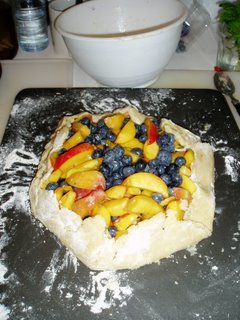
1 ¼ c flour
¼ c yellow cornmeal
½ tsp salt
3 tbs sugar
10 tbs unsalted butter, chilled and sliced
4-5 tbs ice water
1 large egg yolk, whisked with a dollop of water.
Filling:
8 small peaches
One container of blueberries
3 tbs. sugar
1 tbs. flour
Pinch of cinnamon
1 tsp lemon zest
Mix the flour, cornmeal, salt, sugar and butter together—I use my fingers to work the butter in with all of the dry ingredients. And then add the water, one tablespoon at a time, until the dough comes together. Wrap in plastic wrap and chill for at least an hour.
For the filling, slice the peaches and mix with the blueberries, sugar, flour, cinnamon and lemon zest in a bowl.
Preheat the oven to 400. And when ready, roll out the dough into a large circle. Place it on a piece of wax paper, on a cookie sheet, and then put the filling in the middle of the dough-circle. Carefully fold the overhanging sides of dough up over the edges of the fruit. Lightly brush the visible dough with the egg yolk and water mixture and sprinkle a bit of additional sugar on top. Bake (making sure to place tin foil or another pan underneath to catch the liquid overflow) for 30 minutes, until golden brown and bubbling.
“If only we had some 17th-century Dutch artist living here,” Jon said, “Just imagine the still life paintings we would inspire.”
We were serenaded by Tom Wait’s familiar growl as we spent the afternoon blanching and peeling our bucket of tomatoes, chopping a few cucumbers, red onion and green pepper. Together with a hefty dose of garlic, olive oil, cilantro, white wine, lime juice and that (free) serrano pepper, I used the immersion blender in the largest soup pot we own to turn that tumult of vegetables into a smooth soup. Salt, pepper, and later garnished with avocado, onion and cilantro—it was an easy, cooling gazpacho with just a touch of crunch and spice. Friends slowly streamed in at the latter end of our prep work, sipping wine and experiencing the wonders of goat gouda and roasted tomatillos on bread.
Three fans collectively aimed into our kitchen made the summer heat somewhat bearable while we roasted our bi-colored carrots (yellow and orange), later tossed with the light crisp of chopped scallion. Steamed green beans, coated with a sweet balsamic vinaigrette, were cooked way ahead of time to be served cold with a pair of metal tongs. Jon had been inspired by a pilgrimage to a local Middle Easter grocery store to marinate our filets of blue fish with tangy green olives, preserved lemons, cumin, coriander and olive oil. Roasted, the soft fish was infused with deep flavor.
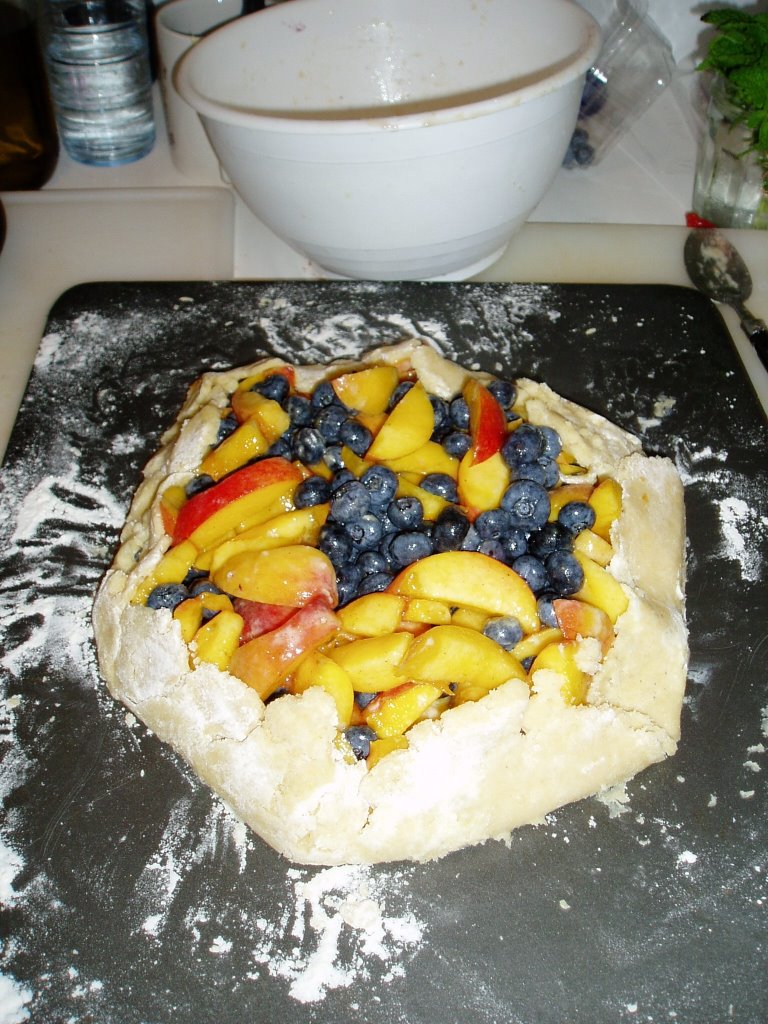
Last week, when Jon and I decided to throw this dinner party, I unearthed my ice cream maker from the back corner of my closet, somewhere behind the pasta roller and yogurt machine, under a pile of sweaters, sadly unused throughout this sweaty summer. And Saturday morning I went straight to work, heating cream, milk, vanilla and a bit of sugar in a heavy saucepan to a quiet simmer. In another bowl I whisked ten egg yolks—I love the slick feeling of the whites sliding through my fingers as I separate the yolks in the palm of my hand—with more sugar, until frothy and pale. After tempering the yolks with a bit of the hot cream mixture, I put it all together on the stove, stirring constantly as the custard thickened. Later that evening, the sound of the ice cream maker’s mechanical churn melded with the soft tunes of Leonard Cohen. The finished ice cream was a thick and off-white, smooth and rich, cold and creamy. It went perfectly with my peach-blueberry freeform galette (an old, favorite recipe which I’ve made and tweaked so many time I’m not even sure from where it began), the dough of which I rolled out with the help of an old wine bottle. When I pulled the tart out of the oven, fruit bubbling its thick syrup amid a deep brown crust, it smelled sweet and warm, faintly of cinnamon.
In an amazing feat of acrobatics—inspired by an apartment so thick with heat you had to practically swim through the air and, perhaps, a glass of wine or two—we brought our feast up to the roof. We handed shopping bags of bowls and plates, forks and knives, one heaping dish at a time to waiting hands, a chain of hungry people balanced on the precarious ladder, hefting food and people in awkward lunges through the hatch-like rooftop opening. Once up there, though, we perched on a picnic blanket, plates resting on our laps, and the sound of laughter reverberated out over our quiet, humid neighborhood streets. A clear outline of the Manhattan skyline gleamed in the distance—its light a deceptively still backdrop to an active evening of cooking, eating and a general raucously delicious time.
Freeform Peach-Blueberry Galette
Dough:
1 ¼ c flour
¼ c yellow cornmeal
½ tsp salt
3 tbs sugar
10 tbs unsalted butter, chilled and sliced
4-5 tbs ice water
1 large egg yolk, whisked with a dollop of water.
Filling:
8 small peaches
One container of blueberries
3 tbs. sugar
1 tbs. flour
Pinch of cinnamon
1 tsp lemon zest
Mix the flour, cornmeal, salt, sugar and butter together—I use my fingers to work the butter in with all of the dry ingredients. And then add the water, one tablespoon at a time, until the dough comes together. Wrap in plastic wrap and chill for at least an hour.
For the filling, slice the peaches and mix with the blueberries, sugar, flour, cinnamon and lemon zest in a bowl.
Preheat the oven to 400. And when ready, roll out the dough into a large circle. Place it on a piece of wax paper, on a cookie sheet, and then put the filling in the middle of the dough-circle. Carefully fold the overhanging sides of dough up over the edges of the fruit. Lightly brush the visible dough with the egg yolk and water mixture and sprinkle a bit of additional sugar on top. Bake (making sure to place tin foil or another pan underneath to catch the liquid overflow) for 30 minutes, until golden brown and bubbling.
Monday, July 03, 2006
A Tribute To Gaudi
A warm breeze tousled my loosely knotted hair and grated against my legs as we walked down the cobble-stoned street. There was no one else outside and, for a generally bustling city, it was oddly quiet. Dark buildings rose up around us as we strolled away from the downtown. We wound up a steep avenue, underneath a long train of white bed sheets that hung off clotheslines, drying in the wind. There were three of us: Dave, Adam and me. We moved together, large backpacks slung over our shoulders—silent in a horizontal line. Our shadows blazed out behind us in the midday sun.
It was Christmas Day; Barcelona, Spain.
That morning in the hostel the three of us had exchanged holiday gifts while perched at a rough wooden picnic table in the lobby. Books and journals were passed around, wrapped haphazardly in recycled newspaper; I was fresh from my semester studying art in Florence and giggled as I gave Adam and Dave each a pair of boxer shorts with a select digital image of Michelangelo’s David imprinted on them. Adam had just finished his semester in Bologna, Italy – and Dave in Sweden. Before we returned to our home college in the States we wanted a bit more adventure. Spain, France, Germany… Barcelona was our first stop and we were shocked by its warmth and color, somehow expecting Christmas to come with cold gray.
We left the hostel that quiet holiday morning, still groggy from a late night filled with paella and a midnight Christmas mass, and walked a long and meandering path to Park Guell. The park sprawls out on top of a hill overlooking Barcelona and was one of the few things open that day. It was designed by Antoni Gaudi, a Catalan architect famous for his fantastical, color-strewn buildings. We sat on a terraced landing—one that was wrapped with an undulating line of benches, covered in vibrant mosaic. There was the light smell of smoke; it wafted towards me from the gray, wrinkled man smoking a cigarette nearby. Children were shrieking in pleasure as they chased pigeons, running around in nonsensical circles. The air was warm. I could see the peaks and whorls of the Sagrada Familia, a wildly designed cathedral by Gaudi towering over in the distance of Barcelona.
Looking around, I felt as though I had landed in another world. The colorful buildings in the park—complete with gyrating design and often pinnacled roofs—may have jumped straight from my imagination. The quiet, winding wilderness paths throughout the park were a displaced proof of reality. Suddenly—with the warmth of this strange Christmas day, sitting on an oddly winding bench in Spain—I felt overwhelmingly aware of the physical world around me. The sun had never hit each hair on my arm so carefully. A puff of smoke had never carried with is such layers of scent. The mosaic on the bench around me screamed in vivid blue, pink, yellow, white. The sound of Dave unzipping his backpack was momentarily set in bold typeface. I felt my heart vibrating in my chest.
I had a few moments like that—flashes of shocking focus—while I traveled around Europe. The bright light of fireworks under the Eiffel Tower on New Years in Paris—a whiff of strong lilac perfume while I stood in front of Picasso’s Guernica in Madrid—a sweet mouthful of tart tatin in a small Parisian bistro—shivering through a snowstorm somewhere near Berlin. But never as wholly as in Park Guell. The vibrant awareness of what was around me was as its most acute in Barcelona.
I like to think that it was inspired by the world we sat in that Christmas Day: Gaudi's.
And how fitting, then, that the inspiration for my most recent moment of vivid corporeal awareness can also be connected to the Spanish architect. It was two weeks ago; I was far away from Europe and the sight of any architectural innovation. I sat in a stiffly linened and leathered dining room, midtown Manhattan. Clinking glasses and muted laughter, dark suits and shiny hair surrounded Becca and I, snug at a corner table. It was a moment of beautiful excess in our epic week of eating; we were dressed to the nines and eating a four course lunch at Le Bernardin.
Things have settled down in my life recently (after moving to NYC, finding a job etc.). There is a newly reinstated sense of control. And with that, the other senses seem to be rapidly reasserting themselves as well—comfort, confidence, not to mention scent. With my best friend and fellow food aficionado, Becca, across the table from me I was, for the first time, able to leave my loss behind and focus fully on what taste I do have.
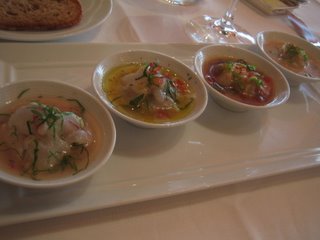 For my first course I had a “Progressive Tasting of Marinated Fluke: Four Different Ceviches; from Simple to Complex Combination.” The idea is to begin with the ceviche cup on the left (the simplest) and work your way to the right (the most complex). Each preparation had the same basic ingredients and as you moved along in complexity there were simply more flavors added. One at a time, I took a bite of each, slowly chewing, concentration on my limited scent and power of temperature and texture to find flavor. Becca followed suit. The fluke, a white flatfish, was cool and soft.
After the first: “Citrus, right? Salt and pepper?” I asked, wondering how much I could actually discern using texture, body and muted scent to taste. I could taste the tang and detect the fruity scent when I breathed out.
She nodded. “Yes, definitely. Lime, I think,” she said, “It’s light, though. Mainly I just taste the fluke.”
The Second: “Olive oil,” I said, a bit more definitive in my assertion. I could feel the silkiness of the oil coating the fish, soft in my mouth
“I agree—it’s thicker, more flavor in the olive oil that calms the citrus.”
The Third: “I can taste more salt—and a bit of a bite, which makes me think there is something vinegary… something Asian inspired…” I said.
“Soy sauce, I think,” Becca said, taking another mouthful, “or something similar.”
“And then there’s that crunch,” I said, “The green—scallions?”
“Jalapeno…” Which would make sense of the lingering spice in the back of my throat. “And shallots perhaps.”
The Fourth: “In this one I don’t even need to put a bite in my mouth to know the basic addition – the white milkiness is either cream or… coconut milk,” I contemplated.
“Tastes like coconut milk,” Becca said. “Curry too.”
“I can’t taste the curry, but the color gives that away to me.” The visual aesthetic of the food, I realize more and more, plays a huge roll in what my I can detect in taste. The orange-red on the plate gives direction to my olfactory neurons; it gives my brain a hint in discerning and making sense of weak scent. I took another bite. “I can, actually, taste a bit of curry flavor lurking around when I breathe out slowly. It’s weak, but vaguely sweet with a spicy bite.”
The texture of the coconut milk was strikingly similar to that of olive oil, the hint of thick viscosity. That feeling in the mouth, coupled with the light nutty flavors, implies inherant deliciousness. There is something undeniably palatable about the texture of a fat.
I tasted Becca’s first course, a Warm Sea Urchin Custard; Shiso Julienne, and was struck by its light milky texture. A smattering of foam on top was a salty foil to the rich cream. When I exhaled, slowly, I could taste the urchin; it was a briny sea-filled breath.
For the second course Becca had the “Skate-Pork” – a Surf and Turf of Crispy Pork Belly and Skate Wing, Gingered Squash Mousseline and Brown Butter Flavored Jus. I don’t remember my reaction to that dish as much because this was the point where Gaudi entered the equation and my taste buds were overwhelmed.
My own main course was the Monkfish, “A Tribute to Gaudi,” – Pan Roasted Monkfish; Confit Peppers and Fiery “Patatas Bravas,” Chorizo-Albarino Emulsion. It was a beautiful dish—carefully arranged with a few well placed barrages of color—slightly asymmetrical and just fantastical enough to implicate the Spanish architect in its conception. I took a moment to digest with my eyes, before attempting on my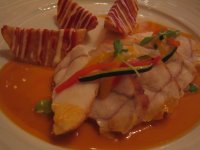 tongue.
What struck me the most in this dish was the texture of the monkfish—light and heavy simultaneously—smoothly flaking while dissolving softly in my mouth. The salt of the chorizo-albarino emulsion—a pale brown river running beneath the fish, complimented the sweet crunch of the pepper confit—a Gaudian swath of color pinnacled on the mountain of fish. The potatoes, three bronzed wedges angled on the side, were drizzled in white and red concentric lines of sauce—spicy and cool. It was a well balanced amalgamation of tastes, a flavor-tribute to Spain (I read somewhere that the Chef, Eric Ripert, spent part of his childhood in Barcelona). The nod to Gaudi in this dish would not have meant so much had I not already held a good deal of memory-infused value for his influence. And yet again while eating, I was acutely aware of all around me, all that went into me. I felt like I was tasting, both intuitively and intellectually, for the first time since the accident. Each taste was more vibrant and tangible than I had remembered possible. I think that had part to do with Becca’s comfortable presence and understanding, the high caliber and interest of the food itself, of course. But who knows, perhaps Gaudi’s presence infused within the meal gave me a subconscious but palpably heightened awareness of flavor.
For dessert I had the “Strawberry”: Strawberry, Mango, and Basil ‘Ice Cream Sandwich’ and Organic Strawberry Juice—sweet and cold between the fresh crunch of strawberry meringue. Becca’s “Chocolate-Cashew”: Dark Chocolate, Cashew and Caramel Tart, Red Wine Reduction, Banana, and Malted Rum Milk Chocolate Ice Cream was thick and understated in its sweetness. The only thing we did not like the entire afternoon was Becca’s ice cream; we aren’t malted rum sorts of people, really.
The waiter then brought us a white napkin filled with piping hot mini cookies; I could smell their sweetness. They tasted warm.
And then, surprised, small white vaulted cups were place before us. In each was an egg shell, open on top. “From the kitchen,” the waiter said with a smile. Inside the egg was a delicately balanced milk chocolate pot de crème, caramel foam, maple syrup with a smattering of Malden sea salt sprinkled on top.
“I saw Michael Laiskonis, the pastry chef here, on Iron Chef America,” Becca said excitedly. “For the coconut and chocolate battle he made this! Well, with coconut, but still, everyone loved it! Especially Jeffrey Steingarten, one of the judges that night. I remember so clearly, because he made me laugh when he said the only thing he would change about this dessert would be to put it in an ostrich rather than a chicken egg….”
It was a wonderful combination of salty and sweet (of which I am already an unabashed fan). I would certainly have eaten an ostrich egg full.
We left Le Bernardin a bit giddy from the rich food and unaccustomed glass of afternoon wine and went for a walk in the park. A warm breeze tousled my loose hair and I could (almost) smell the scent of summer hanging in the air.
It was Christmas Day; Barcelona, Spain.
That morning in the hostel the three of us had exchanged holiday gifts while perched at a rough wooden picnic table in the lobby. Books and journals were passed around, wrapped haphazardly in recycled newspaper; I was fresh from my semester studying art in Florence and giggled as I gave Adam and Dave each a pair of boxer shorts with a select digital image of Michelangelo’s David imprinted on them. Adam had just finished his semester in Bologna, Italy – and Dave in Sweden. Before we returned to our home college in the States we wanted a bit more adventure. Spain, France, Germany… Barcelona was our first stop and we were shocked by its warmth and color, somehow expecting Christmas to come with cold gray.
We left the hostel that quiet holiday morning, still groggy from a late night filled with paella and a midnight Christmas mass, and walked a long and meandering path to Park Guell. The park sprawls out on top of a hill overlooking Barcelona and was one of the few things open that day. It was designed by Antoni Gaudi, a Catalan architect famous for his fantastical, color-strewn buildings. We sat on a terraced landing—one that was wrapped with an undulating line of benches, covered in vibrant mosaic. There was the light smell of smoke; it wafted towards me from the gray, wrinkled man smoking a cigarette nearby. Children were shrieking in pleasure as they chased pigeons, running around in nonsensical circles. The air was warm. I could see the peaks and whorls of the Sagrada Familia, a wildly designed cathedral by Gaudi towering over in the distance of Barcelona.
Looking around, I felt as though I had landed in another world. The colorful buildings in the park—complete with gyrating design and often pinnacled roofs—may have jumped straight from my imagination. The quiet, winding wilderness paths throughout the park were a displaced proof of reality. Suddenly—with the warmth of this strange Christmas day, sitting on an oddly winding bench in Spain—I felt overwhelmingly aware of the physical world around me. The sun had never hit each hair on my arm so carefully. A puff of smoke had never carried with is such layers of scent. The mosaic on the bench around me screamed in vivid blue, pink, yellow, white. The sound of Dave unzipping his backpack was momentarily set in bold typeface. I felt my heart vibrating in my chest.
I had a few moments like that—flashes of shocking focus—while I traveled around Europe. The bright light of fireworks under the Eiffel Tower on New Years in Paris—a whiff of strong lilac perfume while I stood in front of Picasso’s Guernica in Madrid—a sweet mouthful of tart tatin in a small Parisian bistro—shivering through a snowstorm somewhere near Berlin. But never as wholly as in Park Guell. The vibrant awareness of what was around me was as its most acute in Barcelona.
I like to think that it was inspired by the world we sat in that Christmas Day: Gaudi's.
And how fitting, then, that the inspiration for my most recent moment of vivid corporeal awareness can also be connected to the Spanish architect. It was two weeks ago; I was far away from Europe and the sight of any architectural innovation. I sat in a stiffly linened and leathered dining room, midtown Manhattan. Clinking glasses and muted laughter, dark suits and shiny hair surrounded Becca and I, snug at a corner table. It was a moment of beautiful excess in our epic week of eating; we were dressed to the nines and eating a four course lunch at Le Bernardin.
Things have settled down in my life recently (after moving to NYC, finding a job etc.). There is a newly reinstated sense of control. And with that, the other senses seem to be rapidly reasserting themselves as well—comfort, confidence, not to mention scent. With my best friend and fellow food aficionado, Becca, across the table from me I was, for the first time, able to leave my loss behind and focus fully on what taste I do have.
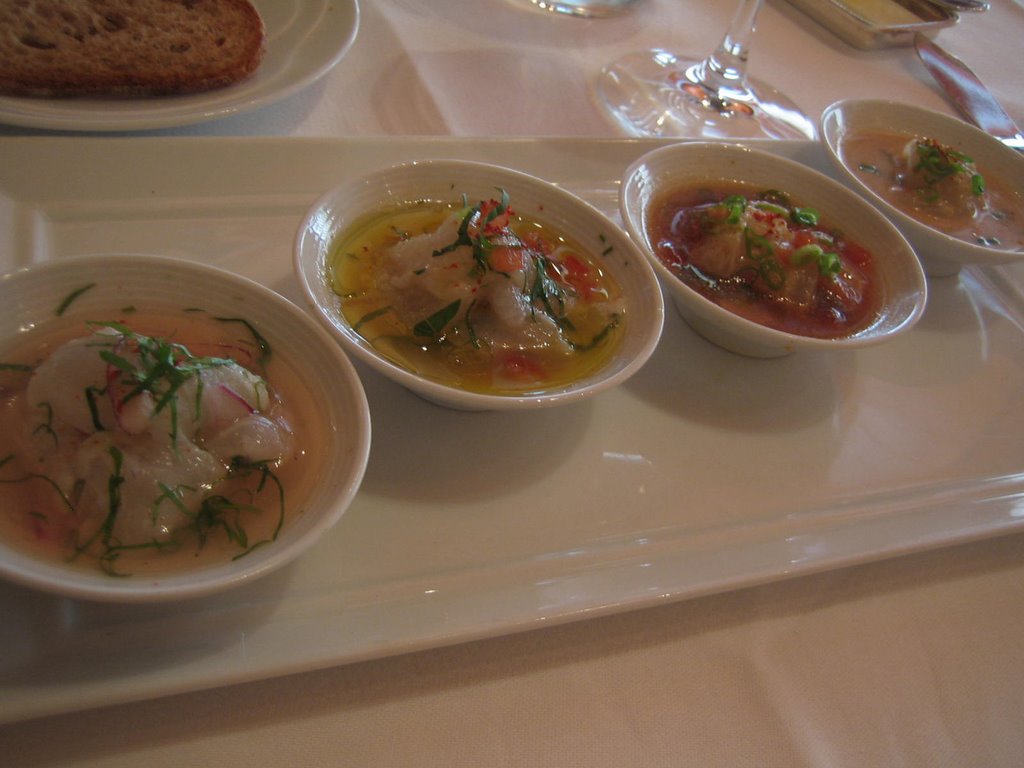 For my first course I had a “Progressive Tasting of Marinated Fluke: Four Different Ceviches; from Simple to Complex Combination.” The idea is to begin with the ceviche cup on the left (the simplest) and work your way to the right (the most complex). Each preparation had the same basic ingredients and as you moved along in complexity there were simply more flavors added. One at a time, I took a bite of each, slowly chewing, concentration on my limited scent and power of temperature and texture to find flavor. Becca followed suit. The fluke, a white flatfish, was cool and soft.
After the first: “Citrus, right? Salt and pepper?” I asked, wondering how much I could actually discern using texture, body and muted scent to taste. I could taste the tang and detect the fruity scent when I breathed out.
She nodded. “Yes, definitely. Lime, I think,” she said, “It’s light, though. Mainly I just taste the fluke.”
The Second: “Olive oil,” I said, a bit more definitive in my assertion. I could feel the silkiness of the oil coating the fish, soft in my mouth
“I agree—it’s thicker, more flavor in the olive oil that calms the citrus.”
The Third: “I can taste more salt—and a bit of a bite, which makes me think there is something vinegary… something Asian inspired…” I said.
“Soy sauce, I think,” Becca said, taking another mouthful, “or something similar.”
“And then there’s that crunch,” I said, “The green—scallions?”
“Jalapeno…” Which would make sense of the lingering spice in the back of my throat. “And shallots perhaps.”
The Fourth: “In this one I don’t even need to put a bite in my mouth to know the basic addition – the white milkiness is either cream or… coconut milk,” I contemplated.
“Tastes like coconut milk,” Becca said. “Curry too.”
“I can’t taste the curry, but the color gives that away to me.” The visual aesthetic of the food, I realize more and more, plays a huge roll in what my I can detect in taste. The orange-red on the plate gives direction to my olfactory neurons; it gives my brain a hint in discerning and making sense of weak scent. I took another bite. “I can, actually, taste a bit of curry flavor lurking around when I breathe out slowly. It’s weak, but vaguely sweet with a spicy bite.”
The texture of the coconut milk was strikingly similar to that of olive oil, the hint of thick viscosity. That feeling in the mouth, coupled with the light nutty flavors, implies inherant deliciousness. There is something undeniably palatable about the texture of a fat.
I tasted Becca’s first course, a Warm Sea Urchin Custard; Shiso Julienne, and was struck by its light milky texture. A smattering of foam on top was a salty foil to the rich cream. When I exhaled, slowly, I could taste the urchin; it was a briny sea-filled breath.
For the second course Becca had the “Skate-Pork” – a Surf and Turf of Crispy Pork Belly and Skate Wing, Gingered Squash Mousseline and Brown Butter Flavored Jus. I don’t remember my reaction to that dish as much because this was the point where Gaudi entered the equation and my taste buds were overwhelmed.
My own main course was the Monkfish, “A Tribute to Gaudi,” – Pan Roasted Monkfish; Confit Peppers and Fiery “Patatas Bravas,” Chorizo-Albarino Emulsion. It was a beautiful dish—carefully arranged with a few well placed barrages of color—slightly asymmetrical and just fantastical enough to implicate the Spanish architect in its conception. I took a moment to digest with my eyes, before attempting on my
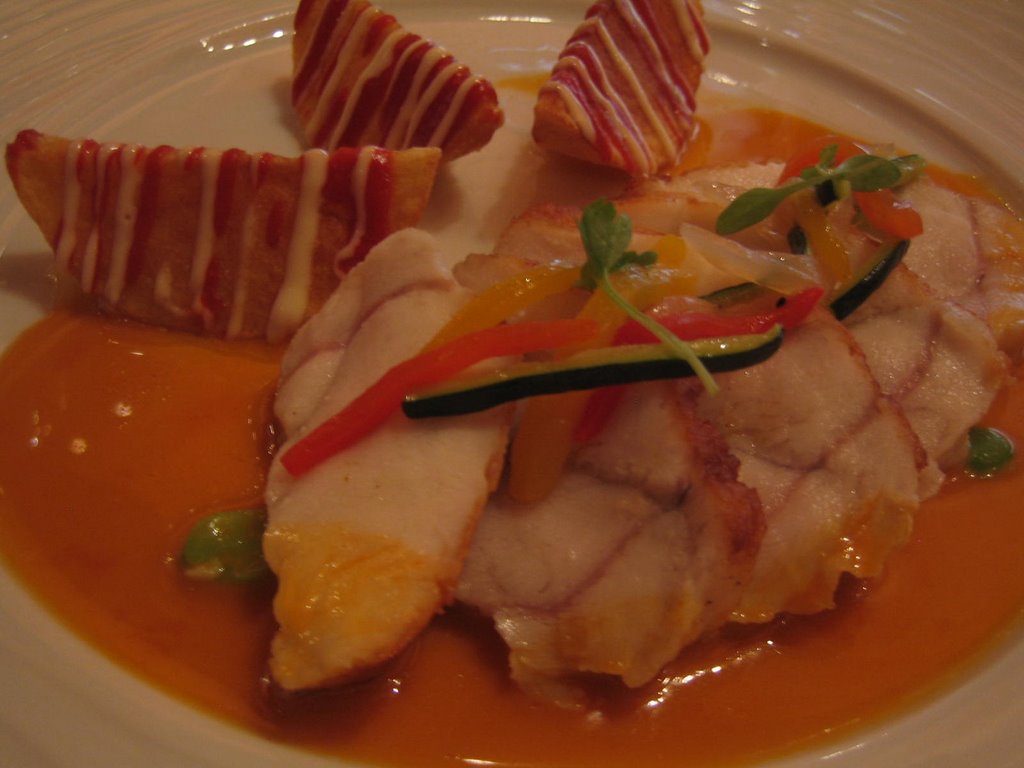 tongue.
What struck me the most in this dish was the texture of the monkfish—light and heavy simultaneously—smoothly flaking while dissolving softly in my mouth. The salt of the chorizo-albarino emulsion—a pale brown river running beneath the fish, complimented the sweet crunch of the pepper confit—a Gaudian swath of color pinnacled on the mountain of fish. The potatoes, three bronzed wedges angled on the side, were drizzled in white and red concentric lines of sauce—spicy and cool. It was a well balanced amalgamation of tastes, a flavor-tribute to Spain (I read somewhere that the Chef, Eric Ripert, spent part of his childhood in Barcelona). The nod to Gaudi in this dish would not have meant so much had I not already held a good deal of memory-infused value for his influence. And yet again while eating, I was acutely aware of all around me, all that went into me. I felt like I was tasting, both intuitively and intellectually, for the first time since the accident. Each taste was more vibrant and tangible than I had remembered possible. I think that had part to do with Becca’s comfortable presence and understanding, the high caliber and interest of the food itself, of course. But who knows, perhaps Gaudi’s presence infused within the meal gave me a subconscious but palpably heightened awareness of flavor.
For dessert I had the “Strawberry”: Strawberry, Mango, and Basil ‘Ice Cream Sandwich’ and Organic Strawberry Juice—sweet and cold between the fresh crunch of strawberry meringue. Becca’s “Chocolate-Cashew”: Dark Chocolate, Cashew and Caramel Tart, Red Wine Reduction, Banana, and Malted Rum Milk Chocolate Ice Cream was thick and understated in its sweetness. The only thing we did not like the entire afternoon was Becca’s ice cream; we aren’t malted rum sorts of people, really.
The waiter then brought us a white napkin filled with piping hot mini cookies; I could smell their sweetness. They tasted warm.
And then, surprised, small white vaulted cups were place before us. In each was an egg shell, open on top. “From the kitchen,” the waiter said with a smile. Inside the egg was a delicately balanced milk chocolate pot de crème, caramel foam, maple syrup with a smattering of Malden sea salt sprinkled on top.
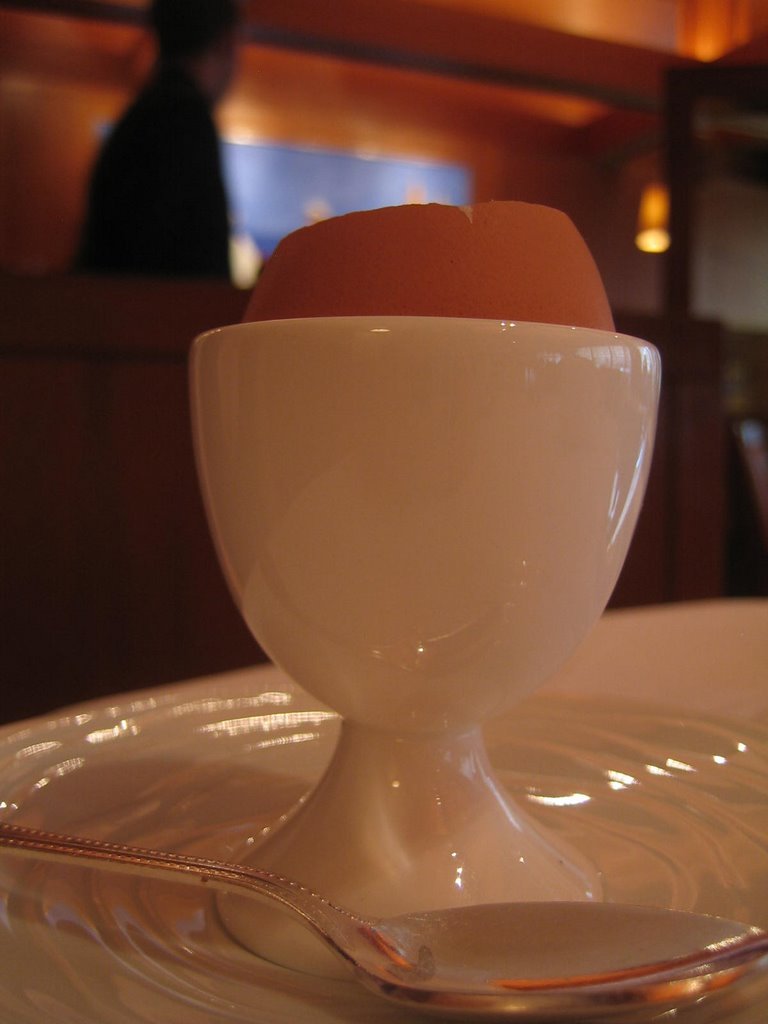
“I saw Michael Laiskonis, the pastry chef here, on Iron Chef America,” Becca said excitedly. “For the coconut and chocolate battle he made this! Well, with coconut, but still, everyone loved it! Especially Jeffrey Steingarten, one of the judges that night. I remember so clearly, because he made me laugh when he said the only thing he would change about this dessert would be to put it in an ostrich rather than a chicken egg….”
It was a wonderful combination of salty and sweet (of which I am already an unabashed fan). I would certainly have eaten an ostrich egg full.
We left Le Bernardin a bit giddy from the rich food and unaccustomed glass of afternoon wine and went for a walk in the park. A warm breeze tousled my loose hair and I could (almost) smell the scent of summer hanging in the air.
Sunday, June 25, 2006
Pickle People
This afternoon my apartment-mate Jon and I left the haze of a quiet Sunday at home to go on a very important journey. We emerged from the subway in the wilds of lower Manhattan and walked a few blocks over to Essex Street, constantly speckled with rain despite a bright sun peaking out from behind the clouds. We made a beeline for the pair of weathered,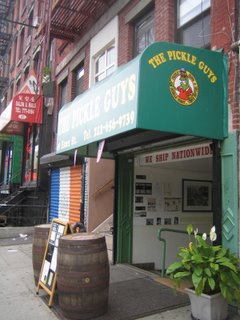 wooden barrels we could see perched outside on the sidewalk. They were in front of a bright green awning, emblazoned with yellow block-letters: The Pickle Guys.
We were on a quest for pickles. And we were in the right place.
Walking into the small open store room I was immediately hit with the briny, savory scent.
Can you smell that? Jon asked, laughing a little at my dumbstruck face.
My God can I ever. I was surprised with the intensity of the vinegar and garlic registering with my olfactory neurons. I could practically taste the odor, just standing one step in the store.
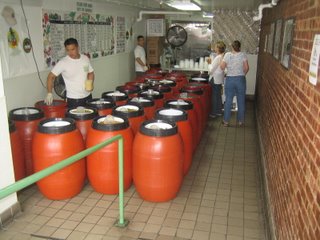 The Pickle Guys have one room, filled with uniform orange barrels and laden with pickled things. Pickled everything. The pickles themselves (new, sour, hot) were a range of greens – from vibrant spring to muddy earth. The pickled tomatoes floated nearby in their vinegary baths – small oval boats of red and green. Barrels of olives (green, greek, kalamata, stuffed with garlic or jalapeno), peppers (jalapeno, pepperoncini, cherry and sweet), soft white mushrooms and transparent pickled celery, vats of sour kraut and horseradish filled the room.
Jon and I have similar taste buds. We share a passion for mustard, ginger, pickles. Between the two of us (and I'm talking solely in the last seven days) there have been four batches of beets roasted in our kitchen’s oven. And this was a week in which the thermometer never seemed to dip below 90. How lucky that we understand each other’s culinary insanity. And can bond over trips to the pickle mecca of New York City.
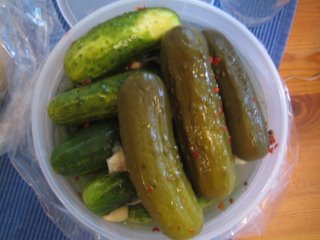
The jovial pickle man lording over the barrels at The Pickle Guys gave each Jon and me a sample s our pickle to eat as we waited for him to load up our half gallon bucket with an assortment of pickle varieties. It was crunchy with a perfect sour bite.
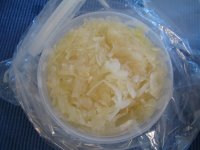
After a quick stop at a nearby kitchen supply store we made our way back to Brooklyn – Jon carrying the load of pickles and (smaller) container of sour kraut, me with a newly purchased muffin pan (which I desperately needed, of course).
This evening pickles were consumed. Beets, too. Perhaps a freshly baked muffin thrown in on the side. And we now have an official The Pickle Guys business flier hanging on our fridge. Looking it over we saw announced, in bold type, that the store is under the Rabbinical Supervision of Rabbi Shmuel Fishelis and now Jon is perhaps contemplating a career change. Because if one result of rabbinical school is the responsibility of overseeing pickle production, how great would that be?
 wooden barrels we could see perched outside on the sidewalk. They were in front of a bright green awning, emblazoned with yellow block-letters: The Pickle Guys.
We were on a quest for pickles. And we were in the right place.
Walking into the small open store room I was immediately hit with the briny, savory scent.
Can you smell that? Jon asked, laughing a little at my dumbstruck face.
My God can I ever. I was surprised with the intensity of the vinegar and garlic registering with my olfactory neurons. I could practically taste the odor, just standing one step in the store.
 The Pickle Guys have one room, filled with uniform orange barrels and laden with pickled things. Pickled everything. The pickles themselves (new, sour, hot) were a range of greens – from vibrant spring to muddy earth. The pickled tomatoes floated nearby in their vinegary baths – small oval boats of red and green. Barrels of olives (green, greek, kalamata, stuffed with garlic or jalapeno), peppers (jalapeno, pepperoncini, cherry and sweet), soft white mushrooms and transparent pickled celery, vats of sour kraut and horseradish filled the room.
Jon and I have similar taste buds. We share a passion for mustard, ginger, pickles. Between the two of us (and I'm talking solely in the last seven days) there have been four batches of beets roasted in our kitchen’s oven. And this was a week in which the thermometer never seemed to dip below 90. How lucky that we understand each other’s culinary insanity. And can bond over trips to the pickle mecca of New York City.
The jovial pickle man lording over the barrels at The Pickle Guys gave each Jon and me a sample s
 our pickle to eat as we waited for him to load up our half gallon bucket with an assortment of pickle varieties. It was crunchy with a perfect sour bite.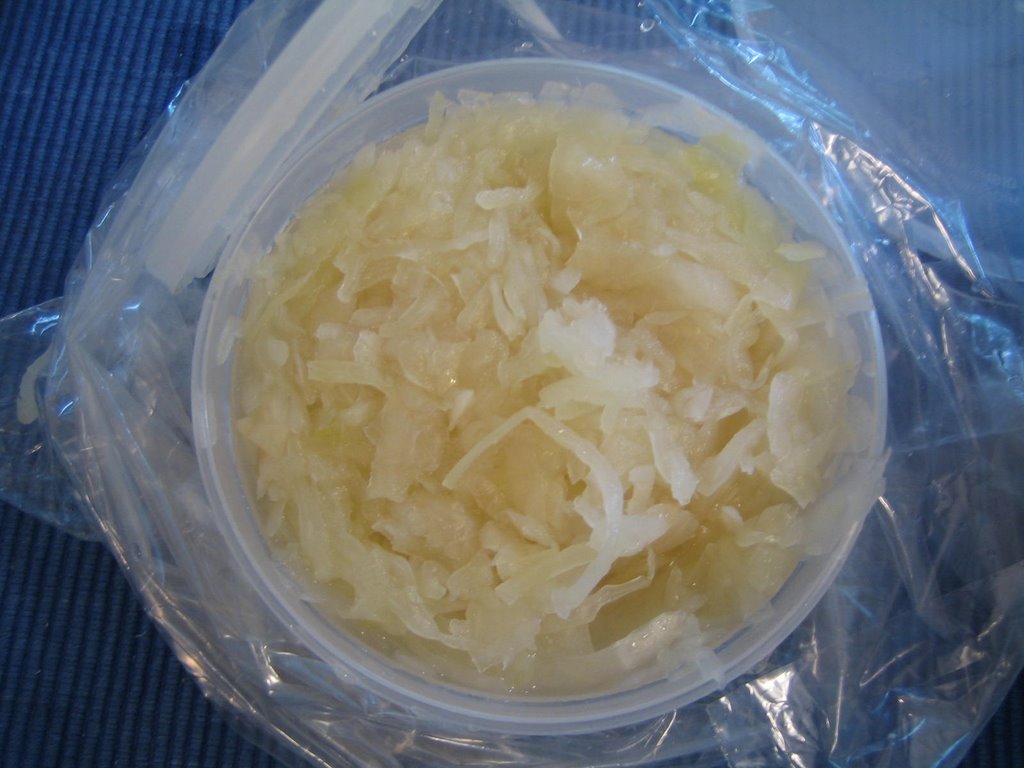
After a quick stop at a nearby kitchen supply store we made our way back to Brooklyn – Jon carrying the load of pickles and (smaller) container of sour kraut, me with a newly purchased muffin pan (which I desperately needed, of course).
This evening pickles were consumed. Beets, too. Perhaps a freshly baked muffin thrown in on the side. And we now have an official The Pickle Guys business flier hanging on our fridge. Looking it over we saw announced, in bold type, that the store is under the Rabbinical Supervision of Rabbi Shmuel Fishelis and now Jon is perhaps contemplating a career change. Because if one result of rabbinical school is the responsibility of overseeing pickle production, how great would that be?
The Pickle Guys
49 Essex Street
New York, NY 10002
(212) 656-9739
[they ship across the country]
[and, on a side note, in this post of around 500 words, I used "pickle" 19 times; pretty impressive.]
49 Essex Street
New York, NY 10002
(212) 656-9739
[they ship across the country]
[and, on a side note, in this post of around 500 words, I used "pickle" 19 times; pretty impressive.]
Sunday, June 18, 2006
The Return of Many Things...
I've been a monstrously infrequent blog writer as of late.
I’ve been sidetracked – by my move to New York, the start of a new job and, most recently, a week-long visit from Becca, all the way from Virginia. I’ve also been sidetracked (to a larger extent than I think even I knew) by my odorless state - that unassuming and constant olfactory nothingness has weighed on my mind. I've kept my love of food throughout my recovery, but have been obviously distracted in my pursuit of the culinary, so easy to shy away from without the full physical ability to taste. I've also realized that a result of stressful transitions in my life (going to college, moving to New York) is a temporarily odd reconfiguration of my appetite. My first week at Brown, for example, I had a strange and all-consuming affinity for white rice and mustard. (Weird, I know.) My first week here in the city consisted of plain burnt toast. And stress coupled with lack of smell has definitely caused me to shy away from the culinary (writing and eating) without even fully realizing it.
Luckily those days are over.
Scents have been constantly, noticeably creeping back into my olfactory consciousness. (Last night while concocting one of my favorite quinoa salads I could hardly concentrate on a story my roommate was telling; I was too enveloped in the smell of cilantro to listen, so strong and pungent to me that I could barely believe it has been almost a year since I last experienced its cool aroma.) (In fact even as I sit here now, at the computer in the tepid 90 degree summer smog of my third-floor apartment, I smell cilantro. Just thinking about last night’s smell-return brings the scent vividly back to my nose.) These vividly regained scents have rejuvenated my love of and involvement in culinary.
A month or so ago, also, I spent an intense week grappling with the direction I want to go professionally. Culinary or writing? I was offered a position as a server at Thomas Keller’s Per Se after spending an evening observing the kitchen and dining room. I can’t write much about that experience (confidentiality agreements…alas), but the temptation of spending my time in a kitchen of such jaw-dropping culinary genius and a restaurant of such beautifully choreographed eating was extremely hard to pass by. I could have, obviously, learned a lot about food there. Just in that one night I learned a great deal. But as I watched Chef Benno at work, graceful and precise, awash with the delicate color of dishes plated so artistically in front of me, I realized that as a permanent fixture at Per Se I would feel a constant sense of loss. It is an all-consuming, intense environment and I would be continually aware of the unattainable. I could see the food, but I could not wholly understand it. Not now, anyway. Instead of carting around a thick cloud of ‘what could be’ I decided to take a step back and move in a different professional direction. One involving writing, of course. More specifically - in the realm of magazine publication. For now.
And what I've found since is that the decision not to follow the official culinary route seems to have given me some kind of mental permission to enjoy food all over again. A rejuvenated sense of culinary enthusiasm. I guess it makes sense, but it has certainly surprised me. And came in perfect timing for Becca’s week-long visit. Becca shares my passion for food in a way no one else I know does and her visit was an intense, beautiful eating-fest. One that my stomach and I are still recovering from.
Before I had even decided to move here, Becca and I had already concocted a gutsy list of things and places we would eat together in the city. (We also have an ongoing list of over 100 different kinds of muffins we will create for our future joint muffin shop. Peppermint muffin? Lemon champagne? Brioche muffin with a foie gras mousse center? The mystifying golden vodka muffin? This preemptive New York eating list is not that strange in the history of our culinary tabulations.)
We did a pretty good job of hitting up the big names on our list – way too well to fully write up for one already prolific post. Just thinking of all the eating to mention is giving me a food-coma relapse. There was an evening exploring soup-dumplings in Chinatown, pizza at Otto and wine in Bryant Park, tapas (and a table next to David Lieberman) at Tia Pol, thai food, peanut butter cookies and coffee dates, biscotti and monkey cake at Amy’s Bread. We even ran into Rachael Ray and Thomas Keller at the Bouchon Bakery in Columbus Circle. The crowning moment, on which a post is soon to come, was lunch at Le Bernardin.
And on one morning while we sat at my kitchen table watching the Today Show (delightfully free of work til 2) I asked, “So what shall we do today?”
Becca looked at me, eyebrows askance.
“What I mean to say,” I quickly reworded, “is what do you want to eat today?”
She smiled and nodded emphatically: “Cupcakes.”

We operate on the same page.
After a morning of poking around the west village and participating in the (continuing) trend of averting my eyes as my bank account rapidly depletes itself ( thoughI did, on a side note, have to buy Bill Buford’s new book, Heat, about his experience in Mario Batali’s Babbo kitchen and beyond – I am seeing him talk this week; there was no choice…) we made our way to The Magnolia Bakery. Cupcakes from there have been first on our to-do list for quite some time. Perhaps that’s because of a certain TV show – but perhaps because, really, what can be happier than a fluffy, sprinkled little tower of cake?
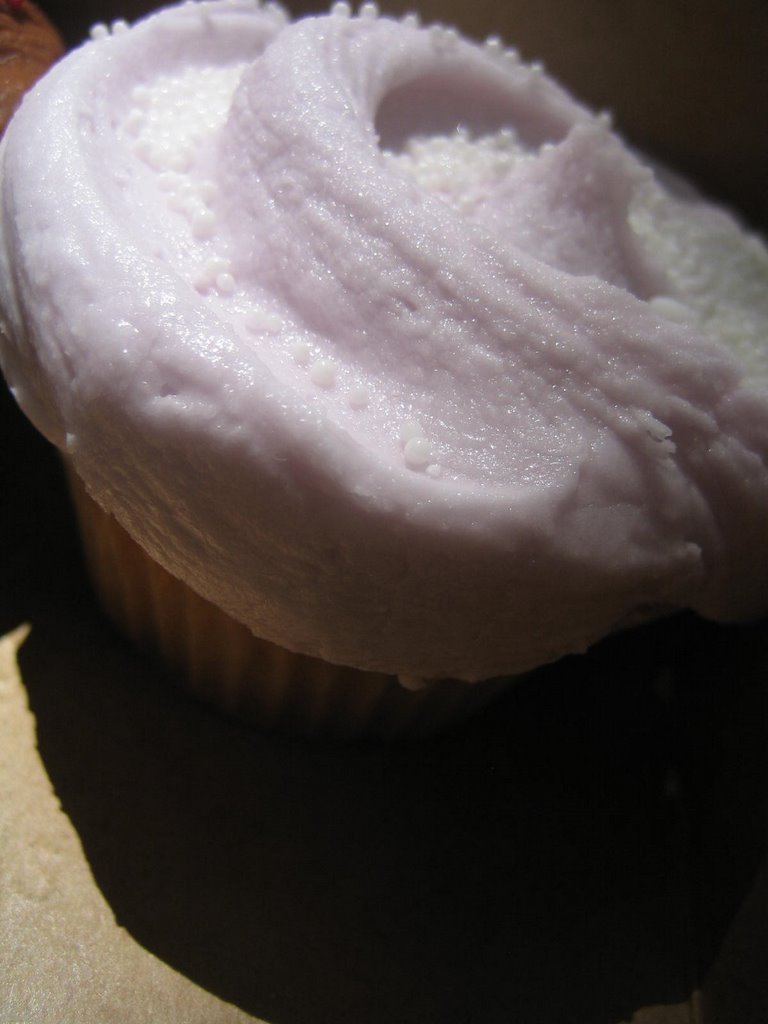
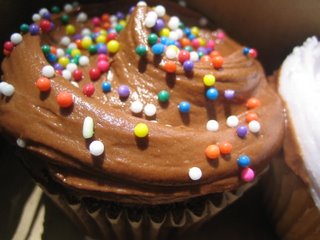 We brought them to Washington Square Park and ate as we watched as a phalanx of tiny dogs chased each other around their owners’ legs in the nearby dog park. The vanilla cupcake was soft and simultaneously dry. But combined with the thick creaminess of the light-purple butter frosting it was textural heaven. The chocolate one was too moist for me – too liquid in its overwhelming chocolaty-ness. Strange, I know. Perhaps it was a result of the stifling heat wave that has been surrounding us, melting everything in its path. But Becca didn’t have the same problem with the chocolate, so who knows. In conclusion, cupcakes are a relaxing way to spend an afternoon. They certainly made the traipse to my office, soon after, much more bearable.
This week-long festival of eating with Becca was a fitting way to celebrate my partial return to smell and the full revival of culinary-love. The words mmmmm and delicious were probably the most commonly used between the two of us. Well, perhaps a garbled oh-my-god-I’m-so-full and the mumbled I-think-I’m-in-a-food-coma could also be thrown in the mix. It was also the first time I ate while seriously attempting to use all my senses but smell, in an intellectual manner and far away from sadness or loss. It was a week reinforcing the fact that Becca is a wonderful partner in taste and friendship alike. And a week that has provided fodder for a good deal of blog writing.
I’ve been sidetracked – by my move to New York, the start of a new job and, most recently, a week-long visit from Becca, all the way from Virginia. I’ve also been sidetracked (to a larger extent than I think even I knew) by my odorless state - that unassuming and constant olfactory nothingness has weighed on my mind. I've kept my love of food throughout my recovery, but have been obviously distracted in my pursuit of the culinary, so easy to shy away from without the full physical ability to taste. I've also realized that a result of stressful transitions in my life (going to college, moving to New York) is a temporarily odd reconfiguration of my appetite. My first week at Brown, for example, I had a strange and all-consuming affinity for white rice and mustard. (Weird, I know.) My first week here in the city consisted of plain burnt toast. And stress coupled with lack of smell has definitely caused me to shy away from the culinary (writing and eating) without even fully realizing it.
Luckily those days are over.
Scents have been constantly, noticeably creeping back into my olfactory consciousness. (Last night while concocting one of my favorite quinoa salads I could hardly concentrate on a story my roommate was telling; I was too enveloped in the smell of cilantro to listen, so strong and pungent to me that I could barely believe it has been almost a year since I last experienced its cool aroma.) (In fact even as I sit here now, at the computer in the tepid 90 degree summer smog of my third-floor apartment, I smell cilantro. Just thinking about last night’s smell-return brings the scent vividly back to my nose.) These vividly regained scents have rejuvenated my love of and involvement in culinary.
A month or so ago, also, I spent an intense week grappling with the direction I want to go professionally. Culinary or writing? I was offered a position as a server at Thomas Keller’s Per Se after spending an evening observing the kitchen and dining room. I can’t write much about that experience (confidentiality agreements…alas), but the temptation of spending my time in a kitchen of such jaw-dropping culinary genius and a restaurant of such beautifully choreographed eating was extremely hard to pass by. I could have, obviously, learned a lot about food there. Just in that one night I learned a great deal. But as I watched Chef Benno at work, graceful and precise, awash with the delicate color of dishes plated so artistically in front of me, I realized that as a permanent fixture at Per Se I would feel a constant sense of loss. It is an all-consuming, intense environment and I would be continually aware of the unattainable. I could see the food, but I could not wholly understand it. Not now, anyway. Instead of carting around a thick cloud of ‘what could be’ I decided to take a step back and move in a different professional direction. One involving writing, of course. More specifically - in the realm of magazine publication. For now.
And what I've found since is that the decision not to follow the official culinary route seems to have given me some kind of mental permission to enjoy food all over again. A rejuvenated sense of culinary enthusiasm. I guess it makes sense, but it has certainly surprised me. And came in perfect timing for Becca’s week-long visit. Becca shares my passion for food in a way no one else I know does and her visit was an intense, beautiful eating-fest. One that my stomach and I are still recovering from.
Before I had even decided to move here, Becca and I had already concocted a gutsy list of things and places we would eat together in the city. (We also have an ongoing list of over 100 different kinds of muffins we will create for our future joint muffin shop. Peppermint muffin? Lemon champagne? Brioche muffin with a foie gras mousse center? The mystifying golden vodka muffin? This preemptive New York eating list is not that strange in the history of our culinary tabulations.)
We did a pretty good job of hitting up the big names on our list – way too well to fully write up for one already prolific post. Just thinking of all the eating to mention is giving me a food-coma relapse. There was an evening exploring soup-dumplings in Chinatown, pizza at Otto and wine in Bryant Park, tapas (and a table next to David Lieberman) at Tia Pol, thai food, peanut butter cookies and coffee dates, biscotti and monkey cake at Amy’s Bread. We even ran into Rachael Ray and Thomas Keller at the Bouchon Bakery in Columbus Circle. The crowning moment, on which a post is soon to come, was lunch at Le Bernardin.
And on one morning while we sat at my kitchen table watching the Today Show (delightfully free of work til 2) I asked, “So what shall we do today?”
Becca looked at me, eyebrows askance.
“What I mean to say,” I quickly reworded, “is what do you want to eat today?”
She smiled and nodded emphatically: “Cupcakes.”
We operate on the same page.
After a morning of poking around the west village and participating in the (continuing) trend of averting my eyes as my bank account rapidly depletes itself ( thoughI did, on a side note, have to buy Bill Buford’s new book, Heat, about his experience in Mario Batali’s Babbo kitchen and beyond – I am seeing him talk this week; there was no choice…) we made our way to The Magnolia Bakery. Cupcakes from there have been first on our to-do list for quite some time. Perhaps that’s because of a certain TV show – but perhaps because, really, what can be happier than a fluffy, sprinkled little tower of cake?
 We brought them to Washington Square Park and ate as we watched as a phalanx of tiny dogs chased each other around their owners’ legs in the nearby dog park. The vanilla cupcake was soft and simultaneously dry. But combined with the thick creaminess of the light-purple butter frosting it was textural heaven. The chocolate one was too moist for me – too liquid in its overwhelming chocolaty-ness. Strange, I know. Perhaps it was a result of the stifling heat wave that has been surrounding us, melting everything in its path. But Becca didn’t have the same problem with the chocolate, so who knows. In conclusion, cupcakes are a relaxing way to spend an afternoon. They certainly made the traipse to my office, soon after, much more bearable.
This week-long festival of eating with Becca was a fitting way to celebrate my partial return to smell and the full revival of culinary-love. The words mmmmm and delicious were probably the most commonly used between the two of us. Well, perhaps a garbled oh-my-god-I’m-so-full and the mumbled I-think-I’m-in-a-food-coma could also be thrown in the mix. It was also the first time I ate while seriously attempting to use all my senses but smell, in an intellectual manner and far away from sadness or loss. It was a week reinforcing the fact that Becca is a wonderful partner in taste and friendship alike. And a week that has provided fodder for a good deal of blog writing.
Saturday, May 27, 2006
a pizza experience
Late last October my Mom and her fiancé, Charley, took me out to dinner. We went to Caffé Umbra, a fun little restaurant in the South End of Boston. It was not even two months after being hit by the car; I was dependent on crutches and a bulky knee brace and only just lucid enough, post-skull-fracture, to comprehend the significance of my injuries.
I remember feeling extremely nervous. My heart fluttered as we drove together to the restaurant. It was the first time I had done something “normal” – the first time I had ventured out into a public, social situation while injured. I was afraid that people would stare at me; I was terrified of attention. I was scared that being in a restaurant would make me sad, truly hammering in the consequences of my loss of smell. I was afraid of entering the familiar culinary environment and suddenly seeing how quantifiable the post-accident changes truly were.
Charley let my mom and me out on the sidewalk in front of the restaurant before he parked. One glance at the small, dimly lit bustle of the dining room made my stomach sink in apprehension. The tables were close together; walking with crutches would be difficult. There were lots of young professionals, fancied up in suits and dresses and sipping drinks at the bar, independent and healthy. Though shy in high school and perhaps (quite) awkward in junior high, I have not had any problems with confidence or social comfort in a long while. But hobbling through the dining room that night, my mom’s hand constantly hovering at my back, the hostess having just helped me climb out of my jacket while I balanced precariously on one leg, I could feel my self-conscious teenage angst creeping steadily out of my ears. No one really looked at me. Even if they had been, there was truly nothing to be embarrassed about. Being young and on crutches is a common occurrence. My cheeks were burning none the less.
But then we sat, my crutches nestled inconspicuously in a nearby corner. My mom and I faced Charley, our backs to the wall, with a full view of the crowded restaurant. The air was peppered with laughter, low tones of deep conversation, loud greetings and the whispered clink of forks and knives. Pomegranate martinis were placed in front of my mom and me, bright purple. I began to feel more comfortable. Charley, would of course never drink something so girlishly colorful, and his glass of Chianti tapped our sweet drinks as we smiled, cheers, happy that we could finally all be out of the house together.
I don’t remember what we ate. I can only recall the vague taste of martini -- like sugar water with a tang, any sort of nuance lost in those early stages of my olfactory regrowth. But the food itself wasn’t the important part. As we sat and talked, eating and drinking our way through a few hours of the evening, my awkward self-consciousness melted away. Perhaps because of the strength of thesaid martinis, yes. But also because, after those few initially awkward moments, I was finally able to look beyond my fear of injury and change. And I remembered that I love all things culinary for a reason -- a reason beyond the subtleties of flavor. Beyond qualifications of the chef and quality of ingredients. Food brings people together – the obvious happiness of those in the restaurant, patrons leaning cheerfully over their plates, sharing bites, laughing into delicate glasses of wine. People dressed nicely, together, bonding over the shared experience of a meal. I had fun for the first time in months that night. My mouth muscles, the ones used for smiling, reasserted themselves back into my physical repertoire.
Recently I’ve been sad about my less-than-full ability to taste. I’m at a plateau, recovery-wise. Completely healed, it is only the lack of smell that lingers in this tumultuous year of change. I’ve been struggling with what I want to be doing with myself and my writing. I’m in a rather constant state of confusion. But I’ve realized that the confusion may not dissipate for a while. And in coming to terms with that, I am now more fully aware of the other things, many other things, that there are to concentrate on. I’ve been happily reminding myself, now that I’m feeling more settled in my new home, why I love the culinary. Taste was a part of my kitchen-love, of course. But certainly not the only part. It’s a matter of exploration and fun. The way food brings us together and inspires universal pleasure.
For example, one night this week my friend Colin and I took a romp from our Park Slope stomping grounds deeper into the realm of Brooklyn. We were on a quest for pizza. The best pizza. Di Fara’s Pizza. And fresh off the Avenue J stop off the Q train, I found myself turning in circles searching for some visual confirmation of the well-lauded pizzeria. Perhaps I expected some kind of spotlight, bright neon sign – fireworks? Singing elves? Something to loudly advertise the amount of wonderful hype I’ve been hearing about this little nook-ish restaurant. I saw only a calm, quiet neighborhood; there was nothing out of the ordinary. I was ready to pull out all my pizza-radar equipment (though, in reality what that involves I have no idea – maybe some kind of magic wand slash scuba diving mask) – when I noticed Colin staring at me, eyebrows raised.
“It’s right here, Molly.”
“Oh. Right.” I looked up, right in front of us, and saw the simple faded sign. Di Fara’s Pizza.
Di Fara’s is contained in a small, bright little room – a tall counter separates the few tables from the oven area. Domenico DeMarco, a slight, older man with gray hair and a green plaid button-down shirt, lorded unassumingly over the pizza dough and the ovens. He wore an apron and exuded an aura of calm. His slow movements were deliberate, delicate and perfectly executed. A light rhythm of guitar chimed in the background, twinkling of old school Italian. The walls were covered with articles about his pizza.
Colin and I watched Mr. DeMarco work (after ordering our cheese pie) as we sat at a small corner table. One pizza at a time; there is nothing fast involved in this food. It deliciously slow. Colin and I had stopped by a neighboring convenience store and had crisp, cold beers to entertain us as we waited. Still in their paper bags, we drank them with straws (Yes the straws were a strange twist, I know. But somehow that straw turned it into the perfect pizza-beer. More perfect than a normal pizza-beer. Don’t ask questions, just believe me.)

Our pizza came to us, an hour later, piping hot, thin crusted with twinges of burnt crispiness on the edges. Bubbling melted mozzarella di bufala over the thick red sauce (homemade multiple times daily, I hear). We watched – Colin practically clapping his hands, seal-like, in pizza-glee – as Mr. DeMarco drizzled olive oil and carefully snipped the leaves off a fresh bunch of basil over the pie, finishing it off with a smattering of hand-ground Grana Padano cheese to sprinkle over. We ate until it felt like death was knocking at the door – the pizza slices fairly melted down my throat. The Di Fara pain is a good one though. As pleasant as an over-eating pain could possibly be.
It’s true that I can’t taste every aspect of this pizza (or any food) fully and completely without smell. But that isn’t the draw of this experience, even. It is the feeling of a lovingly made pizza practically dancing in your mouth, soft and crunchy, salty and sweet. It is the olive oil dribbling down the corner of your mouth (“Now that’s cute, Molly,” said Colin, “beer with a straw and oil dripping down your chin. Classy.”) It’s the adventure of a new neighborhood, new food and new friends.
We slunched ourselves, full to the brim, to the subway for our ride back home. [‘Slunched’ isn’t a word, I know; but I do feel it accurately portrays our state of being at that moment. You can’t just ‘slump’ if you are that full.] Colin was cold, an unusual occurrence for him, and I made the astute observation that all the blood generally keeping him warm was in his belly, working on the pizza. I suppose that if instead of on the subway on a warm spring night we were somewhere out in the unprotected open wilderness in the middle of winter for a long time, this pizza-induced-cold might have been dangerous. But what I really think is that the human body does have its priorities straight. If I had to choose between basic body function (such as temperature control) and an evening of Di Fara’s pizza – I would probably choose pizza. That’s why they invented the jacket.
I remember feeling extremely nervous. My heart fluttered as we drove together to the restaurant. It was the first time I had done something “normal” – the first time I had ventured out into a public, social situation while injured. I was afraid that people would stare at me; I was terrified of attention. I was scared that being in a restaurant would make me sad, truly hammering in the consequences of my loss of smell. I was afraid of entering the familiar culinary environment and suddenly seeing how quantifiable the post-accident changes truly were.
Charley let my mom and me out on the sidewalk in front of the restaurant before he parked. One glance at the small, dimly lit bustle of the dining room made my stomach sink in apprehension. The tables were close together; walking with crutches would be difficult. There were lots of young professionals, fancied up in suits and dresses and sipping drinks at the bar, independent and healthy. Though shy in high school and perhaps (quite) awkward in junior high, I have not had any problems with confidence or social comfort in a long while. But hobbling through the dining room that night, my mom’s hand constantly hovering at my back, the hostess having just helped me climb out of my jacket while I balanced precariously on one leg, I could feel my self-conscious teenage angst creeping steadily out of my ears. No one really looked at me. Even if they had been, there was truly nothing to be embarrassed about. Being young and on crutches is a common occurrence. My cheeks were burning none the less.
But then we sat, my crutches nestled inconspicuously in a nearby corner. My mom and I faced Charley, our backs to the wall, with a full view of the crowded restaurant. The air was peppered with laughter, low tones of deep conversation, loud greetings and the whispered clink of forks and knives. Pomegranate martinis were placed in front of my mom and me, bright purple. I began to feel more comfortable. Charley, would of course never drink something so girlishly colorful, and his glass of Chianti tapped our sweet drinks as we smiled, cheers, happy that we could finally all be out of the house together.
I don’t remember what we ate. I can only recall the vague taste of martini -- like sugar water with a tang, any sort of nuance lost in those early stages of my olfactory regrowth. But the food itself wasn’t the important part. As we sat and talked, eating and drinking our way through a few hours of the evening, my awkward self-consciousness melted away. Perhaps because of the strength of thesaid martinis, yes. But also because, after those few initially awkward moments, I was finally able to look beyond my fear of injury and change. And I remembered that I love all things culinary for a reason -- a reason beyond the subtleties of flavor. Beyond qualifications of the chef and quality of ingredients. Food brings people together – the obvious happiness of those in the restaurant, patrons leaning cheerfully over their plates, sharing bites, laughing into delicate glasses of wine. People dressed nicely, together, bonding over the shared experience of a meal. I had fun for the first time in months that night. My mouth muscles, the ones used for smiling, reasserted themselves back into my physical repertoire.
Recently I’ve been sad about my less-than-full ability to taste. I’m at a plateau, recovery-wise. Completely healed, it is only the lack of smell that lingers in this tumultuous year of change. I’ve been struggling with what I want to be doing with myself and my writing. I’m in a rather constant state of confusion. But I’ve realized that the confusion may not dissipate for a while. And in coming to terms with that, I am now more fully aware of the other things, many other things, that there are to concentrate on. I’ve been happily reminding myself, now that I’m feeling more settled in my new home, why I love the culinary. Taste was a part of my kitchen-love, of course. But certainly not the only part. It’s a matter of exploration and fun. The way food brings us together and inspires universal pleasure.
For example, one night this week my friend Colin and I took a romp from our Park Slope stomping grounds deeper into the realm of Brooklyn. We were on a quest for pizza. The best pizza. Di Fara’s Pizza. And fresh off the Avenue J stop off the Q train, I found myself turning in circles searching for some visual confirmation of the well-lauded pizzeria. Perhaps I expected some kind of spotlight, bright neon sign – fireworks? Singing elves? Something to loudly advertise the amount of wonderful hype I’ve been hearing about this little nook-ish restaurant. I saw only a calm, quiet neighborhood; there was nothing out of the ordinary. I was ready to pull out all my pizza-radar equipment (though, in reality what that involves I have no idea – maybe some kind of magic wand slash scuba diving mask) – when I noticed Colin staring at me, eyebrows raised.
“It’s right here, Molly.”
“Oh. Right.” I looked up, right in front of us, and saw the simple faded sign. Di Fara’s Pizza.
Di Fara’s is contained in a small, bright little room – a tall counter separates the few tables from the oven area. Domenico DeMarco, a slight, older man with gray hair and a green plaid button-down shirt, lorded unassumingly over the pizza dough and the ovens. He wore an apron and exuded an aura of calm. His slow movements were deliberate, delicate and perfectly executed. A light rhythm of guitar chimed in the background, twinkling of old school Italian. The walls were covered with articles about his pizza.
Colin and I watched Mr. DeMarco work (after ordering our cheese pie) as we sat at a small corner table. One pizza at a time; there is nothing fast involved in this food. It deliciously slow. Colin and I had stopped by a neighboring convenience store and had crisp, cold beers to entertain us as we waited. Still in their paper bags, we drank them with straws (Yes the straws were a strange twist, I know. But somehow that straw turned it into the perfect pizza-beer. More perfect than a normal pizza-beer. Don’t ask questions, just believe me.)
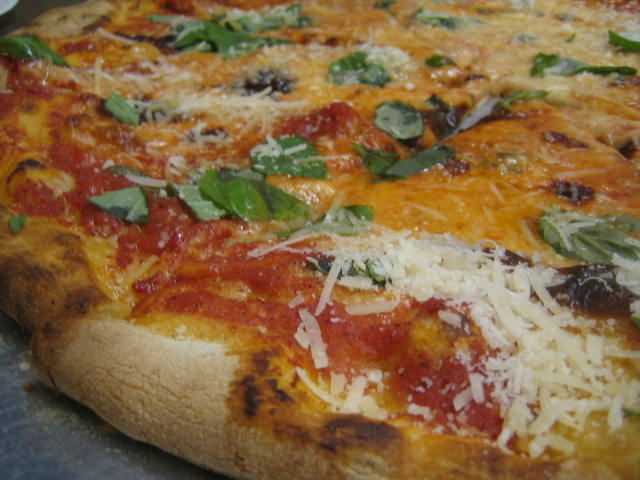
Our pizza came to us, an hour later, piping hot, thin crusted with twinges of burnt crispiness on the edges. Bubbling melted mozzarella di bufala over the thick red sauce (homemade multiple times daily, I hear). We watched – Colin practically clapping his hands, seal-like, in pizza-glee – as Mr. DeMarco drizzled olive oil and carefully snipped the leaves off a fresh bunch of basil over the pie, finishing it off with a smattering of hand-ground Grana Padano cheese to sprinkle over. We ate until it felt like death was knocking at the door – the pizza slices fairly melted down my throat. The Di Fara pain is a good one though. As pleasant as an over-eating pain could possibly be.
It’s true that I can’t taste every aspect of this pizza (or any food) fully and completely without smell. But that isn’t the draw of this experience, even. It is the feeling of a lovingly made pizza practically dancing in your mouth, soft and crunchy, salty and sweet. It is the olive oil dribbling down the corner of your mouth (“Now that’s cute, Molly,” said Colin, “beer with a straw and oil dripping down your chin. Classy.”) It’s the adventure of a new neighborhood, new food and new friends.
We slunched ourselves, full to the brim, to the subway for our ride back home. [‘Slunched’ isn’t a word, I know; but I do feel it accurately portrays our state of being at that moment. You can’t just ‘slump’ if you are that full.] Colin was cold, an unusual occurrence for him, and I made the astute observation that all the blood generally keeping him warm was in his belly, working on the pizza. I suppose that if instead of on the subway on a warm spring night we were somewhere out in the unprotected open wilderness in the middle of winter for a long time, this pizza-induced-cold might have been dangerous. But what I really think is that the human body does have its priorities straight. If I had to choose between basic body function (such as temperature control) and an evening of Di Fara’s pizza – I would probably choose pizza. That’s why they invented the jacket.
Friday, May 12, 2006
another beginning
It has been eight months since I lost my sense of smell.
There are certainly moments when I am positive it will never come back. My olfactory neurons seem to aggressively advertise their stagnant growth with silence.
I can clearly imagine myself at eighty-five, stooped and wrinkled, hair white as snow, baking cookies with my young granddaughter. Right before we take them out of the oven - golden brown, glistening pools of melted chocolate – I’ll lean towards the small girl and say in my creaky old voice, “When I was a little girl, about your age, the smell of baking cookies was my favorite. It always reminded me of Christmas; it smelled like school vacation. I can only imagine it now.” I will have a far-off, nostalgic gleam in my eye. And the little girl will just smile at me, confused, her batty old grandmother.
The fact that I actually do imagine myself (with vivid dexterity) as a gray-haired grandmother is slightly disturbing. So is my apparent penchant for wild exaggeration. Because the truth of the matter, when I take a small step back and view my sense of smell with a hint of reality, is that things are getting better. Slowly, almost so sluggishly it is impossible to tell if I am hallucinating.
I got a whiff of Spring the other day. I walked outside of my apartment building and most decidedly, concretely, could smell Spring. I couldn’t put my finger on any of the scent-details that were once so familiar - the freshly cut grass, perfumed budding flowers, a sweet warmth in the breeze – but I knew they were there, hiding under the inexperience of my regenerating olfactory neurons. The strength and depth of smell is not there; it was a simple baseline of Spring. But it was something, something concrete.
Beyond the distinctively sharp, recognizable scents I have had back for a while (chocolate, cinnamon, citrus, laundry, herbs, wine), I am now gaining a general sense of “scent.” Unknown and indescribable. But, I think, infinitely more hopeful. Even lacking the subtleties and nuance that give scent a name – there are smells, constantly. I find myself walking into a room and with a slam, my nose registers something. Something indefinable and weak. But it is something. I will say, confused, “What does it smell like in here?” And whomever I am with often looks equally confused, sniffing, and says ‘I don’t know… nothing much.”
I had almost forgotten that there is scent everywhere. It is easy to forget the universality and continuance of smell when you have it. The subtleties are so common they are literally unnoticeable. Every room, everywhere, has an individual smell. Temperature, too; warm has a smell, as well as cold and wet. Their baseline scents are different than their physical feeling. And the difficult thing for me at the moment is that I don’t have the words to describe them. They are registering in my nose with such a weak hum that it is more of a feeling, an idea, than a smell. But at the same time, I know that it is the beginning step to a full scent palate.
The only way I can describe these new delicate smell-ideas is to say that they make me feel alive. It is surprising how quickly I forgot that these universal scents ever existed, as I myself have existed in an odorless world. But the memory, however feeble the actual smells coming back, gives me the momentum to step out of black and white and into a world of color. Or at least sepia toned. Small steps, moving in the right direction. There are hints of a newfound vibrancy lurking everywhere.
***
On another note, it has been one year today since I began writing My Madeleine. The past year has been the most difficult and, simultaneously (the realization has been slowly dawning on me, though, I suppose that is another story in itself) the most beautiful of my life. I am very happy to have documented a great deal of the change here; the process of writing through it all has helped me in an infinite number of ways. So thank you, all, for reading.
There are certainly moments when I am positive it will never come back. My olfactory neurons seem to aggressively advertise their stagnant growth with silence.
I can clearly imagine myself at eighty-five, stooped and wrinkled, hair white as snow, baking cookies with my young granddaughter. Right before we take them out of the oven - golden brown, glistening pools of melted chocolate – I’ll lean towards the small girl and say in my creaky old voice, “When I was a little girl, about your age, the smell of baking cookies was my favorite. It always reminded me of Christmas; it smelled like school vacation. I can only imagine it now.” I will have a far-off, nostalgic gleam in my eye. And the little girl will just smile at me, confused, her batty old grandmother.
The fact that I actually do imagine myself (with vivid dexterity) as a gray-haired grandmother is slightly disturbing. So is my apparent penchant for wild exaggeration. Because the truth of the matter, when I take a small step back and view my sense of smell with a hint of reality, is that things are getting better. Slowly, almost so sluggishly it is impossible to tell if I am hallucinating.
I got a whiff of Spring the other day. I walked outside of my apartment building and most decidedly, concretely, could smell Spring. I couldn’t put my finger on any of the scent-details that were once so familiar - the freshly cut grass, perfumed budding flowers, a sweet warmth in the breeze – but I knew they were there, hiding under the inexperience of my regenerating olfactory neurons. The strength and depth of smell is not there; it was a simple baseline of Spring. But it was something, something concrete.
Beyond the distinctively sharp, recognizable scents I have had back for a while (chocolate, cinnamon, citrus, laundry, herbs, wine), I am now gaining a general sense of “scent.” Unknown and indescribable. But, I think, infinitely more hopeful. Even lacking the subtleties and nuance that give scent a name – there are smells, constantly. I find myself walking into a room and with a slam, my nose registers something. Something indefinable and weak. But it is something. I will say, confused, “What does it smell like in here?” And whomever I am with often looks equally confused, sniffing, and says ‘I don’t know… nothing much.”
I had almost forgotten that there is scent everywhere. It is easy to forget the universality and continuance of smell when you have it. The subtleties are so common they are literally unnoticeable. Every room, everywhere, has an individual smell. Temperature, too; warm has a smell, as well as cold and wet. Their baseline scents are different than their physical feeling. And the difficult thing for me at the moment is that I don’t have the words to describe them. They are registering in my nose with such a weak hum that it is more of a feeling, an idea, than a smell. But at the same time, I know that it is the beginning step to a full scent palate.
The only way I can describe these new delicate smell-ideas is to say that they make me feel alive. It is surprising how quickly I forgot that these universal scents ever existed, as I myself have existed in an odorless world. But the memory, however feeble the actual smells coming back, gives me the momentum to step out of black and white and into a world of color. Or at least sepia toned. Small steps, moving in the right direction. There are hints of a newfound vibrancy lurking everywhere.
***
On another note, it has been one year today since I began writing My Madeleine. The past year has been the most difficult and, simultaneously (the realization has been slowly dawning on me, though, I suppose that is another story in itself) the most beautiful of my life. I am very happy to have documented a great deal of the change here; the process of writing through it all has helped me in an infinite number of ways. So thank you, all, for reading.
Monday, May 01, 2006
a brief return to boston
On Thursday morning I lugged my huge suitcase down the two flights of stairs from my apartment to the sidewalk. With each lopsided step the suitcase bounced against my leg; it was a fight to keep from falling face first down the stairs. Coupled with the gigantic backpack I had somehow managed to stuff with every possible item under the sun (did I really need 6 different books for my four days in Boston?) my balance was widely off-kilter. Once on the ground I rolled the case behind me as I walked to the subway, leading like a tugboat of sorts, silently berating myself for agreeing to deliver this monstrous suitcase to my mother in Boston. She is going to London; she likes to pack a lot. By the time I awkwardly bounced myself down onto the F train, up the stairs at East Broadway, and down the few blocks of Canal Street to the friendly “Fung Wah Bus Station,” I was covered in sweat. After hectically throwing my money ($15.75; best deal ever) in the tiny glass window to get my ticket stub (handwritten on a scrap of paper) I lofted my suitcase (with a combination of arm raising, back bending and a few aggressive karate kicks) onto the luggage platform of the bus and collapsed into my seat, hot, sweaty and tired. I promptly fell asleep, wading through hazy dreams of subway trains somehow supplanted into the office of the magazine I am currently working for alongside some spinning cherry trees in full blossom, an old friend from elementary school and a series of shooting firecrackers launched from a rooftop. Strange dreams; I’ll blame it on the loads of allergy medication I need to take this time of year in order not to sneeze my nose off. I woke up when we reached South Station in Boston somewhat disoriented, but happy to be back, however briefly, in such a familiar land.
My mom and I walked to a local French bistro that night and had a glass of wine (or two) together while we ate fresh pea soup, vibrantly green with a pool of white crème fraiche in its center, grilled calamari and spicy chorizo. We talked about a lot of things: my new life in New York, hers continuing in Boston, future trips, plans, the excitement of my little (well not so little; 6’3 varsity lacrosse playing) brother spending the summer in NYC as well. And simply the strangeness of finding myself back in Boston, even if for only a few days, after my first two months in New York. I am beginning to feel comfortable in Brooklyn – like I live there and it may possibly one day be called ‘home’. In Boston it seems as if in every corner there lurks a ghost of my former, injured self. Driving to the grocery store there is a girl on crutches sitting in the passenger seat next to me; she winces whenever we go over a bump. Riding the T I brush hands with my shrunken self, the one wearing a large black knee brace, as we simultaneously grab the handrail. The kitchen reverberates with the sound of my cane and when I walk into my bedroom I leave behind a woman who is not able to climb the stairs to reach it. It’s amazing what only two months away can do to change your mindset. New York is good for me. It is wonderful, however, to be back at home for a weekend and see my family.
And Friday night I again took the helm of the kitchen and cooked dinner for my mom and her boyfriend Charley. I think they miss having an enthusiastic personal chef around the house; I certainly miss their standing mixer and Cuisinart (maybe them, too). I made a simple meal from the Balthazar Cookbook: mustard glazed salmon and earthy lentils, roasted asparagus with parmesan and a toasted vanilla pound cake with strawberries. It was very spring, fitting well alongside the yellow daffodils winking through the kitchen window. And comforting – to cook, to eat, to be back home, and to know how far I’ve come.
Mustard-Crusted Salmon
Adapted from the Balthazar Cookbook
6 salmon fillets
1 ½ tsp salt
½ tsp black pepper
¼ cup Dijon mustard
6 tsp dry bread crumbs
2 tbs vegetable oil
-preheat oven to 500
-season salmon with salt and pepper. On top, spread 2 tsp of mustard and a sprinkling of bread crumbs. Press the crumbs into the mustard with your fingers.
-heat oil in large sauté pan, when it begins to smoke, add the salmon, mustard side down and lower the flame to medium. Sear for 2 minutes, until there is a crust. Flip for one minute and then transfer the pan into the oven to finish cooking for 3 minutes.
-Plate on top of the lentils
Lentils:
Adapted from the Balthazar Cookbook
1 cup green lentils
2 slices diced bacon
4 sprigs thyme
½ medium onion, diced
1 minced garlic clove
1 tsp salt
2 tbs unsalted butter
1 medium carrot, diced
1 celery stalk, diced
¼ tsp white pepper.
-rinse the lentils in cold water and drain. Put them in a sauce pan with 4 cups of water and bring to a boil. Simmer for 20 minutes.
-meanwhile in another saucepan, sauté the bacon and thyme for two minutes. Add the garlic, onion and salt and sauté 5 minutes. Add butter, carrot, celery, white pepper and one cup of water and boil five minutes.
-drain lentils and then put them back in their pot. Add the vegetable mixture and simmer 10 minutes. Serve under the salmon.
Roasted Asparagus with Parmesan:
 Asparagus
Olive oil
Salt and pepper
Handful of parmesan cheese
-preheat oven to 500.
-toss asparagus with olive oil, salt and pepper.
-roast 7 – 10 minutes, until fork tender.
-throw the parmesan on top, while hot, and serve.
My mom and I walked to a local French bistro that night and had a glass of wine (or two) together while we ate fresh pea soup, vibrantly green with a pool of white crème fraiche in its center, grilled calamari and spicy chorizo. We talked about a lot of things: my new life in New York, hers continuing in Boston, future trips, plans, the excitement of my little (well not so little; 6’3 varsity lacrosse playing) brother spending the summer in NYC as well. And simply the strangeness of finding myself back in Boston, even if for only a few days, after my first two months in New York. I am beginning to feel comfortable in Brooklyn – like I live there and it may possibly one day be called ‘home’. In Boston it seems as if in every corner there lurks a ghost of my former, injured self. Driving to the grocery store there is a girl on crutches sitting in the passenger seat next to me; she winces whenever we go over a bump. Riding the T I brush hands with my shrunken self, the one wearing a large black knee brace, as we simultaneously grab the handrail. The kitchen reverberates with the sound of my cane and when I walk into my bedroom I leave behind a woman who is not able to climb the stairs to reach it. It’s amazing what only two months away can do to change your mindset. New York is good for me. It is wonderful, however, to be back at home for a weekend and see my family.
And Friday night I again took the helm of the kitchen and cooked dinner for my mom and her
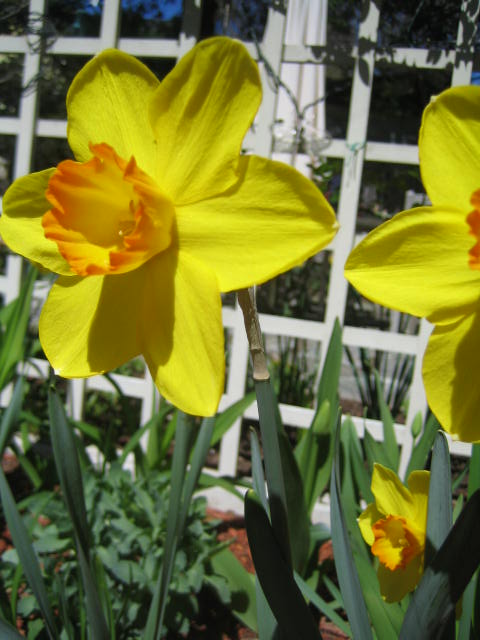 boyfriend Charley. I think they miss having an enthusiastic personal chef around the house; I certainly miss their standing mixer and Cuisinart (maybe them, too). I made a simple meal from the Balthazar Cookbook: mustard glazed salmon and earthy lentils, roasted asparagus with parmesan and a toasted vanilla pound cake with strawberries. It was very spring, fitting well alongside the yellow daffodils winking through the kitchen window. And comforting – to cook, to eat, to be back home, and to know how far I’ve come.
Mustard-Crusted Salmon
Adapted from the Balthazar Cookbook
6 salmon fillets
1 ½ tsp salt
½ tsp black pepper
¼ cup Dijon mustard
6 tsp dry bread crumbs
2 tbs vegetable oil
-preheat oven to 500
-season salmon with salt and pepper. On top, spread 2 tsp of mustard and a sprinkling of bread crumbs. Press the crumbs into the mustard with your fingers.
-heat oil in large sauté pan, when it begins to smoke, add the salmon, mustard side down and lower the flame to medium. Sear for 2 minutes, until there is a crust. Flip for one minute and then transfer the pan into the oven to finish cooking for 3 minutes.
-Plate on top of the lentils
Lentils:
Adapted from the Balthazar Cookbook
1 cup green lentils
2 slices diced bacon
4 sprigs thyme
½ medium onion, diced
1 minced garlic clove
1 tsp salt
2 tbs unsalted butter
1 medium carrot, diced
1 celery stalk, diced
¼ tsp white pepper.
-rinse the lentils in cold water and drain. Put them in a sauce pan with 4 cups of water and bring to a boil. Simmer for 20 minutes.
-meanwhile in another saucepan, sauté the bacon and thyme for two minutes. Add the garlic, onion and salt and sauté 5 minutes. Add butter, carrot, celery, white pepper and one cup of water and boil five minutes.
-drain lentils and then put them back in their pot. Add the vegetable mixture and simmer 10 minutes. Serve under the salmon.
Roasted Asparagus with Parmesan:
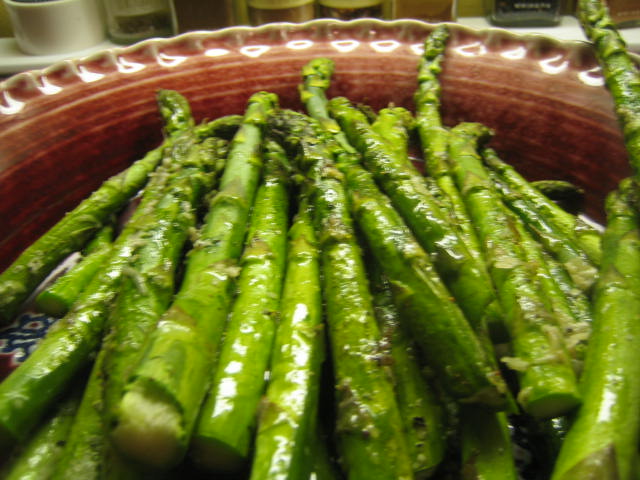 Asparagus
Olive oil
Salt and pepper
Handful of parmesan cheese
-preheat oven to 500.
-toss asparagus with olive oil, salt and pepper.
-roast 7 – 10 minutes, until fork tender.
-throw the parmesan on top, while hot, and serve.
Tuesday, April 11, 2006
The State of the Fava
For those on the shipping and receiving crew, there are boxes to unpack in the produce area.
The omnipotent intercom-voice directed; I obeyed. It was my first shift as a working member of my local Food Coop.
I unpacked and organized boxes of bright oranges, radishes, banded bunches of asparagus, a vivid color differentiation of beets, soft loaves of bread, multitudinous buckets of cottage cheese and yogurt. I swept up the remains of spilled farro wheat, rolled oats, and red lentils. I stood on a little step stool in order to crane my too-short body over the edge of the top shelf to rearrange more packages of rice cakes than I ever knew existed.
Are there any workers in the shipping and receiving crew who feel comfortable handling raw meat? Calling all non-vegetarians; we need meat handlers.
In the apparent dearth of carnivorous coop members, I had the opportunity to spend a long time unpacking cool chicken carcasses wrapped in plastic. Thighs, drums, legs, breasts; I organized all organic body parts with my small band of fellow meat-eaters. Grass-fed beef steaks, short ribs, stew meat. Racks of lamb. Pouisson. Tiny capons. Pates and smoked delicacies. Duck and Turkey. A ready phalanx of diverse and organic meat showered itself into the shelves as we organized. I entertained myself thinking on the deliciously endless cooking possibilities.
The hours of menial labor were pretty boring. But worthwhile, certainly. I am happy to have a nearby organization of people who care about the quality and diversity of their food. I am delighted to have things like Meyer lemons and blood oranges available at an affordable price [especially since it seems that I have zero grocery store self control]. And not only has it inspired a few interesting new acquaintances [how many Passover Seders can a girl actually go to?], but has also given me a root-like sense of community, important in this new city.
At one point in my shift, as I waded through the swamp of vegetable containers in the produce arena, my gloved hands ripped open a damp cardboard box. The contents were covered in a sheet of white paper; I could see a hint of green in leafy protrusions on the side. But it wasn’t until I crinkled and tossed the paper into the nearby trash that I fully realized what, in fact, I was dealing with. Fresh fava beans. Bright green, slightly fuzzy. I hadn’t realized they were yet in season; the large pods contain the delectable crunch of spring.
As I tossed the beans into the bins in the produce section of the Coop I was immediately back in The Restaurant. It has been almost a year since I worked as a dishwasher at the intense Boston bistro in a (sadly, aborted) attempt to work my way up the line of the culinary world. On one of my first nights working in the kitchen, I was thrown in front of a monstrous pile of fresh fava beans. I had never seen them in this unpeeled state before. My co-dishwasher S. and I spent a few bonding hours together as we pierced open the thick outer pod and freed each light green bean with our fore-fingers, tossing the edible nubbins into a metal dish.
No matter what the exact hour, as I peeled those favas for the first time I was most likely covered in chicken stock, my white staff shirt stained with beet juice and a smidgen of chocolate, my hair a detached frizzy mess on top of my sweating head. That was my usual state of things. I did not yet have such an extensive knowledge of kitchen-Spanish and probably mumbled in an odd mix of Italian and English as I attempted to converse with S. I vividly remember, however, looking at the piles of bright empty pods and bowls of fresh cleaned beans. I wondered how they were cooked, how they tasted, and how The Chef would use them. I imagined the smiles of the eager restaurant patrons as they drank in the sight of the vibrant green favas with their eyes, their steaming plates set carefully in front of them. We did that kind of prep right before the first big wave of dirty dishes of the night; I remember feeling very happy.
I bought my own little bag of fresh fava beans before leaving the Coop on Saturday. And last night I peeled them while sipping a glass of red wine, relaxed and chatting with my apartment-mate. I worked slowly, relishing the crunch of the open pod, the delicate color of the inner bean. I blanched them in a pod of salted water and then quickly slipped them out of their outer membranes. In a salad of plump farro wheat, fresh cherry tomatoes and arugula, dressed simply with olive oil, red wine vinegar and salt and pepper, the fava beans were a bright addition.
The fava beans were a vivid reminder of where I was a year ago and simultaneously a token of where I am now. No longer am I entrenched in the culinary world; I am finding my way in the confusing mash of NY. I’ve been sad, these days, as I watch my life continue in a path that veers farther and farther from my original culinary plans. My days (however short) as a dishwasher were a concrete jump into a passion and now seem very far removed from my current existence. Today I am not ‘sure’ of anything, really. I’m having trouble thinking of a job that I really want. The majority of my physical body has recovered from the accident. I can walk comfortably with both legs. Run, even. (Well, nothing close to a sprint. But jog a bit when I’m running really late). I can sit cross legged and can again do a mean yogic backbend. The only lingering losses from the accident almost 8 months ago are my sense of smell and my professional convictions. And I miss them. A lot.
The omnipotent intercom-voice directed; I obeyed. It was my first shift as a working member of my local Food Coop.
I unpacked and organized boxes of bright oranges, radishes, banded bunches of asparagus, a vivid color differentiation of beets, soft loaves of bread, multitudinous buckets of cottage cheese and yogurt. I swept up the remains of spilled farro wheat, rolled oats, and red lentils. I stood on a little step stool in order to crane my too-short body over the edge of the top shelf to rearrange more packages of rice cakes than I ever knew existed.
Are there any workers in the shipping and receiving crew who feel comfortable handling raw meat? Calling all non-vegetarians; we need meat handlers.
In the apparent dearth of carnivorous coop members, I had the opportunity to spend a long time unpacking cool chicken carcasses wrapped in plastic. Thighs, drums, legs, breasts; I organized all organic body parts with my small band of fellow meat-eaters. Grass-fed beef steaks, short ribs, stew meat. Racks of lamb. Pouisson. Tiny capons. Pates and smoked delicacies. Duck and Turkey. A ready phalanx of diverse and organic meat showered itself into the shelves as we organized. I entertained myself thinking on the deliciously endless cooking possibilities.
The hours of menial labor were pretty boring. But worthwhile, certainly. I am happy to have a nearby organization of people who care about the quality and diversity of their food. I am delighted to have things like Meyer lemons and blood oranges available at an affordable price [especially since it seems that I have zero grocery store self control]. And not only has it inspired a few interesting new acquaintances [how many Passover Seders can a girl actually go to?], but has also given me a root-like sense of community, important in this new city.
At one point in my shift, as I waded through the swamp of vegetable containers in the produce arena, my gloved hands ripped open a damp cardboard box. The contents were covered in a sheet of white paper; I could see a hint of green in leafy protrusions on the side. But it wasn’t until I crinkled and tossed the paper into the nearby trash that I fully realized what, in fact, I was dealing with. Fresh fava beans. Bright green, slightly fuzzy. I hadn’t realized they were yet in season; the large pods contain the delectable crunch of spring.
As I tossed the beans into the bins in the produce section of the Coop I was immediately back in The Restaurant. It has been almost a year since I worked as a dishwasher at the intense Boston bistro in a (sadly, aborted) attempt to work my way up the line of the culinary world. On one of my first nights working in the kitchen, I was thrown in front of a monstrous pile of fresh fava beans. I had never seen them in this unpeeled state before. My co-dishwasher S. and I spent a few bonding hours together as we pierced open the thick outer pod and freed each light green bean with our fore-fingers, tossing the edible nubbins into a metal dish.
No matter what the exact hour, as I peeled those favas for the first time I was most likely covered in chicken stock, my white staff shirt stained with beet juice and a smidgen of chocolate, my hair a detached frizzy mess on top of my sweating head. That was my usual state of things. I did not yet have such an extensive knowledge of kitchen-Spanish and probably mumbled in an odd mix of Italian and English as I attempted to converse with S. I vividly remember, however, looking at the piles of bright empty pods and bowls of fresh cleaned beans. I wondered how they were cooked, how they tasted, and how The Chef would use them. I imagined the smiles of the eager restaurant patrons as they drank in the sight of the vibrant green favas with their eyes, their steaming plates set carefully in front of them. We did that kind of prep right before the first big wave of dirty dishes of the night; I remember feeling very happy.
I bought my own little bag of fresh fava beans before leaving the Coop on Saturday. And last night I peeled them while sipping a glass of red wine, relaxed and chatting with my apartment-mate. I worked slowly, relishing the crunch of the open pod, the delicate color of the inner bean. I blanched them in a pod of salted water and then quickly slipped them out of their outer membranes. In a salad of plump farro wheat, fresh cherry tomatoes and arugula, dressed simply with olive oil, red wine vinegar and salt and pepper, the fava beans were a bright addition.
The fava beans were a vivid reminder of where I was a year ago and simultaneously a token of where I am now. No longer am I entrenched in the culinary world; I am finding my way in the confusing mash of NY. I’ve been sad, these days, as I watch my life continue in a path that veers farther and farther from my original culinary plans. My days (however short) as a dishwasher were a concrete jump into a passion and now seem very far removed from my current existence. Today I am not ‘sure’ of anything, really. I’m having trouble thinking of a job that I really want. The majority of my physical body has recovered from the accident. I can walk comfortably with both legs. Run, even. (Well, nothing close to a sprint. But jog a bit when I’m running really late). I can sit cross legged and can again do a mean yogic backbend. The only lingering losses from the accident almost 8 months ago are my sense of smell and my professional convictions. And I miss them. A lot.
Tuesday, April 04, 2006
On the Birthday of a Dear Friend
It was a cool October evening, a whiff of rain lurking somewhere in the humid overtones of the night air. Adrienne’s brown hair whipped up in the frenzy of a sudden gust of wind while my raincoat ballooned out into a cape of gortex as we quickly moved down the marbled cobblestone street of a small Italian town, somewhere near the coast of Capri. I clutched my shoulder bag close to my body, checking the dark sky for signs of clouds obscuring the stars, impending precipitation. Lights were twinkling in the noisy trattorias and cozy cafes we passed as we walked; bearded Italian men and women, bronzed to European perfection, strolled nearby, tossing the light cadence of their language into our ears.
We landed at our destination, smiling – a single bench perched on a small hill. In a calm little park overlooking the cool flapping water of the Tyrrhenian Sea, Adrienne and I sat together, comfortable despite the hard wood seat. We opened my roomy bag and pulled out the bottle of rich red wine, two plastic cups and a bottle opener, a loaf of crusty white bread, hunks of white flaky cheese and mounds of fresh green grapes. Bright juicy tomatoes. We clinked our glasses in the cheers of happy travelers and attacked our wandering picnic fare with the same gusto that we often shared in those months of studying and traveling abroad. As the evening went along, always with the sound of soft waves breaking close-by, we ate, drank, and talked with the serious ease of comfortable companionship.
That autumn semester Adrienne and I lived in the same apartment, studying art history in Florence and exploring the Italian countryside in unison. It was a world deliciously far from the usual large lecture halls and musty libraries of our home university. Adrienne and I had not known each other in our first few college years, but when thrown serendipitously together in Italy we immediately found that we were kindred spirits. We hiked throughout all of Italy, picnicked at Pompeii, rode trains with large contingents of singing Italian soldiers, hitchhiked through a fit of giggles when we found ourselves stranded in a remote corner of the Tuscan countryside. Perfectly situated in our apartment right down the street from Florence’s Mercato Centrale, we cooked dinner together every night; Adrienne’s infectious laugh was always a delightful companion.
I don’t, actually, know what I would have done without her. I had arrived to begin my semester in Italy only a week after returning from Namibia, Africa. I had spent the previous three months as a volunteer English teacher in Katima Mulilo, a remote village on the Caprivi Strip. Coming from that intense experience of pervasive poverty, encroaching disease and little hope, Italy was a blaring shock to my senses. I was overwhelmed, to say the least. My post-Africa anxiety, I soon found, was all-encompassing. I felt guilty for who I had left behind; hesitant and wary of the unmitigated pleasures of my current situation.
On that cool and humid night near the ocean of Capri, one month into my Italian life, Adrienne listened as I talked about my experience in Namibia. It was the first time I had been able to verbalized what I was feeling. My fears, guilt, sadness over leaving the troubled African village to which I had grown so close. She listened that night; she listened consistently, continually, beautifully as I worked my way through all of the difficult emotions in the coming months, painful feelings I was not even aware I harbored until Adrienne’s gentle support allowed me to explore myself more deeply. Hours of involved conversation later, peppered, of course, with a plethora of fresh picnic food, we felt the sharp splash of rain drops landing on our cheeks as we looked up at the dark sky. A bright red umbrella magically appeared in Adrienne’s hand. Arms around each other and laughing with unabashed giddiness, suddenly free of tension and fear, we skipped up the hill back towards the hostel we were bunking in that night. Dark figures awash with the pattering of laughter, lost under a vibrant red umbrella.
***
On Saturday night Adrienne arrived at my apartment, a short ten blocks from her own, glowing in a bright flowered dress, funky cowboy boots. Her laugh, infectious as always, filled the room. Joined by other familiar college faces, we celebrated her birthday with a vivacious eating-fest.
For my first foray into ‘serious’ cooking since my move to New York, I indulged the vegetarian in all of us (though mainly our anti-meat friend, Grace) and made quinoa (one of my favorite things) with Moroccan winter squash and carrot stew, pomodori ripieni (roasted tomatoes stuffed with bread and cheese), and a voluptuous dark chocolate cake. The meal was warm and colorful. The smell of the chocolate cake as it baked lingered happily in my nose all evening. It was comforting and homey, fitting fare to celebrate the birthday of a wonderful friend.

We all gathered together on the rooftop of my apartment toward the later hours of the night, clinking glasses of wine and gazing at the sparkly view of Manhattan. Though nowhere near Italy and far from picnics of bread, cheese and grapes, when we stood there on the roof, none-the-less, I could almost hear the lapping ocean waves. Or maybe that was just the wine.
Happy Birthday Adrienne!
Quinoa with Moroccan Winter Squash and Carrot Stew
Adapted from Epicurious
Stew
2 tablespoons olive oil
2 onions, chopped
3 minced garlic cloves
1 tsp salt
1/2 tsp ground black pepper
1/2 tsp ground coriander
1/2 tsp ground cumin
1/2 tsp turmeric
1/2 tsp ground ginger
1/2 tsp cayenne pepper
Pinch of saffron
1 cup water
1 can diced tomatoes
2 tablespoons fresh lemon juice
1 medium sized butternut squash, peeled, cut into 1-inch cubes 2 cups peeled and cubed carrots
Quinoa
1 cup quinoa
2 tablespoons olive oil
1/2 cup finely chopped onion
1/4 cup finely chopped peeled carrot
2 garlic cloves, minced
1/2 teaspoon salt
1/2 teaspoon turmeric
2 cups water
1/2 cup chopped fresh cilantro, divided
For stew:
Heat oil in large saucepan over medium heat. Add onion; sauté until soft, stirring often, about 5 minutes. Add garlic; stir 1 minute. Mix in next 8 ingredients. Add 1 cup water, tomatoes, and lemon juice. Bring to boil. Add squash and carrots. Cover and simmer over medium-low heat. I let it simmer for almost an hour; the vegetables were soft and tender, a wonderful consistency. Season with salt and pepper.
For quinoa:
Rinse quinoa; drain. Sauté onion and carrot in the olive oil in a large saucepan over medium heat, about 10 minutes, until beginning to brown. Add garlic, salt, and turmeric and sauté 1 minute. Add quinoa; stir 1 minute. Add 2 cups water. Bring to boil; reduce heat to medium-low. Cover; simmer until liquid is absorbed and quinoa is tender, about 15 minutes.
Stir in half of cilantro to the stew. Serve with quinoa and more cilantro sprinkled on top.
We landed at our destination, smiling – a single bench perched on a small hill. In a calm little park overlooking the cool flapping water of the Tyrrhenian Sea, Adrienne and I sat together, comfortable despite the hard wood seat. We opened my roomy bag and pulled out the bottle of rich red wine, two plastic cups and a bottle opener, a loaf of crusty white bread, hunks of white flaky cheese and mounds of fresh green grapes. Bright juicy tomatoes. We clinked our glasses in the cheers of happy travelers and attacked our wandering picnic fare with the same gusto that we often shared in those months of studying and traveling abroad. As the evening went along, always with the sound of soft waves breaking close-by, we ate, drank, and talked with the serious ease of comfortable companionship.
That autumn semester Adrienne and I lived in the same apartment, studying art history in Florence and exploring the Italian countryside in unison. It was a world deliciously far from the usual large lecture halls and musty libraries of our home university. Adrienne and I had not known each other in our first few college years, but when thrown serendipitously together in Italy we immediately found that we were kindred spirits. We hiked throughout all of Italy, picnicked at Pompeii, rode trains with large contingents of singing Italian soldiers, hitchhiked through a fit of giggles when we found ourselves stranded in a remote corner of the Tuscan countryside. Perfectly situated in our apartment right down the street from Florence’s Mercato Centrale, we cooked dinner together every night; Adrienne’s infectious laugh was always a delightful companion.
I don’t, actually, know what I would have done without her. I had arrived to begin my semester in Italy only a week after returning from Namibia, Africa. I had spent the previous three months as a volunteer English teacher in Katima Mulilo, a remote village on the Caprivi Strip. Coming from that intense experience of pervasive poverty, encroaching disease and little hope, Italy was a blaring shock to my senses. I was overwhelmed, to say the least. My post-Africa anxiety, I soon found, was all-encompassing. I felt guilty for who I had left behind; hesitant and wary of the unmitigated pleasures of my current situation.
On that cool and humid night near the ocean of Capri, one month into my Italian life, Adrienne listened as I talked about my experience in Namibia. It was the first time I had been able to verbalized what I was feeling. My fears, guilt, sadness over leaving the troubled African village to which I had grown so close. She listened that night; she listened consistently, continually, beautifully as I worked my way through all of the difficult emotions in the coming months, painful feelings I was not even aware I harbored until Adrienne’s gentle support allowed me to explore myself more deeply. Hours of involved conversation later, peppered, of course, with a plethora of fresh picnic food, we felt the sharp splash of rain drops landing on our cheeks as we looked up at the dark sky. A bright red umbrella magically appeared in Adrienne’s hand. Arms around each other and laughing with unabashed giddiness, suddenly free of tension and fear, we skipped up the hill back towards the hostel we were bunking in that night. Dark figures awash with the pattering of laughter, lost under a vibrant red umbrella.
***
On Saturday night Adrienne arrived at my apartment, a short ten blocks from her own, glowing in a bright flowered dress, funky cowboy boots. Her laugh, infectious as always, filled the room. Joined by other familiar college faces, we celebrated her birthday with a vivacious eating-fest.
For my first foray into ‘serious’ cooking since my move to New York, I indulged the vegetarian in all of us (though mainly our anti-meat friend, Grace) and made quinoa (one of my favorite things) with Moroccan winter squash and carrot stew, pomodori ripieni (roasted tomatoes stuffed with bread and cheese), and a voluptuous dark chocolate cake. The meal was warm and colorful. The smell of the chocolate cake as it baked lingered happily in my nose all evening. It was comforting and homey, fitting fare to celebrate the birthday of a wonderful friend.

We all gathered together on the rooftop of my apartment toward the later hours of the night, clinking glasses of wine and gazing at the sparkly view of Manhattan. Though nowhere near Italy and far from picnics of bread, cheese and grapes, when we stood there on the roof, none-the-less, I could almost hear the lapping ocean waves. Or maybe that was just the wine.
Happy Birthday Adrienne!
Quinoa with Moroccan Winter Squash and Carrot Stew
Adapted from Epicurious
Stew
2 tablespoons olive oil
2 onions, chopped
3 minced garlic cloves
1 tsp salt
1/2 tsp ground black pepper
1/2 tsp ground coriander
1/2 tsp ground cumin
1/2 tsp turmeric
1/2 tsp ground ginger
1/2 tsp cayenne pepper
Pinch of saffron
1 cup water
1 can diced tomatoes
2 tablespoons fresh lemon juice
1 medium sized butternut squash, peeled, cut into 1-inch cubes 2 cups peeled and cubed carrots
Quinoa
1 cup quinoa
2 tablespoons olive oil
1/2 cup finely chopped onion
1/4 cup finely chopped peeled carrot
2 garlic cloves, minced
1/2 teaspoon salt
1/2 teaspoon turmeric
2 cups water
1/2 cup chopped fresh cilantro, divided
For stew:
Heat oil in large saucepan over medium heat. Add onion; sauté until soft, stirring often, about 5 minutes. Add garlic; stir 1 minute. Mix in next 8 ingredients. Add 1 cup water, tomatoes, and lemon juice. Bring to boil. Add squash and carrots. Cover and simmer over medium-low heat. I let it simmer for almost an hour; the vegetables were soft and tender, a wonderful consistency. Season with salt and pepper.
For quinoa:
Rinse quinoa; drain. Sauté onion and carrot in the olive oil in a large saucepan over medium heat, about 10 minutes, until beginning to brown. Add garlic, salt, and turmeric and sauté 1 minute. Add quinoa; stir 1 minute. Add 2 cups water. Bring to boil; reduce heat to medium-low. Cover; simmer until liquid is absorbed and quinoa is tender, about 15 minutes.
Stir in half of cilantro to the stew. Serve with quinoa and more cilantro sprinkled on top.
Tuesday, March 28, 2006
A Close Encounter
I ran to the row of bright yellow machines perched in a dark corner of the subway station last night, credit card in hand, bouncing with awkwardly spaced skips through the crowded muddle of people. I was attempting to buy a metro card with unflappingly focused speed before the F train blew in on the track below me. I had just finished an educational but intensely busy day interning at an art magazine. It was late and I was so hungry that the thought of eating even my own arm was somewhat appealing. Unfortunately (fortunately?) I had on a bulky jacket and I could not reach the tender arm-flesh through my layers of winter cloth.
I made a beeline to the first ticket machine available in the row, sidestepping around a woman in a large, fuzzy black coat. She was grabbing her own yellow ticket out of the dispenser and turning quickly around in a jump to her own train; we could hear it vibrating on the track down below. I moved quickly aside, unreasonably annoyed that her physical presence could dare to possibly be in my way. I looked at her, radiating a frustrated vibe of overtired grumpiness (in what I like to imagine is a magnificently wilting, terrifying gaze) but immediately recoiled in surprise. I recognized this woman. It was Sara Moulton, executive chef of Gourmet Magazine and star of her Food Network show “Sara’s Secrets”.
In my post-accident, pre-New York and unemployed series of states, I have spent many an hour watching her on TV as she tames the seeming complexities of risotto or beef bourguignon. She has always struck me as a deliciously real person; never with the narcissistic, showy makings of a ‘celebrity chef’. Someone I could relate to as well as respect. Granted, I don’t think I’ve ever attempted one of her Food Network recipes myself, but those in Gourmet Magazine have been often well used and received. Instead of a manic recipe guru and larger-than-life cooking fiend (as I may or may not categorize other well-known chefs) I think I have viewed her more as (dare I say it?) a friend.
And so I was somewhat shocked last night when I found myself attempting to kill Sara Moulton with the death-rays of my gaze. She hardly even glanced at me, though, and certainly did not consciously register my presence. She ran quickly off to her train. We can all breath a sigh of relief; I didn’t kill Sara Moulton. I didn’t eat my own arm either. Overall, it was a largely productive evening.
I made a beeline to the first ticket machine available in the row, sidestepping around a woman in a large, fuzzy black coat. She was grabbing her own yellow ticket out of the dispenser and turning quickly around in a jump to her own train; we could hear it vibrating on the track down below. I moved quickly aside, unreasonably annoyed that her physical presence could dare to possibly be in my way. I looked at her, radiating a frustrated vibe of overtired grumpiness (in what I like to imagine is a magnificently wilting, terrifying gaze) but immediately recoiled in surprise. I recognized this woman. It was Sara Moulton, executive chef of Gourmet Magazine and star of her Food Network show “Sara’s Secrets”.
In my post-accident, pre-New York and unemployed series of states, I have spent many an hour watching her on TV as she tames the seeming complexities of risotto or beef bourguignon. She has always struck me as a deliciously real person; never with the narcissistic, showy makings of a ‘celebrity chef’. Someone I could relate to as well as respect. Granted, I don’t think I’ve ever attempted one of her Food Network recipes myself, but those in Gourmet Magazine have been often well used and received. Instead of a manic recipe guru and larger-than-life cooking fiend (as I may or may not categorize other well-known chefs) I think I have viewed her more as (dare I say it?) a friend.
And so I was somewhat shocked last night when I found myself attempting to kill Sara Moulton with the death-rays of my gaze. She hardly even glanced at me, though, and certainly did not consciously register my presence. She ran quickly off to her train. We can all breath a sigh of relief; I didn’t kill Sara Moulton. I didn’t eat my own arm either. Overall, it was a largely productive evening.
Saturday, March 18, 2006
Familiar Smells
In a free afternoon last week I went to The Strand Bookstore, a beautifully large mess of books – new, old, a smattering of favorites and deliciously intriguing new reads. I wandered, browsing for a long time. Surrounded by books, the infinite possibilities of prose and poem, I am in my favorite state of being. Libraries and bookstores are my havens of comfort and stability. Even my room has an obscene number of books stacked in all corners, spilling over in large flows from my bookcase. Especially in times like today, when the concreteness of my own life is awash with confusion and ungrounded future, promise of the other worlds housed in literature beckons unavoidably. The Strand boasts to have “18 miles of books”; and I didn’t doubt it while perusing their crowded floor to ceiling shelves, cases, tables, nooks and crannies. It was the perfect place to go after a stressful job interview.
In the extensive time that I spent browsing there, I realized that there was something missing. Something I had not yet thought of yet all of sudden felt very acutely. I miss the smell of books. The musty aromas of old novels have always hinted of past people, places, and untold stories; the possibilities of getting lost in a book for me are intrinsically tied to a scent. A combination of sharp paper, clean ink, clouded leather and mildewed pages – an odor so easily imagined yet now quite unobtainable. I felt strangely dissociated in such a richly supplied arena of past and present, leather binding and rippled paperback, without that familiar scent. It was as if a part of the experience was missing; the striking odor of “bookstore” is one I had forgotten means so much to me.
The minor depression of the scentless bookstore didn’t stop me, of course, from buying more books than I will be able to read in the anywhere near future. When I emerged from the store my bag was noticeably heavier. It was warm outside, sunny and hinting of the immediacy of Spring. I walked to nearby Union Square and wandered through the spattering of farmers market stalls set up in the late afternoon breeze. When I saw a woman surrounded by small pots of herbs and flowers on the tables under her white tent, I knew what I needed to erase the odorless bookstore from my presently troubled musings. I bought myself a tiny rosemary plant, slightly off kilter and snaking up in an arch around the side of its plastic pot, small and musky green. I sat with it on my lap on the subway, heading over the bridge back towards Brooklyn. I rubbed its small leaves gently with my thumb and forefinger and sniffed, my nose touching the felty stem. Its deep, resounding herb scent crept deliciously up through the connections of my still functioning olfactory neurons.
The little rosemary plant is living on my kitchen table for the moment, situated in perfect view as I sip my morning coffee and read one of the million books I have piled up on my bedroom floor.
In the extensive time that I spent browsing there, I realized that there was something missing. Something I had not yet thought of yet all of sudden felt very acutely. I miss the smell of books. The musty aromas of old novels have always hinted of past people, places, and untold stories; the possibilities of getting lost in a book for me are intrinsically tied to a scent. A combination of sharp paper, clean ink, clouded leather and mildewed pages – an odor so easily imagined yet now quite unobtainable. I felt strangely dissociated in such a richly supplied arena of past and present, leather binding and rippled paperback, without that familiar scent. It was as if a part of the experience was missing; the striking odor of “bookstore” is one I had forgotten means so much to me.
The minor depression of the scentless bookstore didn’t stop me, of course, from buying more books than I will be able to read in the anywhere near future. When I emerged from the store my bag was noticeably heavier. It was warm outside, sunny and hinting of the immediacy of Spring. I walked to nearby Union Square and wandered through the spattering of farmers market stalls set up in the late afternoon breeze. When I saw a woman surrounded by small pots of herbs and flowers on the tables under her white tent, I knew what I needed to erase the odorless bookstore from my presently troubled musings. I bought myself a tiny rosemary plant, slightly off kilter and snaking up in an arch around the side of its plastic pot, small and musky green. I sat with it on my lap on the subway, heading over the bridge back towards Brooklyn. I rubbed its small leaves gently with my thumb and forefinger and sniffed, my nose touching the felty stem. Its deep, resounding herb scent crept deliciously up through the connections of my still functioning olfactory neurons.
The little rosemary plant is living on my kitchen table for the moment, situated in perfect view as I sip my morning coffee and read one of the million books I have piled up on my bedroom floor.
Tuesday, March 07, 2006
The Best Possible Nourishment for a Girl with Largely Impaired Olfactory Neurons: A Perfect Combination of Taste, Texture, and Discernible Scent
As I have written before, the loss of my sense of smell affects my taste. The soft subtleties of flavor so imbedded in every eating experience are often lost to my largely scentless palate. My olfactory neurons have been working diligently since the accident; certain scents have been returning. And as a result, my eating habits have changed, focusing ever so much more on what I can taste. I would bath in salsa if that wouldn’t be gross; the feeling of spicy is wonderful in the muted field of my mouth. Anything with rosemary, thyme or citrus. Coffee, cinnamon and wine. (Yes, my brain seems to have its priorities straight. It knows what’s important to restore). I can smell soap, shampoo and laundry; I would probably eat them too if that didn’t mean a slow and uncomfortable death. The most important, however, is my reestablished ability to smell chocolate. Without smell, chocolate is nothing more than a texture, the true flavor floating off into the netherworld of damaged neurons. Though it is not any huge lifestyle change for me to eat a healthy daily dose of chocolate, its consistently whole flavor means all that much more now.

I don’t think there could be a more perfect scent to have remained intact. I just moved to NYC. I am confused about my future. I’m starting some temporary waitress work today and the heating system is all out of whack in my apartment. If there were ever a time for chocolate, it is now. Luckily, I have discovered the perfect bar of chocolate. And, believe me, I have done some extensive chocolate tasting in the last few months. Not only is it delicious, interesting, and made by a company that values fine ingredients and inventing creative new taste combinations, but it is artfully constructed with components that sing magnificently well for those who cannot smell.
Vosges Haut Chocolate’s ‘Barcelona Bar’; hickory smoked almonds, fleur de sel gray sea salt, and dark milk chocolate.
The sea salt is imbedded in careful, subtle yet tasteful discretion throughout the chocolate. Without smell, taste buds in general have full ability to register ‘salty’ ‘sweet’ ‘bitter’ and ‘sour’. The salt cuts through the already sweet, slightly bitter overtones of the chocolate. There hickory smoked almonds, small bits, are scattered throughout, providing perfect texture. In the midst of the soft melt of the chocolate, there are the satisfying crunches spread in each bite. Salty crunches, excommunicating any feeling of boredom some less thoughtful chocolate bars may have the tendency to inspire. It is an excellent quality dark milk chocolate, not too sweet, not too hard or soft. It melts quietly on the tongue. At least twice, more likely thrice or more times in any given day, I reach for a small square of the Barcelona Bar. I seem to consistently have one stored in my pocketbook, always there when just a little shot of deep, rich sweetness will get me by. And not just any dark, rich sweetness; it is one that caters to best of every viable taste and smell I still have intact. It is a solid bar of perfection. And in honor of the 2006 Independent Food Festival, I name the Vosges ‘Barcelona Bar’ the Best Possible Nourishment for a Girl with Largely Impaired Olfactory Neurons: A Perfect Combination of Taste, Texture, and Discernible Scent.
Saturday, March 04, 2006
A Playground of Sorts
My feet skid on the thin crust of sidewalk ice as I walk briskly to a nearby café; the cold morning air bites my cheeks. My breath forms clouds of mist as I exhale. Out of the corner of my eye, I catch a hazy reflection of myself (flash of green coat, purple hat) in the shining front glass of a used book store. The dark window of a butcher’s shop hints of hanging cured meats, salty jars of olives. An elderly woman decked out in fur leads a tiny, delicate lapdog on a bright pink leash as she crosses the street, a newspaper tucked under her arm. Cars honk; a bus rushes by in a jittery haze of exhaust. The sky is blue and the sun gleams off car roofs. The café is a few blocks away from my new apartment. I arrive in a warm rush of heat, the familiar rhythm of Nick Drake humming in the background.
I sit in a cozy window seat, a mug of tea steaming next to my computer. A young hipster in her funky vintage wear is to one side; an older, gray haired man to the other, dark bulky glasses perch on his thin nose. My table moves in miniscule rocks as I change position; the legs are not quite even. I read over what I’ve typed and sigh. Detailed descriptions jump to my fingertips unbidden these days, a bubbling fountain of adjectival observation. It’s been difficult to push myself away from it in the last week; perhaps it is my attempt to feel at home.
I have officially moved out of Boston, away from the lengthy convalescent baggage of my accident. I now inhabit a small, often sunny, sometimes freezing little apartment on the top floor of a creaky old brownstone in Brooklyn. And I find myself constantly, keenly observing what is around me. [This morning I carefully noticed that the burnished cream radiator next to my bed stands at a slightly defiant angle; its bulk protests the small grains of chipping paint, the unattainable brush of morning light, the red wall screaming behind its back.] I am decidedly overwhelmed by this move; in hopes of making some sense of the transition I give full concentration to my immediate surroundings.
A little girl, her straight brown hair tied in floppy pigtails, hops on one foot by my table. Her pink corduroy dress bounces around the white socks at her ankles with each bounding leap. She seems determined to land in the center of each large square tile on the floor of the café. She frantically hurries her movements as her mother calls her name sternly. This isn’t a playground! I smile to myself behind the screen of my laptop. A large part of me would like to get up and join the cheerfully hopping girl, holding her hand and giggling as we pounce all over the coffee shop in carefree abandon. This is the part of me that also thinks spending every day from now to eternity at the MET, blissfully ignoring the pressing matter of unemployment, is a wonderful idea. It’s the one that feels blindsided by my jump to the Real World, a currently planless New York existence. But with the endless number of possibilities this city offers, I can appease all of my parts and look at it as a playground of sorts. It’s different than the tiles on the café floor, but still with plenty of room for hopping about.
I stand to pack up my things; it is time to meet a friend for lunch.
I sit in a cozy window seat, a mug of tea steaming next to my computer. A young hipster in her funky vintage wear is to one side; an older, gray haired man to the other, dark bulky glasses perch on his thin nose. My table moves in miniscule rocks as I change position; the legs are not quite even. I read over what I’ve typed and sigh. Detailed descriptions jump to my fingertips unbidden these days, a bubbling fountain of adjectival observation. It’s been difficult to push myself away from it in the last week; perhaps it is my attempt to feel at home.
I have officially moved out of Boston, away from the lengthy convalescent baggage of my accident. I now inhabit a small, often sunny, sometimes freezing little apartment on the top floor of a creaky old brownstone in Brooklyn. And I find myself constantly, keenly observing what is around me. [This morning I carefully noticed that the burnished cream radiator next to my bed stands at a slightly defiant angle; its bulk protests the small grains of chipping paint, the unattainable brush of morning light, the red wall screaming behind its back.] I am decidedly overwhelmed by this move; in hopes of making some sense of the transition I give full concentration to my immediate surroundings.
A little girl, her straight brown hair tied in floppy pigtails, hops on one foot by my table. Her pink corduroy dress bounces around the white socks at her ankles with each bounding leap. She seems determined to land in the center of each large square tile on the floor of the café. She frantically hurries her movements as her mother calls her name sternly. This isn’t a playground! I smile to myself behind the screen of my laptop. A large part of me would like to get up and join the cheerfully hopping girl, holding her hand and giggling as we pounce all over the coffee shop in carefree abandon. This is the part of me that also thinks spending every day from now to eternity at the MET, blissfully ignoring the pressing matter of unemployment, is a wonderful idea. It’s the one that feels blindsided by my jump to the Real World, a currently planless New York existence. But with the endless number of possibilities this city offers, I can appease all of my parts and look at it as a playground of sorts. It’s different than the tiles on the café floor, but still with plenty of room for hopping about.
I stand to pack up my things; it is time to meet a friend for lunch.
Subscribe to:
Posts (Atom)